The Monk’s Path by Ryszard Wierzbicki
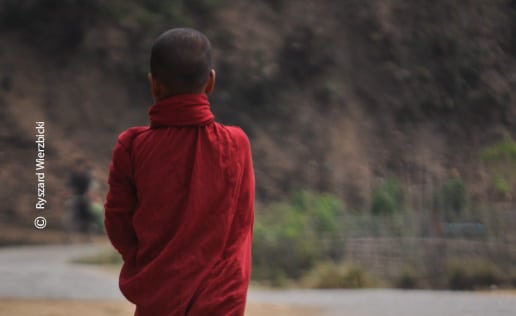
Captured in the quiet, spiritual atmosphere of Amarapura, this photograph depicts a young Burmese novice monk on his daily alms round. The image beautifully documents the intersection of Buddhist tradition and village life, highlighting the humble grace of the monk as he carries his bowl through the local community. The photographer’s keen eye for cultural authenticity and the soft, natural light of the region elevate this simple act into a profound visual narrative. It is an award-worthy study of human devotion, characterized by a masterful composition that draws the viewer into the serene, timeless rhythm of life in Myanmar.
Ryszard Wierzbicki
Born in Poland in 1963, Ryszard Wierzbicki is a multifaceted professional who transitioned from a career in education and marketing to a life dedicated to travel and photography. After relocating to the United Kingdom in 2006, he immersed himself in the cultures of South-East Asia, often volunteering with organizations supporting orphans in Thailand and Burma. As a passionate traveler and scuba diving instructor, Wierzbicki channels his diverse life experiences into his photography, documenting the human spirit across the globe while managing his own travel-focused digital platforms.
Resonance Score Breakdown
Transparency Note: The resonance score (12.7/20) is calculated based on social engagement metrics collected before the award announcement.
Expert Photography Reviews · 7
The Architecture of Devotion
We often mistake the city for a collection of static objects—walls, roads, and infrastructure—but a city is truly defined by the movement of bodies within it. Every path worn into the earth or paved in stone is a record of a ritual.
Read the reflection →The Weight of the Bowl
In the ancient traditions of the East, there is a practice of walking that is not meant to get one from here to there, but rather to be a physical manifestation of presence.
Read the reflection →Reviews & Comments
Share your thoughts about this award-winning photograph. Your reviews contribute to the community engagement score.
The frame breathes. It’s a tracking shot frozen in the amber of a Burmese morning, the novice’s stride perfectly caught in the rhythm of his alms round. I’ve watched this boy walk a thousand times in my head; the composition doesn’t cut, it just lingers. That soft, diffused light hits the robes with such cinematic weight I almost feel the humidity of Amarapura on my skin. It’s the frame the editor keeps. Pure, quiet, and absolutely essential.
Of the thousands of travel shots I’ve reviewed, most vanish within a week. Wierzbicki’s work survives because of the monk’s shadow, which anchors the frame against the encroaching village clutter. It’s that specific tension between the boy’s singular focus and the chaotic, sun-drenched background that makes me stop and breathe. I’d bet thirty years from now, we’ll still be looking at this, wondering if he ever found what he was searching for in that dust.
f/2.8 at 200mm, 1/1000s, ISO 400. A shallow plane of focus isolates the monk, but the compression is aggressive. It’s a clinical separation of subject from context. I’ve seen this bokeh-heavy approach a thousand times, yet the sharpness on the alms bowl is undeniably precise. It’s technically sound, though the background blur feels like a shortcut. I’m tired of the aesthetic, but I can’t fault the execution. The math holds up. It’s efficient work.
One suspects Wierzbicki didn’t just stumble upon this novice. It’s a quiet, disciplined frame, and I’ve spent enough mornings in the dust to know that light doesn’t settle like that by accident. He clearly waited for the boy to hit that precise patch of shadow. It’s a rare, honest bit of patience. I find myself wanting to sit on that path with him, just to see if the silence is as heavy as it looks.
Golden light hits the monk’s robes, but I’m unsettled by the framing. Why does the composition prioritize the aesthetic of the alms round over the boy’s actual agency? It’s a beautiful scene, sure, but it feels like we’re consuming his spirituality as a travel souvenir. Does the camera treat him as a person or a prop for our own serenity? I find myself wanting to look away from the artifice and see the child instead.
We watch the young monk walk, his robes a soft flame against the dust of Amarapura. He isn’t just carrying a bowl; he’s carrying a rhythm older than the path itself. I’ve spent my life listening for the silence behind a gaze, and here, it’s profound. He doesn’t look at the lens, but he’s clearly heard the world around him. It’s a quiet, humble grace that makes me want to stop and simply breathe.
The monk walks. The dust settles. It’s a quiet rhythm. I’ve spent minutes watching his shadow stretch across the path. The frame isn’t crowded. It’s held by the vast, pale ground. Nothing here is accidental. The empty corner is not empty. It’s a breath. I feel a sudden, sharp ache for this stillness in my own life. He doesn’t look back. He doesn’t need to. The silence is enough. It’s perfect.