Looking Up by Ryszard Wierzbicki
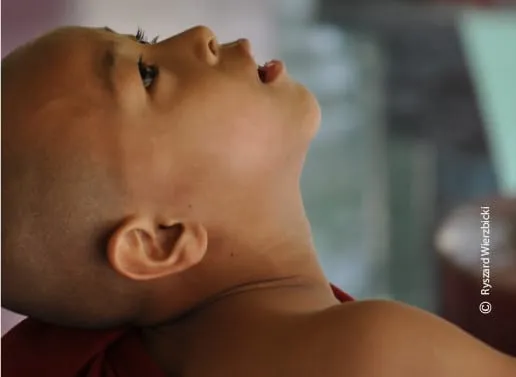
Captured within the historic temples of Bagan, Myanmar, this photograph documents a poignant moment of discovery. The photographer encountered a young Buddhist monk gazing upward, his expression radiating genuine wonder at the intricate details adorning the temple ceiling. By focusing on the monk’s rapt attention, the image captures a universal sense of awe and spiritual curiosity. This piece is award-worthy for its ability to distill a profound, quiet human experience into a single frame, highlighting the intersection of cultural heritage and individual emotion through a sensitive and observant lens.
Ryszard Wierzbicki
Born in 1963 and a graduate of the University of Gdansk, Ryszard Wierzbicki transitioned from a diverse career in social sciences and marketing to become a dedicated traveler and photographer. Since relocating to the United Kingdom in 2006, he has focused his lens on South-East Asia, often combining his creative pursuits with volunteer work for orphanages. As the founder of the travel and photography forums Instant Travelling and World Around, Wierzbicki balances his professional life as a marketing advisor with a deep-seated passion for exploring the world and documenting the human spirit.
Resonance Score Breakdown
Transparency Note: The resonance score (12.2/20) is calculated based on social engagement metrics collected before the award announcement.
Expert Photography Reviews · 8
The Architecture of Wonder
We spend so much of our lives looking at the horizon, measuring the distance between where we stand and where we wish to be. We map our days by the weight of the earth beneath our boots and the obstacles that rise to meet our gaze.
Read the reflection →The Architecture of Awe
The ceiling of my grandmother’s kitchen was once a map of water stains, a topography of leaks that I spent hours tracing while she moved through the room.
Read the reflection →Reviews & Comments
Share your thoughts about this award-winning photograph. Your reviews contribute to the community engagement score.
Holi looks….. nicely captured
It’s easy to snap a monk in a temple; it’s quite another to catch that precise, unforced tilt of the chin. One suspects Wierzbicki didn’t just wander in for a quick frame. He’s clearly spent hours in the dust, waiting for the light to hit those ceiling frescoes just so. I’ve spent enough time in similar heat to recognize the patience here. It’s a quiet, earned moment. I’d have liked to have been there.
Most entries in this category rely on the exoticism of Bagan to do the heavy lifting. Wierzbicki avoids that trap. By tightening the frame on the monk’s upturned chin and the specific geometry of the ceiling, he forces us into the boy’s internal orbit. It’s a quiet, fragile moment that I’ve found myself returning to all week. In thirty years, this won’t just be a travel photo; it’ll be a rare, honest record of human wonder.
Before the eye identifies the monk, something in the chest tightens. It’s that sudden, vertical pull of the neck, the way his chin tilts toward the temple’s vaulted shadows. I’ve felt that exact ache—the physical weight of being small beneath history. When I return to this, I don’t see Bagan; I feel the quiet, rhythmic expansion of his lungs. It’s a rare, breathless activation of wonder that lingers long after you look away.
The focal plane rests precisely on the monk’s iris, resolving the micro-contrast of his gaze against the temple’s dim interior. It’s a masterclass in managing the diffraction limit; the ceiling’s intricate stucco remains sharp, avoiding the muddying effects of excessive aperture. I’m genuinely moved by how the light renders the texture of his robe. It’s not just a portrait; it’s a precise optical capture of wonder, where the lens resolves what our eyes would surely miss.
You caught him in a moment of pure, unscripted grace. Most people walk through those temples and see only stone, but you saw the boy’s soul reaching for the ceiling. Because you waited, I can feel that weightless sense of wonder in my own chest. It’s rare to find a frame that doesn’t feel staged or intrusive. You didn’t just document a monk; you captured the exact second he forgot the camera existed. That’s honest work.
The light hits his face and the world stops. It’s a perfect tracking shot frozen in amber. He’s looking up, and for a second, I’m right there in the dust of Bagan with him, feeling that same dizzying pull of the heavens. The framing is tight, intimate, cutting out the noise to keep the focus on his wonder. It’s the shot the editor keeps because it’s the only one that truly breathes. I love it.
The monk’s gaze anchors the frame. Above him, the temple ceiling recedes into shadow. It’s a vast, dark void. Most would fill that space with detail. Wierzbicki doesn’t. He lets the emptiness breathe. I’ve stood in such places, feeling my own insignificance against the stone. It’s humbling. Nothing here is accidental. The empty corner is not empty. It’s the weight of history pressing down. A rare, quiet discipline. It’s enough.
Bagan’s ancient stone doesn’t just frame the monk; it consumes him. The darkness clinging to the temple walls isn’t mere neglect, but a heavy, silent witness to his upward gaze. I’ve spent hours staring at the way the light dies against his robes, and it’s haunting. It’s not about the ceiling’s detail, but the void that forces his wonder into existence. If he weren’t surrounded by such profound shadow, his awe wouldn’t feel so fragile.