Friends on the Bridge by Ryszard Wierzbicki
Captured at the serene Inle Lake, this photograph offers an intimate glimpse into the vanishing traditions of the local Burmese community. The photographer skillfully frames the subjects on a bridge, utilizing a telephoto perspective to compress the scene and emphasize the connection between the villagers and their unique floating environment. The image is award-worthy for its authentic storytelling and ability to transport the viewer to a quiet moment of cultural reflection. By balancing the soft, natural light with the rich textures of the village architecture, the composition serves as a poignant tribute to a way of life defined by simplicity and resilience.
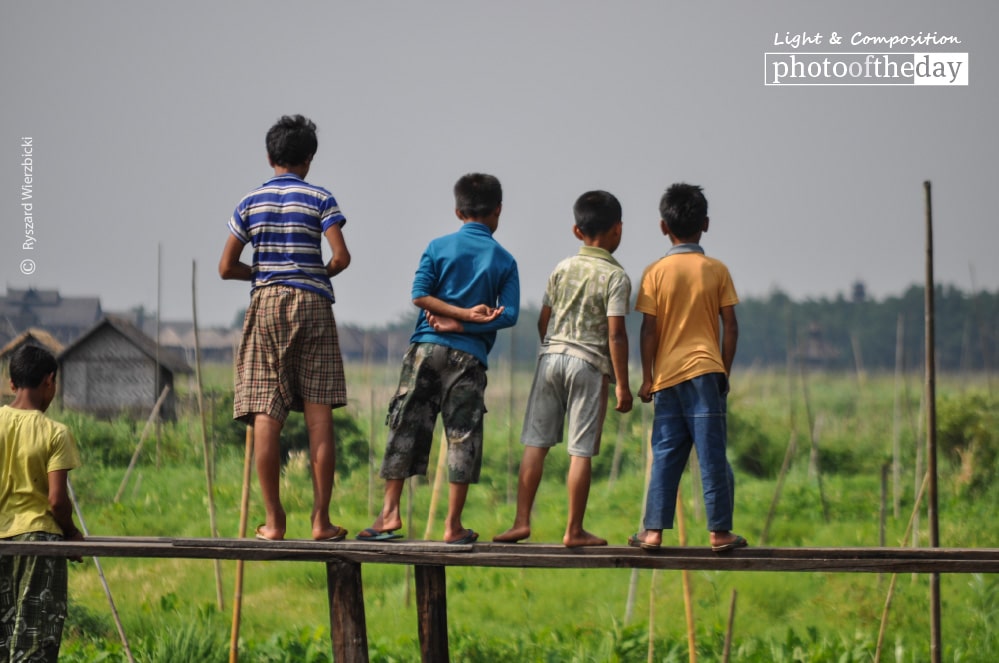
Exposure 1/250sec @ f/5 | ISO 500 | Focal Length 145mm
Ryszard Wierzbicki
Born in 1963 and a graduate of the University of Gdańsk, Ryszard Wierzbicki transitioned from a career in social sciences and marketing to become a dedicated traveler and photographer. After relocating to the United Kingdom in 2006, he channeled his passion into exploring South-East Asia, often volunteering with charitable organizations supporting orphans. As a self-employed marketing advisor and tour organizer, Wierzbicki balances his professional life with a deep commitment to documenting global cultures, sharing his experiences through his established travel forums and evocative photography.
Resonance Score Breakdown
Transparency Note: The resonance score (13.4/20) is calculated based on social engagement metrics collected before the award announcement.
Expert Photography Reviews · 6
The Weight of Shared Silence
Why do we feel the need to fill the spaces between us with words, as if silence were a void that threatens to swallow our connection? We often mistake noise for intimacy, believing that if we are not speaking, we are somehow drifting apart.
Read the reflection →The Weight of Shared Silence
There is a particular grace in walking alongside another without the need for words. We spend so much of our lives trying to fill the air with noise, as if silence were a void that must be occupied.
Read the reflection →Reviews & Comments
Share your thoughts about this award-winning photograph. Your reviews contribute to the community engagement score.
At 145mm, the compression flattens the depth of field, pushing the bridge’s weathered timber into a singular, sharp focal plane. While the Nikon’s sensor struggles slightly with ISO 500 noise, the lens resolves the texture of the wood with surprising clarity. I’m genuinely moved by how the soft, ambient light wraps around the subjects. It’s a delicate optical balance; the bokeh doesn’t distract, it simply cradles the humanity of this fleeting, quiet Burmese moment.
It’s easy to snap a bridge in Myanmar, but capturing this specific stillness requires more than a tourist’s morning. One suspects Wierzbicki didn’t just wander by; he likely sat in the damp heat until the light softened and the villagers stopped noticing his lens. I’ve spent enough hours shivering in the dark to recognize that patience. It’s a quiet, honest frame. He didn’t find this moment; he earned it by simply refusing to leave.
Does this bridge belong to the villagers, or is it merely a stage for our consumption? Wierzbicki compresses the frame, turning these lives into a flattened, aestheticized postcard of resilience. It’s a comfortable view, but it leaves me feeling deeply uneasy. Why do we insist on framing poverty as serene? I’ve seen this gaze before, and it rarely serves the subjects. We’re looking at them, but are we actually seeing the people behind the lens’s distance?
We look at these two friends on the Inle bridge and we aren’t just seeing villagers; we’re seeing a conversation held in silence. Ryszard didn’t just point his lens; he waited until their posture softened into trust. I’ve spent my life listening to stories, and I can feel the weight of their shared history in the way they lean together. It’s a quiet, beautiful intimacy. This is a photograph that asks to be returned to.
The telephoto compression here flattens the bridge’s structural rhythm, turning a sequence of movement into a static, two-dimensional datum. It’s a shame, really; I’d love to feel the actual threshold between those wooden planks and the water below. The light hits the timber with a soft, diffused quality that softens the mass, yet I find myself longing for the void—the space between the villagers that defines their relationship to this fragile, floating architecture.
The bridge doesn’t just connect land; it suspends these figures in a precarious, liminal silence. I’m struck by how the shadows beneath the planks swallow the water’s reflection, forcing us to confront the void beneath their feet. It’s a heavy, unsettling stillness. Wierzbicki hasn’t just captured a scene; he’s mapped the anxiety of a vanishing world. When I look at those dark, encroaching gaps, I feel the weight of time slipping through the wood.