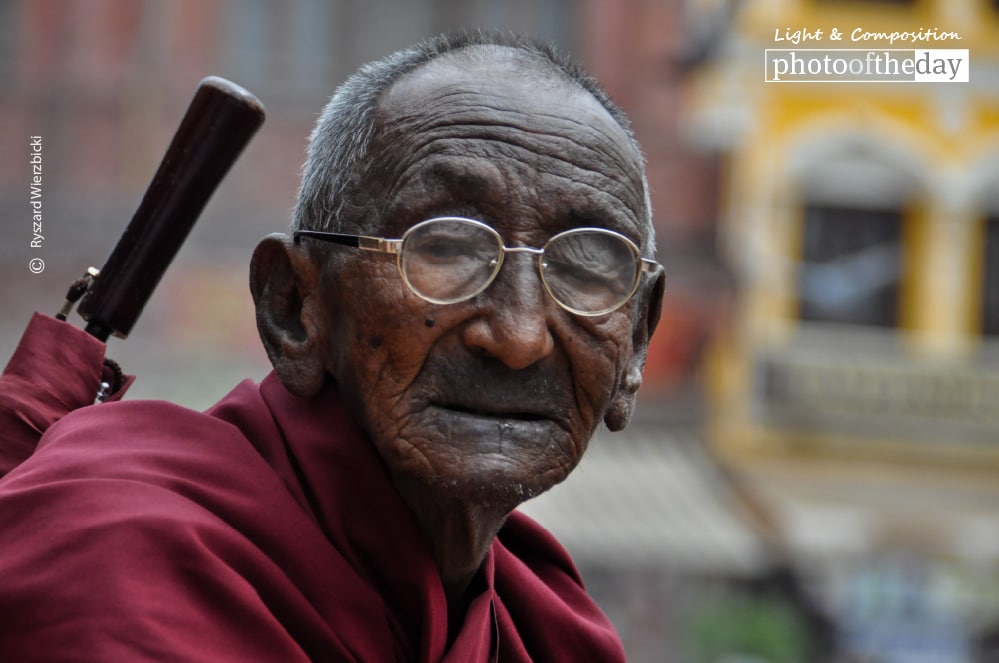
A Pilgrim Monk by Ryszard Wierzbicki
Captured amidst the spiritual atmosphere of Swayambhunath, this portrait of a pilgrim monk reflects the profound serenity found within Kathmandu’s ancient religious sites. The photographer masterfully utilized the natural light and the historic architecture of the hilltop complex to frame a moment of quiet devotion. By focusing on the monk’s presence against the backdrop of Nepal’s sacred landscape, the image conveys a deep sense of cultural reverence and human connection. Its award-worthy quality lies in the harmonious balance between the subject’s contemplative expression and the rich, textured environment, offering viewers an intimate glimpse into the life of a traveler on a spiritual journey.
Ryszard Wierzbicki
Born in 1963, Ryszard Wierzbicki is a Polish-born photographer and educator currently based in Swindon, United Kingdom. After a diverse career spanning social sciences, marketing, and child care, he transitioned into a life of global exploration, photography, and scuba diving instruction. His work is deeply influenced by his extensive travels across South-East Asia and his commitment to humanitarian efforts, including volunteering with orphanages. Through his photography and his travel forums, he documents the human experience with a focus on cultural immersion and the spirit of adventure.
Resonance Score Breakdown
Transparency Note: The resonance score (11.3/20) is calculated based on social engagement metrics collected before the award announcement.
Expert Photography Reviews · 5
The Architecture of Silence
We spend our lives building walls, brick by heavy brick, hoping to keep the chaos of the world at bay. We stack our certainties like stones, carving out rooms for our fears and our small, flickering joys.
Read the reflection →The Geography of Devotion
We often mistake the city for a collection of infrastructure—roads, pipes, and zoning laws—forgetting that it is, at its core, a vessel for human belief. Every urban space is a map of what a society values, a physical manifestation of our collective priorities.
Read the reflection →Reviews & Comments
Share your thoughts about this award-winning photograph. Your reviews contribute to the community engagement score.
The monk’s verticality anchors the frame, creating a necessary fulcrum against the horizontal decay of the stone. It’s a rigid geometry that demands attention. The negative space doesn’t merely exist; it breathes, pushing the subject toward the edge of the picture plane. I’ve grown tired of soft portraits, but this structural discipline holds. The tension between the monk’s stillness and the architectural weight is precise. It’s a rare instance where the frame doesn’t collapse.
The monk’s stillness against the blurred, swirling energy of Swayambhunath is where the real work happens. I’m genuinely moved by the decision to let the architecture dissolve into a painterly haze; it’s closer to Hiroshi Sugimoto’s long-exposure theatres than conventional portraiture. Why resolve the background when the spiritual weight lies in the friction between movement and stasis? It’s a brave refusal of clarity that makes the subject’s quiet devotion feel truly visceral. I love that.
The monk sits. The stone wall behind him is vast, weathered, and grey. It’s a heavy silence. I feel my own breath slow as I look at the space he doesn’t occupy. He is small against the ancient architecture. Nothing here is accidental. The empty corner is not empty. It’s a pause. I’ve spent minutes just watching the light touch his robes. It’s enough. The stillness is the point. It’s rare to find such peace.
Swayambhunath’s ancient masonry provides a heavy, textured datum that grounds the monk’s fleeting presence. The light rakes across the stupa’s weathered surface, defining the depth of the relief against the soft, blurred void behind him. It’s a rare moment where the architecture doesn’t just frame the subject; it breathes with him. I’m genuinely moved by how the fenestration and stone grain anchor his stillness. It’s not just a portrait; it’s a spatial dialogue.
Before the eye identifies the monk, a sudden stillness anchors the chest. It’s the weight of that saffron fabric against the weathered stone that triggers a visceral, grounding response. I’ve returned to this portrait for years, and each time, the monk’s gaze pulls my own breath into a slower rhythm. It’s not just a portrait; it’s a quiet, persistent ache for a solitude I haven’t yet earned. It follows me into the dark, silent hours.