Time for a Short Nap by Sudeep Mehta
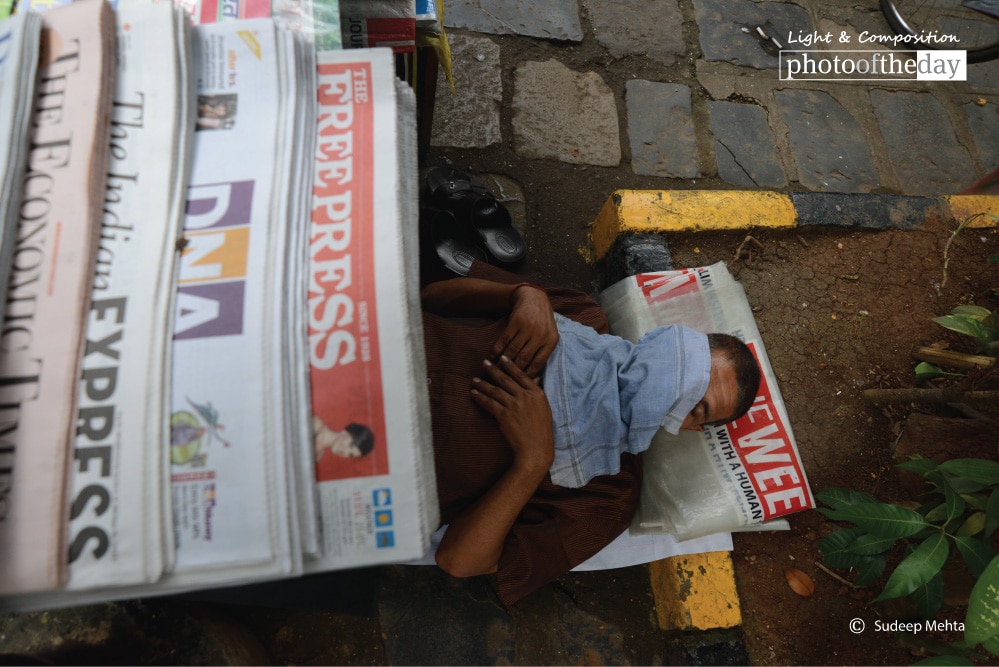
In the bustling heart of Mumbai, Sudeep Mehta captures a quiet, humanizing moment amidst the city's relentless pace. The photograph depicts a newspaper vendor finding a brief respite, curled up for a nap on a public footpath beneath the shelter of his market stall. By focusing on this intimate scene of stillness, the photographer highlights the intersection of urban struggle and personal endurance. The image is award-worthy for its poignant storytelling and the delicate balance between the subject's vulnerability and the chaotic, sun-drenched environment of the Indian metropolis.
Sudeep Mehta
Born and based in Mumbai, India, Sudeep Mehta is a freelance photographer who balances contractual work in events, weddings, and portraiture with a deep-seated passion for photojournalism. His creative foundation began in film editing, a background that transitioned him into documentary and short filmmaking while fostering a commitment to environmental advocacy. Through his lens, Mehta consistently seeks to document the human condition, blending his technical expertise with a narrative-driven approach that has established him as a compelling voice in contemporary street photography.
Resonance Score Breakdown
Transparency Note: The resonance score (12.0/20) is calculated based on social engagement metrics collected before the award announcement.
Expert Photography Reviews · 8
The Architecture of Rest
In the nineteenth century, the city was often described as a machine—a clockwork of gears, steam, and relentless motion. We are taught to measure our worth by the speed of our output, as if we were merely extensions of the iron and glass that surround us.
Read the reflection →The Architecture of Rest
There is a profound grace in the ability to surrender to the present, even when the world around us refuses to slow its rhythm. We often mistake stillness for a lack of purpose, yet there is a quiet strength in the way a body finds its own sanctuary amidst the noise.
Read the reflection →Reviews & Comments
Share your thoughts about this award-winning photograph. Your reviews contribute to the community engagement score.
The shutter speed here is perfect. It catches the stillness of the vendor against the blur of a city that never stops breathing. I’ve spent years watching frames like this, and it’s the way the light hits his curled form that gets me—it’s quiet, heavy, and deeply human. The cut would’ve been a mistake; the frame holds because the world outside the stall is just noise. It’s a beautiful, frozen beat of exhaustion.
Mumbai’s sun is a violent, bleaching force, yet here, the shadow isn’t just a refuge; it’s a sanctuary of thought. Mehta’s vendor curls into the dark, retreating from the city’s relentless, blinding pace. It’s a profound surrender. I’ve stared at this frame for an hour, and I’m struck by how the darkness protects his humanity from the glare. When the world demands your constant visibility, choosing to disappear into the shade is a radical, necessary act.
You didn’t just snap a vendor sleeping; you caught the weight of a city resting on his shoulders. It’s a quiet, heavy scene. I’ve spent enough time on those hot Mumbai pavements to recognize that exhaustion—it’s not just a nap, it’s a surrender. And you waited for the right light to cut through the chaos. There’s something honest happening here. You felt his stillness, and because you did, I can feel it too. Good work.
Mumbai’s noise recedes. The vendor curls into the concrete. He’s a comma in a frantic sentence. I’ve spent years watching the city, but this stillness catches my breath. It’s the weight of the shadow against the pavement. The stall isn’t just shelter; it’s a boundary. Nothing here is accidental. The empty corner is not empty. It’s the space where he exists, separate from the heat. A rare, quiet pause. I’m grateful for it.
In the relentless hum of Mumbai, we find a man curled beneath his own newsprint canopy. It’s a quiet surrender to gravity. Did Sudeep listen to the rhythm of this vendor’s breath before he framed the light? We look at this face and we understand that rest is a radical act. It makes my heart ache, this fragile stillness amidst the chaos. It’s a photograph that asks to be returned to, again and again.
Before the eye identifies the vendor, something in the chest tightens. It’s the sudden, jarring stillness amidst Mumbai’s heat. I’ve returned to this frame a dozen times, and each time, my own breath hitches in sympathy with his exhaustion. It’s not just a nap; it’s a total surrender to the pavement. When I look away, I still feel the grit of that concrete against my own cheek. It’s a haunting, heavy kind of peace.
Mumbai’s relentless urban fabric usually demands we ignore the threshold between public transit and private rest. Here, the vendor’s stall creates a makeshift datum, a fragile shelter against the harsh, raking light that defines the street’s mass. It’s a quiet subversion of the city’s scale. I’m genuinely moved by how the shadow cradles him; it’s a rare, honest glimpse of how architecture—even a temporary, improvised one—actually holds a human life within the void.
Mumbai’s chaos usually demands a sharp, clinical gaze, but I’m drawn to how Mehta lets the edges dissolve into the heat. It’s not about the vendor’s face; it’s about the blur of the city’s indifference. Why resolve the background when the subject is already fading into the pavement? It’s closer to Sugimoto’s long-exposure theatres than standard street reportage. I find the lack of crispness here deeply moving—it’s a quiet, beautiful surrender to the light.