The Buildings by Rodrigo Luft
Captured in the heart of New York, this architectural study masterfully explores the visual tension between classic structures and modern design. The photographer utilized a striking light source positioned behind the buildings to create a dramatic silhouette and high-contrast aesthetic. By choosing a wide 10mm focal length, the image emphasizes the towering scale of the urban environment, turning everyday city geometry into a compelling narrative of light and form. This photograph stands out for its technical precision and the photographer's ability to transform a standard cityscape into a thoughtful, award-worthy composition that highlights the evolving character of the metropolis.
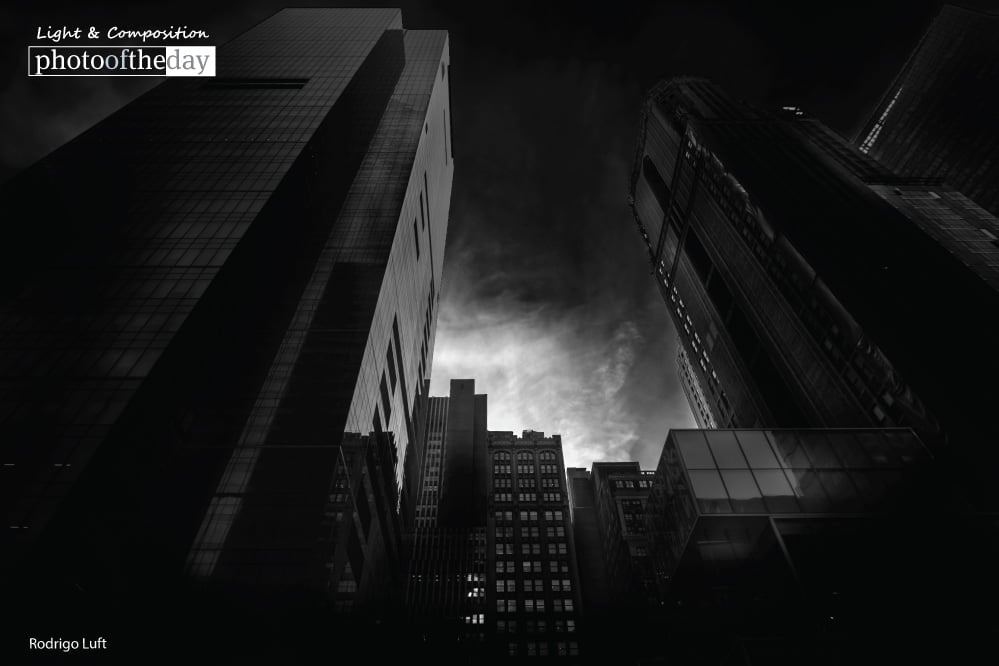
Exposure 1/1250sec @ f/3.8 | ISO 125 | Focal Length 10mm
Rodrigo Luft
Born in the south of Brazil, Rodrigo Luft is an accomplished amateur photographer who continues to live and work in his home country. His diverse portfolio spans landscapes, architecture, and abstract subjects, often characterized by a sophisticated interplay of light and shadow. Having gained international recognition through exhibitions in New York, Luft is noted for his evolving aesthetic, which balances a traditional affinity for black-and-white imagery with an increasingly vibrant use of color. His work is frequently showcased on prominent global photography platforms.
Resonance Score Breakdown
Transparency Note: The resonance score (12.7/20) is calculated based on social engagement metrics collected before the award announcement.
Expert Photography Reviews · 6
Shadows of the Stone Giants
I keep a small, rusted iron key in a velvet pouch, one that no longer fits any lock I own. It is heavy, cold to the touch, and carries the weight of a door that has long since been torn from its hinges.
Read the reflection →The Weight of the Sky
Cities are often sold to us as vertical ambitions, a race toward the clouds that leaves the ground level behind.
Read the reflection →Reviews & Comments
Share your thoughts about this award-winning photograph. Your reviews contribute to the community engagement score.
New York’s steel giants loom, yet they feel hollowed out by this aggressive silhouette. Why strip these structures of their texture, reducing a living city to mere jagged geometry? It’s a cold, exclusionary gaze that prioritizes form over the people inhabiting these shadows. I’m left feeling strangely alienated by the 10mm distortion. Does the photographer even see the history embedded in these facades, or are they just props for a high-contrast exercise in urban erasure?
We look at these towering silhouettes and we don’t see mere steel; we see a city’s posture. Rodrigo Luft has listened to the rhythm of New York’s skyline, capturing how it leans in to whisper secrets against the light. It’s a portrait of a giant, breathing in the dusk. I feel a sudden, sharp loneliness looking at those jagged edges. It’s a photograph that asks to be returned to, like a story we’ve heard before.
The 10mm focal length forces a violent convergence of vertical lines. It’s a precarious geometry. The silhouette creates a rigid, impenetrable barrier against the sky, denying the eye any entry point. I’m genuinely unsettled by how the negative space crushes the architecture. It doesn’t invite; it demands submission. The frame holds, but only just. The tension between the light source and the dense massing creates a structural friction that keeps the composition from collapsing entirely.
The frame hits you like a sudden cut to black. It’s a wide, aggressive 10mm gaze that forces the city to surrender its scale. I love how the backlight bleeds through the geometry; it’s the kind of high-contrast tension that makes an editor hold the shot just a second longer. Luft didn’t just capture a building; he captured the silence between two skyscrapers. It’s a film that refused to move, and I’m glad it didn’t.
New York isn’t stone; it’s a cage of light. Luft forces these buildings into a brutal, jagged silhouette, stripping away the trivialities of glass and steel. It’s a cold, honest reduction. I’ve walked these canyons, and I’ve felt that same crushing weight of the void pressing against my chest. When you starve the frame of detail, you finally force the viewer to confront the architecture of their own isolation. It doesn’t invite; it demands.
You’ve captured the scale of New York, but I’m looking for the pulse beneath the steel. It’s technically sharp, sure, but it feels a bit cold. I’ve walked those streets and felt the crushing weight of the city, yet this doesn’t quite capture that ache. Because you chose such a wide lens, the buildings feel distant, almost clinical. I want to feel your heartbeat in the frame. Where were you when you felt the city breathe?