Hide and Seek by Ann Arthur
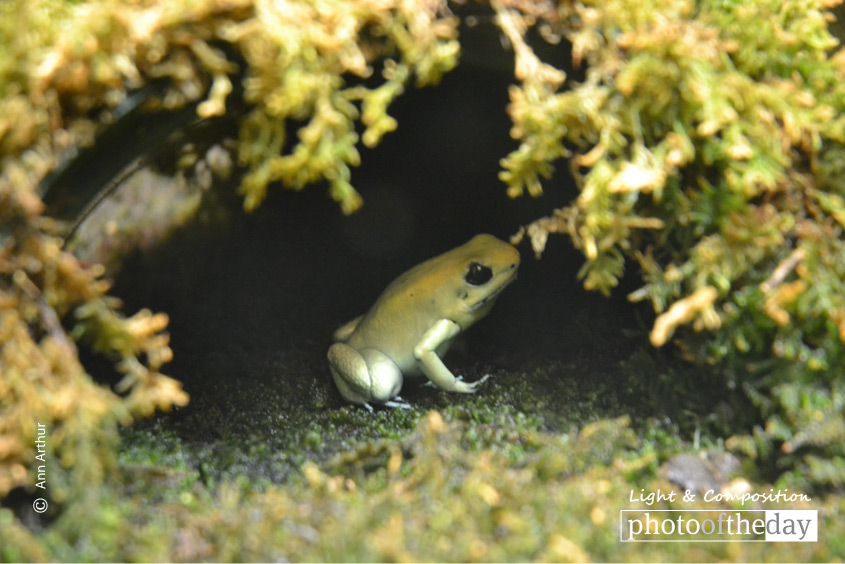
In this captivating wildlife study, the photographer captures a moment of subtle discovery at the Georgia Aquarium. While observing the exhibit, the photographer’s eye was drawn to a yellow frog expertly camouflaged within its vibrant surroundings, nearly invisible to the casual passerby. By focusing on the intricate textures and the creature's masterful concealment, the image transforms a simple observation into a compelling game of 'Hide and Seek.' The photograph is award-worthy for its keen observational skill and the patience required to isolate such a well-hidden subject, revealing the hidden beauty of the natural world.
Michiko Matsumoto
Michiko Matsumoto was born in Shizuoka, Japan in 1950. In 1974 she got her B.A. in Japanese literature from Hosei University. She started photography in the early 1980s with several series of portraits of artists living in various countries and famous dancers of major dance companies. Later she published 10 books in the field of photography. Her works are in the collections of a number of museums internationally. Currently she is based in Tokyo. [caption id="" align="alignnone" width="145"] Michiko Matsumoto [/caption] Current Location: Tokyo, Japan Website: http://www.matsumotomichiko.co
Resonance Score Breakdown
Transparency Note: The resonance score (13.2/20) is calculated based on social engagement metrics collected before the award announcement.
Expert Photography Reviews · 6
The Art of Staying Still
I spent twenty minutes this morning looking for my keys, only to find them sitting in plain sight on the kitchen counter. They had been there the whole time, blending into the clutter of mail and grocery lists. It is funny how our eyes work.
Read the reflection →The Art of Becoming Still
To be seen is a vulnerability, but to remain unseen is a profound act of grace. In the natural world, there is a quiet wisdom in blending, in choosing to become a part of the tapestry rather than standing apart from it.
Read the reflection →Reviews & Comments
Share your thoughts about this award-winning photograph. Your reviews contribute to the community engagement score.
The aquarium’s artificial glow isn’t the sun, yet it demands the same stillness. I’ve spent hours waiting for a forest to breathe, and here, Ann Arthur waited for a frog to reveal its secret. It’s a quiet, humid patience. When I look at those vibrant, textured leaves, I feel a sudden, sharp ache for the wild. She didn’t just take a picture; she listened to the glass until the creature finally decided to be seen.
We look at this yellow frog and we don’t just see camouflage; we see a creature holding its breath. Ann Arthur didn’t just snap a shutter; she waited until the silence between them became a shared secret. It’s a portrait of stillness, a quiet game where the subject decides when to be found. I find myself leaning in, holding my own breath, hoping not to break the spell. It’s a photograph that asks to be returned to.
1/30sec at f/4.5, ISO 3200, 70mm. It’s a technical disaster. That shutter speed is far too slow for a handheld shot at 70mm, and the ISO 3200 noise on a D3100 sensor creates a muddy mess. The motion blur ruins the texture of the frog’s skin. I’ve seen better clarity from a smartphone. It’s frustrating to see a decent composition sabotaged by such sloppy camera handling. The numbers don’t lie; this failed.
You waited. I can feel it. Most people walk past that glass without seeing a thing, but you stopped. You looked until the yellow frog finally revealed itself to you. It’s a quiet, patient kind of work that I really respect. Because you didn’t rush, you caught that tiny, hidden life. It makes me feel like I’m standing right there in the dim light of the aquarium, holding my breath with you. That’s a rare gift.
At f/4.5, the Nikon’s sensor struggles against the aquarium’s low-light noise, yet the focal plane finds the frog’s granular skin with startling precision. I’m genuinely moved by how the lens resolves those tiny, warty textures against the chaotic bokeh. It’s a delicate dance between diffraction and ISO-induced grain. You’ve captured a biological secret here; the way the light refracts through the glass to reveal such hidden, vibrant camouflage is, in the strictest physical sense, extraordinary.
The frame’s geometry is compromised by a chaotic distribution of foliage. While the frog’s placement provides a necessary fulcrum, the surrounding textures lack the requisite spatial tension to anchor the eye. It’s a cluttered visual field that doesn’t quite resolve into a coherent architecture. I’ve spent minutes searching for a structural logic that simply isn’t there. The negative space is wasted, leaving the composition to drift into the realm of mere documentation.