Flocks of Common Redshank by Masudur Rahman
On a crisp morning in November, the photographer ventured to the coastal wetlands of Fallitoli, Chittagong, a sanctuary renowned for its diverse winter bird populations. While observing the shoreline, he encountered a gathering of Common Redshanks, capturing them in a moment of natural grace. This image stands out for its sharp focus and the intimate perspective it offers on avian behavior. The photographer’s patience and keen eye for detail transform a simple wildlife observation into a compelling narrative, highlighting the beauty of migratory species and the profound humility that comes with studying the natural world.
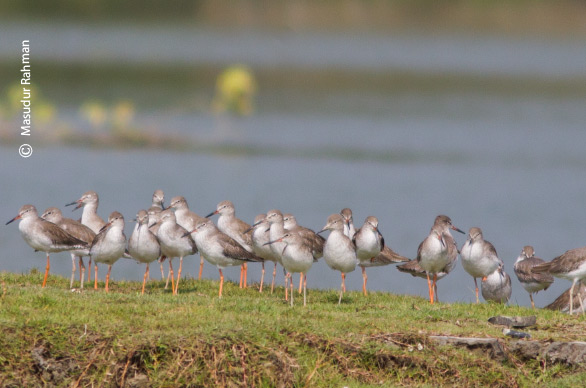
Exposure 1/1250sec @ f/5.6 | ISO 320 | Focal Length 420mm
Masudur Rahman
Born in 1967, Masudur Rahman Mamoon is a dedicated wildlife photographer based in Chittagong, Bangladesh. Since beginning his journey with film portraiture in 1998, he has evolved into a specialist in bird photography, balancing his artistic pursuits with a career in the RMG sector. A member of the Chittagong Bird Club, Mamoon frequently travels across the country to document avian life, contributing his work and insights to local weekly publications. He views photography as a vital medium for personal expression and a catalyst for positive societal change.
Resonance Score Breakdown
Transparency Note: The resonance score (12.9/20) is calculated based on social engagement metrics collected before the award announcement.
Expert Photography Reviews · 6
The Salt on the Wind
The air near the water has a specific grit to it, a fine, invisible powder that settles on the back of your throat. It tastes of brine and ancient, cooling mud.
Read the reflection →The Geometry of Migration
We are all tethered to invisible currents, pulled by the silent, insistent gravity of belonging. There is a profound language in the way a collective moves—not as a single entity, but as a thousand individual heartbeats synchronized by the turning of the season.
Read the reflection →Reviews & Comments
Share your thoughts about this award-winning photograph. Your reviews contribute to the community engagement score.
You waited in the mud at Fallitoli, and it shows. I’ve spent enough time in the field to know that stillness isn’t just about the shutter speed; it’s about disappearing. When I look at these Redshanks, I don’t just see birds. I feel the cold morning air and the quiet respect you held for them. You didn’t force the moment. You let them be. There’s something honest happening here. It’s a rare, peaceful kind of truth.
Of the thousands of wildlife frames I’ve reviewed, most are just sharp snapshots. What separates this from the pack is the rhythmic spacing of the Redshanks against the mudflat’s texture. It’s not just a record of birds; it’s a study in repetition and stillness. I’ll admit, the way those reflections mirror the movement makes me want to stand in that cold water myself. It’s a quiet, enduring piece of natural history that won’t lose its relevance.
The frame’s geometry relies on the rhythmic repetition of the Redshanks’ silhouettes. It’s a disciplined arrangement of mass against the negative space of the mudflat. The horizontal alignment creates a stable, if predictable, fulcrum. While the tonal range lacks the grit I’d prefer, the spatial tension holds the eye firmly within the frame’s boundaries. It’s rare to find such structural clarity in wildlife work. Honestly, the precision of this alignment is quite satisfying to behold.
The Redshanks wade through the silt, yet it’s the encroaching gloom that truly anchors them. Rahman hasn’t just captured birds; he’s mapped the boundary where the tide’s retreat surrenders to the void. I’ve spent hours staring at these dark, muddy recesses, and I’m struck by a sudden, cold loneliness. It’s a quiet violence. Light here doesn’t illuminate; it merely marks the perimeter of a silence that refuses to be filled. Darkness isn’t empty—it’s waiting.
At 420mm, the Canon 1D Mark IV resolves the Redshank’s plumage with startling fidelity. By stopping down to f/5.6, Rahman avoids the diffraction limit while maintaining a razor-thin focal plane that isolates the birds against the soft, refractive bokeh of the Chittagong wetlands. It’s a masterclass in light management. I’m genuinely moved by how the lens captures the iridescence of their feathers; it’s a level of optical clarity that makes my own heart skip a beat.
We look at these Redshanks and we aren’t just seeing birds; we’re seeing a community in mid-sentence. They’ve gathered in the Chittagong mud, heads tilted as if sharing a secret. I’ve spent my life listening to stories, and here, the silence is heavy with intent. It’s a portrait of collective grace that makes me feel small, yet deeply connected. This is a photograph that asks to be returned to, because it’s really about us.