End of the Day by Shariful Alam
Captured during the fleeting moments of twilight, this photograph explores the transition between day and night. As the sun dipped below the horizon, the sky transformed into a dramatic canvas of dark, white, and blue hues. The photographer was drawn to this residual brightness, seeking to preserve the quiet beauty of the day's conclusion. By focusing on the interplay of light and color, the image captures a serene, atmospheric stillness. Its award-worthy quality lies in the photographer's ability to translate a simple, ephemeral observation into a compelling visual narrative that invites the viewer to pause and reflect on the natural world.
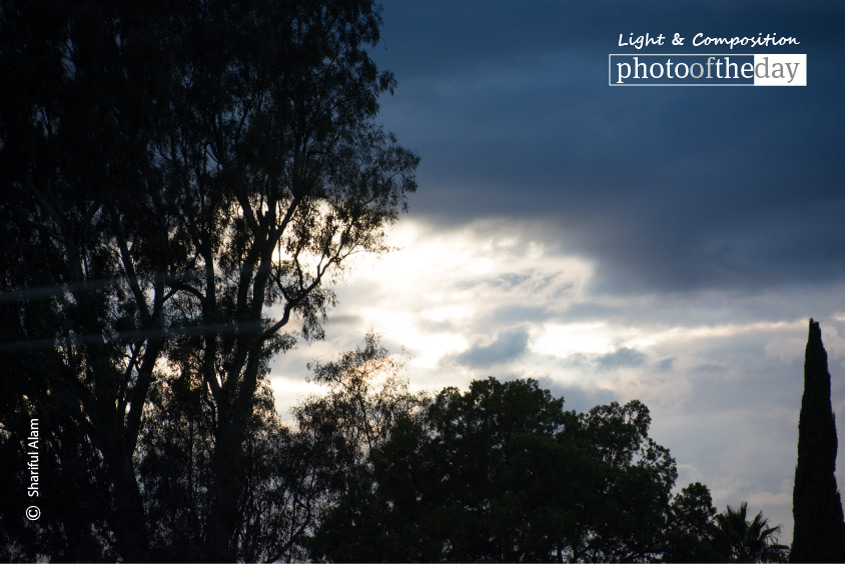
Exposure 1/1600sec @ f/6 | ISO 1000 | Focal Length 179mm
Shariful Alam
Born in Bangladesh, Shariful Alam relocated to California in 2013, where he continues to explore the art of photography as a dedicated passion. Though he approaches the craft as an enthusiast rather than a professional, he has refined his technical foundation through formal basic training. His work frequently highlights the beauty of urban and rural landscapes, as well as expressive portraiture, often inspired by the emotional depth of human subjects and the vibrant colors of the sky. Alam views photography as a meaningful way to document and cherish the fleeting, beautiful moments he encounters.
Resonance Score Breakdown
Transparency Note: The resonance score (11.8/20) is calculated based on social engagement metrics collected before the award announcement.
Expert Photography Reviews · 7
The Architecture of the Fade
There is a quiet, almost mathematical precision to the way a day unspools. We tend to think of time as a steady march, a constant ticking forward, but the end of the light suggests something more like a slow folding of fabric.
Read the reflection →The Salt of Twilight
The air at dusk always tastes of cooling stone and the faint, metallic tang of a day folding itself away.
Read the reflection →Reviews & Comments
Share your thoughts about this award-winning photograph. Your reviews contribute to the community engagement score.
You caught a quiet, heavy stillness here. When I look at those dark, bruised blues against the fading light, I feel that specific ache of a day slipping away—the kind of loneliness that hits when you’re driving home alone. It’s not just a sunset; it’s a mood you’ve pinned down. You waited for the light to die, and it paid off. There’s something honest happening here. It’s a moment of genuine, human reflection.
Twilight in Valley Village isn’t just a sky; it’s a conversation between the light and the earth. We look at these deep blues and we feel the silence of a day letting go. Shariful Alam didn’t just capture a sunset; he listened to the quiet exhaustion of the horizon. It’s a portrait of a place catching its breath. I find myself wanting to sit in that stillness, just to hear what the shadows are whispering.
The sun has surrendered, leaving behind a bruised, indigo silence. Shariful stood here as the light thinned, waiting for the horizon to exhale its final, pale breath. I feel a sudden, sharp ache in my chest looking at those cooling blues; it’s the quiet loneliness of a day ending. He didn’t rush the shutter. He simply listened to the sky’s slow retreat, capturing that fleeting, heavy stillness before the world turned entirely to shadow.
The horizon line bisects the frame with clinical indifference. It’s a rigid anchor, yet the vertical silhouettes lack the necessary mass to counter the sky’s expansive gradient. The composition doesn’t quite resolve; the negative space feels hollow rather than deliberate. I’m frustrated by the lack of structural tension here. It’s a missed opportunity for geometry. The frame holds, but it doesn’t command. Without a stronger fulcrum, the visual architecture simply drifts into the twilight.
The light hits the sensor and the world stops breathing. It’s a long lens compression that flattens the Valley Village sky into a moody, cinematic backdrop. I love the way the residual glow clings to the horizon; it’s the exact moment a director calls for a cut, but the scene refuses to end. The shutter speed is tight, freezing the transition perfectly. It’s a frame the editor keeps because it holds the weight of the entire day.
Most sunset shots are forgettable clutter, but this one lingers. I’ve seen thousands of twilight frames, yet the way Alam isolates that singular, piercing sliver of light against the encroaching blue gloom feels honest. It doesn’t rely on cheap saturation. It’s quiet, almost lonely, and that’s why I’ll remember it in thirty years. It’s a rare, restrained observation that actually makes me want to stop and breathe. That’s the difference between a snapshot and a legacy.
1/1600sec at f/6, ISO 1000, 179mm. A telephoto reach that demands stability, yet the ISO choice is baffling. Why push the sensor to 1000 in twilight when the shutter speed is overkill? It’s a noisy compromise that degrades the sky’s subtle gradients. I’ve spent years calibrating sensors, and seeing this grain makes me wince. The optics were capable, but the exposure logic is fundamentally flawed. It’s a technical failure that obscures the intended stillness.