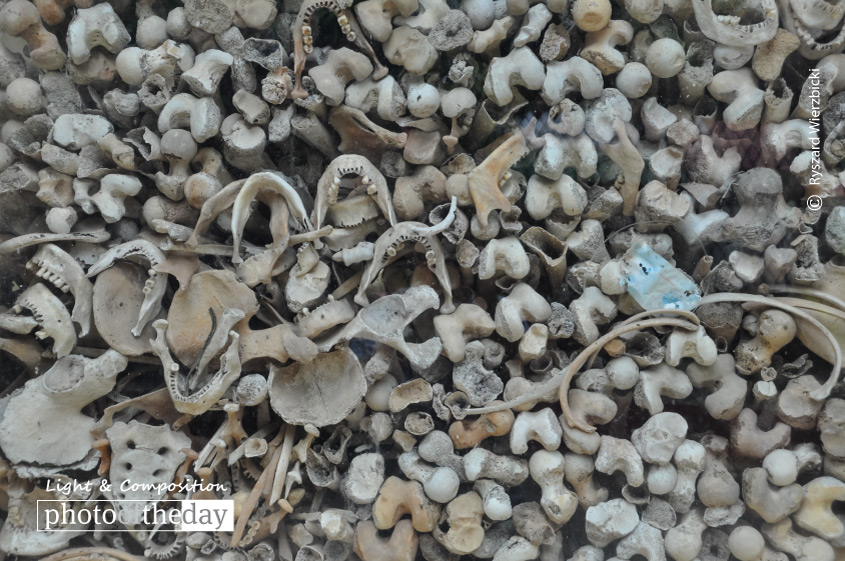
Bones and Jaws by Ryszard Wierzbicki
In this poignant documentary photograph, Ryszard Wierzbicki captures the haunting remnants of Cambodia’s tragic history at a memorial site near Siem Reap. By focusing on the physical evidence of the Khmer Rouge genocide, the image serves as a somber reflection on the country's past. The photographer utilizes a 50mm focal length to create an intimate, grounded perspective, drawing the viewer into the stark reality of the site. This work is award-worthy for its ability to transform a difficult, historical subject into a powerful visual narrative, ensuring that the memory of these events remains vivid and impactful for a global audience.
Ryszard Wierzbicki
Born in 1963 and a graduate of the University of Gdańsk, Ryszard Wierzbicki transitioned from a career in social sciences and marketing to become a dedicated traveler and photographer after relocating to the United Kingdom in 2006. His work is deeply influenced by his extensive explorations of South-East Asia and his commitment to humanitarian efforts, including volunteering with orphanages in Thailand and Burma. Now based in Swindon, he balances his professional life as a marketing advisor with his passion for documenting the world, frequently sharing his insights through his established travel and photography forums.
Resonance Score Breakdown
Transparency Note: The resonance score (13.6/20) is calculated based on social engagement metrics collected before the award announcement.
Expert Photography Reviews · 8
The Weight of What Remains
Archaeologists often speak of the silence of objects. When a civilization retreats into the earth, it leaves behind a vocabulary of stone, clay, and bone—a language that no longer requires a speaker to be understood.
Read the reflection →The Weight of Memory
I spent this morning clearing out the back of my closet. I found a box of old letters I hadn't touched in years. The paper was yellowed, the ink fading, but the moment I touched them, the voices of people I haven't spoken to in a decade came rushing back.
Read the reflection →Reviews & Comments
Share your thoughts about this award-winning photograph. Your reviews contribute to the community engagement score.
At f/10, the Nikon’s sensor resolves the calcified texture of these remains with chilling precision. The 50mm focal plane renders the porous bone structure with such clinical sharpness that I’ve found myself shivering; it’s as if the diffraction limit has been pushed to reveal the very marrow of history. There’s a haunting clarity here, where the light doesn’t just illuminate the tragedy—it dissects it. It’s a brutal, necessary optical encounter with the ghosts of Siem Reap.
The light here isn’t searching; it’s resting, heavy and flat against the earth. I feel a sudden, sharp chill looking at these remains, as if the air in Siem Reap hasn’t moved for decades. He stood here in the quiet, letting the 50mm lens hold the silence of the bones. It’s not a scene you rush. You wait until the land itself decides to reveal its grief. It’s a haunting, necessary stillness.
Before the eye identifies the calcified geometry of the remains, something in the chest tightens. It’s a visceral, involuntary recoil. Wierzbicki’s frame forces a confrontation with the fragility of bone against the indifference of dust. I’ve found that returning to this, the silence doesn’t soften; it deepens. It’s the weight of the jawbone that haunts me, a reminder of voices extinguished. It’s an ache that lingers, following me into the quiet of my own sleep.
Death doesn’t reside in the bones themselves, but in the suffocating gray light that refuses to define them. Wierzbicki’s shadows here aren’t merely absent; they are the heavy, unyielding silence of a mass grave. I’ve stared at these calcified remains until my own pulse slowed to match the stillness. It’s a brutal, necessary darkness. When light fails to illuminate the horror, it forces us to confront the void where humanity once breathed. It’s truly haunting.
Most entries in this category rely on shock, but Wierzbicki chooses the quiet weight of the earth. The 50mm framing forces an intimacy that feels almost intrusive, yet necessary. I’ve spent years looking at memorials, and honestly, this one makes my chest tighten. It’s the way the light catches the texture of the bone against the grit. It doesn’t scream; it lingers. That’s why we’ll still be looking at this in thirty years. It’s hauntingly permanent.
1/100sec at f/10, ISO 200, 50mm. The aperture choice is clinical, forcing a deep focus that demands we confront every jagged edge of these remains. It’s a cold, calculated decision that works. I’ve spent years looking at these sites, but the sharpness here makes my stomach turn. He didn’t hide behind a shallow depth of field. He forced the reality into the frame. It’s technically sound, and frankly, it’s the only way to document this.
The silence here is deafening. It’s a locked-off shot, steady and unflinching, forcing us to stare at the calcified remains of a nightmare. The 50mm focal length keeps the perspective human, grounded, almost uncomfortably close. I felt a chill hit my chest the second I saw the texture of those bones. It’s the frame the editor keeps because the cut would have been a mistake. Wierzbicki knew exactly what he was holding when he closed the shutter.
The calcified ochre of these remains, bleached by a relentless Cambodian sun into the brittle, chalky white of a Morandi still life, creates a dissonance that’s truly harrowing. It’s the colour of dust settling over forgotten grief, a pale, suffocating silence that makes my own breath hitch in the throat. One finds no warmth here, only the cold, clinical light of history, stripping away the comfort of shadow to reveal a devastating, monochromatic ache.