The Beauty in Truth by Ahmed Al.Badawy
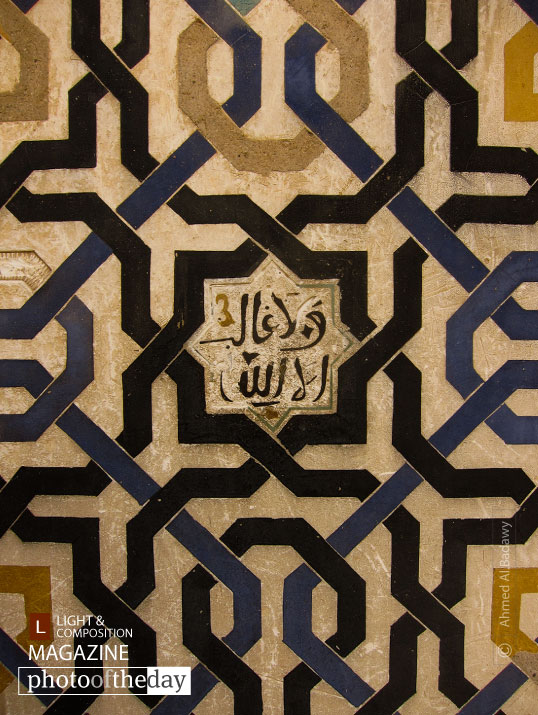
Captured within the historic walls of the Al-Hambra Palace, this photograph highlights the intricate beauty of Arabic calligraphy integrated into the architecture. The photographer focused on the 112th chapter of the Quran, where the script elegantly disrupts the surrounding geometric patterns. By choosing a precise angle, the image emphasizes the spiritual weight and artistic harmony of the text against the palace's storied backdrop. The work is award-worthy for its ability to bridge the gap between architectural documentation and profound philosophical reflection, transforming a structural detail into a meditative visual experience.
Ahmed Al.Badawy
Born in Mansoura, Egypt, in 1985, Ahmed Al.Badawy is a professional architect and photographer who began his creative journey in 2010. As a founder of the design studio Gozour, he draws heavily upon his architectural background to define the character and structural precision of his photographic work. His portfolio is deeply rooted in the exploration of historical sites, where he seeks to uncover the profound beauty hidden within the simplicity of his surroundings.
Resonance Score Breakdown
Transparency Note: The resonance score (13.0/20) is calculated based on social engagement metrics collected before the award announcement.
Expert Photography Reviews · 4
The Echo of the Hand
There is a specific silence left behind by a craftsman who has long since laid down his tools. It is not the silence of an empty room, but the heavy, deliberate quiet of a mark made to last.
Read the reflection →The Script of Power
We often mistake the city for its stone and steel, forgetting that every wall is a manifesto. Architecture is never neutral; it is a physical manifestation of an ideology, a way of carving a specific worldview into the landscape.
Read the reflection →Reviews & Comments
Share your thoughts about this award-winning photograph. Your reviews contribute to the community engagement score.
The geometry pulls the eye. Then, the script interrupts. It’s a sharp, rhythmic breath against the stone. I’ve spent minutes here, just watching the light settle into the carved depth of the calligraphy. It doesn’t demand attention. It simply exists. Nothing here is accidental. The empty corner is not empty. It’s a pause. I feel a sudden, quiet ache in my chest. It’s the weight of silence, held perfectly in place by the stone.
Shadows here don’t merely frame the calligraphy; they anchor it in the silence of the Alhambra. Al.Badawy understands that truth isn’t found in the light, but in the dark recesses where the stone holds its breath. I’ve stared at these curves until my eyes ached, feeling the weight of the 112th chapter pressing against the void. It’s a haunting, heavy meditation. When the light fails to reach the script, the architecture finally begins to think.
The geometry here doesn’t merely decorate; it anchors the frame. The calligraphic script disrupts the rigid grid, creating a necessary spatial tension that prevents the composition from collapsing into mere pattern. It’s a precise calibration of weight. I’ve rarely seen such disciplined alignment between text and stone. The fulcrum of the frame holds, even if the focal length feels slightly constrained. It’s a rigorous study of balance. The architecture demands this level of structural clarity.
At f/5.6, the S90’s sensor captures the calligraphy’s relief with surprising fidelity. The focal plane sits perfectly across the stucco, where the diffraction limit hasn’t yet softened the intricate geometry. I’m genuinely moved by how the light catches those carved edges; it’s a tactile, almost rhythmic precision. It’s rare to see such clarity from a compact sensor, but here, the optics resolve the spiritual weight of the script into something truly, physically profound.