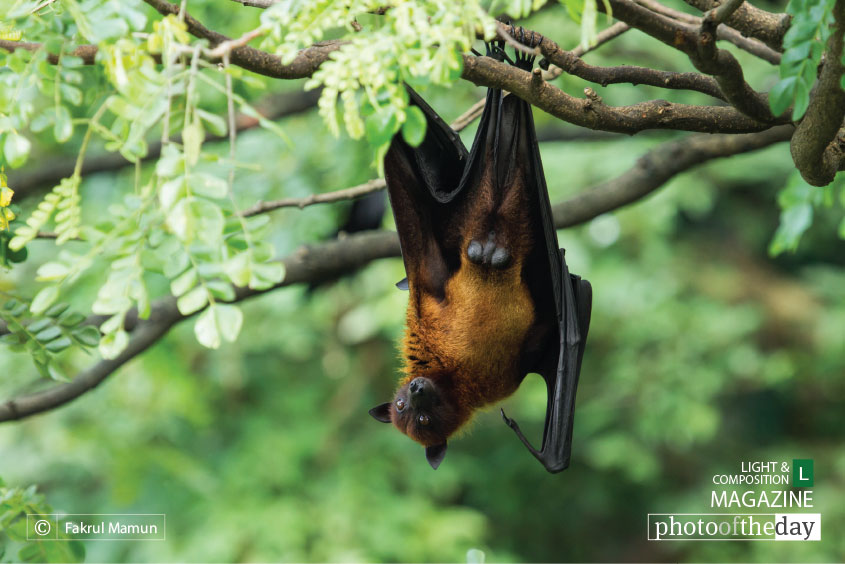
Indian Flying Fox by Fakrul Mamun
Captured during a casual birding excursion near his home, Fakrul Mamun encountered a remarkable colony of Indian Flying Foxes resting in the canopy. The photographer observed these large mammals as they spent their lazy daytime hours suspended from the branches of a grand tree. This image is award-worthy for its intimate portrayal of wildlife behavior, showcasing the photographer’s ability to pivot from his original subject to capture a rare, serene moment in nature. The composition highlights the texture and scale of these creatures, turning a simple local discovery into a compelling study of biodiversity.
Fakrul Mamun
Born in Chittagong in 1986, Fakrul Mamun is a businessman and dedicated self-taught photographer. After beginning his creative journey in 2009 as a street photographer, he transitioned his focus to bird photography in 2013 following an influential encounter with local wildlife enthusiasts. He now travels extensively throughout the diverse landscapes of Bangladesh, with a particular passion for documenting the avian and mammalian life within the country's hill-track regions.
Resonance Score Breakdown
Transparency Note: The resonance score (12.5/20) is calculated based on social engagement metrics collected before the award announcement.
Expert Photography Reviews · 7
The Canopy’s Unseen Tenants
We often mistake the city for a collection of concrete, steel, and glass—a rigid grid designed for human transit and commerce. Yet, if we look toward the canopy, we find a parallel geography.
Read the reflection →The Weight of the Inverted
In the ancient myths, the world was often held up by giants, or perhaps a turtle, or a series of pillars stretching into the dark. We are taught to stand upright, to defy gravity as a matter of pride, as if our verticality is the only way to prove we exist.
Read the reflection →Reviews & Comments
Share your thoughts about this award-winning photograph. Your reviews contribute to the community engagement score.
Suspended in the canopy, these creatures don’t merely rest; they inhabit the threshold between existence and the void. Mamun captures the leather of their wings as if they’re shrouds, pulling the light into a suffocating, velvet depth. It’s unsettling. I’ve spent hours staring at these dark, folded shapes, and I feel a sudden, cold vertigo. When the shadow swallows the detail, the animal becomes a question. It’s a haunting, silent refusal to be fully known.
Before the eye identifies the leathery, furred weight of the bats, a strange stillness settles in the chest. It’s a heavy, inverted quiet. Looking at these creatures, I feel a sudden, sharp ache for the forgotten corners of my own childhood, where shadows felt alive. Returning to this frame a year later, the texture of their wings still triggers a phantom shiver. It doesn’t just document nature; it pulls the viewer into that suspended, breathless dark.
Of the thousands of wildlife shots I’ve reviewed, most are just clinical records. Mamun’s capture of these bats succeeds because it resists the urge to isolate the subject. By keeping the tangled, chaotic branches in focus, he forces us to see the colony as a living, breathing architecture. It’s haunting. I’ve looked at this for years, and I still feel the weight of those leathery wings. It’s a rare, enduring glimpse into a hidden world.
You didn’t just snap a bat; you caught a moment of quiet gravity. I’ve spent enough time in the field to know that patience is the only gear that matters. You waited for them to settle, and it shows in the way those wings wrap around the frame like heavy velvet. It’s intimate. Looking at them hanging there, I felt a strange, sudden stillness in my own chest. You really saw them. That’s rare.
The air in Mehedibagh must have been heavy that day. Watching these creatures hang in the canopy, I feel a sudden, quiet ache for the stillness they possess. It’s not just wildlife; it’s a suspended prayer. He stood there, waiting for the light to soften against their leathery wings. I’ve spent enough hours under similar trees to know that silence. It’s a rare, sacred patience that lets the world reveal its hidden, hanging life.
At f/7.1, the 300mm focal length renders the flying fox’s fur with a crispness that pushes against the diffraction limit. I’m genuinely moved by the way the light catches the translucent wing membranes; it’s a masterclass in managing depth of field to isolate such complex, leathery textures. The lens hasn’t just captured a creature; it’s resolved the microscopic detail of the canopy’s shadow. It’s rare to see such optical clarity in a casual encounter.
The vertical axis here is dominated by the rhythmic, repetitive suspension of the bats, creating a dense, interlocking grid of dark masses. I’m struck by the 3:1 ratio of shadow to highlight, which forces the eye to navigate the tangled geometry of the canopy. It’s a complex spatial equation solved through repetition. Honestly, I’ve never seen such a chaotic cluster feel so mathematically balanced. The negative space doesn’t exist; it’s entirely consumed by the creatures’ wings.