Beauty of Butterfly by Tanmoy Saha
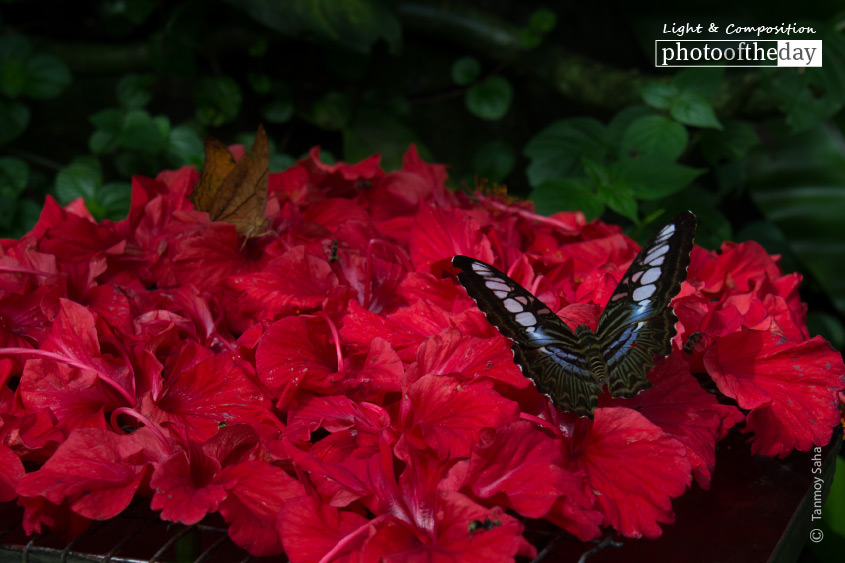
Captured within the lush, expansive environment of the KL Butterfly Park in Malaysia, this photograph highlights the delicate elegance of its subject amidst a sprawling 80,000-square-foot landscape. The photographer utilized a precise aperture of f/11 to ensure deep clarity across the butterfly's intricate wing patterns, balancing the vibrant exotic flora with the subject's fragile form. This image is award-worthy for its masterful control of depth and composition, transforming a common wildlife encounter into a refined study of nature’s artistry. The result is a vivid, intimate portrait that celebrates the quiet beauty of one of the world's most diverse butterfly habitats.
Tanmoy Saha
Based in Dhaka, Bangladesh, Tanmoy Saha Turja is an accomplished photographer and engineer who began his creative journey in 2007. With a strong academic background in Electronics and Telecommunication Engineering, he balances his technical expertise with a passion for portraits, landscapes, and wildlife photography. His work has been showcased at the National Art Gallery in Bangladesh during the Friendship Art Exhibition, reflecting his commitment to capturing the natural world through a refined, artistic lens.
Resonance Score Breakdown
Transparency Note: The resonance score (12.0/20) is calculated based on social engagement metrics collected before the award announcement.
Expert Photography Reviews · 7
The Weight of Wings
We are taught that fragility is a weakness. We build walls, we harden our skin, we look for permanence in a world that is defined by its passing. But there is a different kind of strength in the ephemeral.
Read the reflection →The Weight of Dust and Velvet
There is a specific, dry tickle that happens when you press your face into the velvet of a moth-eaten curtain. It smells of attic air and the slow, patient decay of summer.
Read the reflection →Reviews & Comments
Share your thoughts about this award-winning photograph. Your reviews contribute to the community engagement score.
The shutter clicks, and time stops dead. It’s a freeze-frame of pure, fragile motion. At f/11, Saha demands we look at every vein, every scale, refusing to let the background blur into a cheap cinematic trick. I’m struck by how the butterfly holds its position, a silent protagonist in a sprawling, lush set. It’s a perfect cut. The editor keeps this one because it’s the only frame where the world finally sits still for us.
The butterfly’s placement creates a precarious fulcrum against the chaotic foliage. It’s a rigid geometry that barely survives the background’s visual noise. The f/11 aperture forces a depth that threatens to collapse the subject into the flora, yet the wing patterns hold their own. I’m genuinely irritated by the distracting leaf encroaching on the left margin; it breaks the frame’s discipline. Without that intrusion, the spatial tension would have been absolute. It’s almost perfect.
It’s the stillness that catches me. Tanmoy waited for the wings to settle, listening to the rhythm of the park. At f/11, he’s invited us into a quiet conversation between the flora and the fragile, patterned light. I’ve spent hours in such gardens, and I know the patience required to let a creature trust you. It’s a gentle, breathing portrait. Looking at it, I feel the humidity of the air and the soft, green silence.
You’ve captured a stillness here that’s rare. I’ve spent enough time in the humidity of places like Bandarban to know how hard it is to hold your breath when nature is this fragile. You didn’t just document a butterfly; you respected its space. It’s quiet, and I appreciate that you didn’t force the frame. There’s something honest happening here. You waited for the light to settle, and I can feel that patience in the wings.
At f/11, the diffraction limit begins to soften the micro-contrast, yet Saha’s focal plane remains remarkably sharp across those iridescent scales. It’s a delicate balance; he’s pushed the 15-85mm lens to its physical threshold to capture such depth. I’m genuinely moved by how the light refracts through the wing’s chitinous structure. It doesn’t just show a butterfly; it reveals the complex geometry of nature’s own optics. It’s a rare, precise intersection of biology and glass.
The ochre veins of these wings hum with the dusty, sun-bleached warmth of a Morandi still life, yet it’s the sudden, electric shock of that cerulean edge—the precise blue of shallow tidal water at dusk—that truly steals one’s breath. I’ve found myself mesmerized by how the verdant, mossy bokeh doesn’t just recede, but actively breathes, cradling the insect in a humid, emerald embrace that feels almost impossibly lush, as if the air itself were weeping chlorophyll.
The butterfly’s wings form a near-perfect bilateral symmetry, bisected by a sharp vertical axis that anchors the frame. I’m struck by the f/11 depth of field; it forces the intricate, repeating geometric patterns of the scales into a flat, mathematical plane. The negative space in the lower quadrant creates a 1:2 ratio with the subject, balancing the visual weight. It’s a beautifully solved spatial equation. I’ve rarely seen such precise, rigid order in nature.