The Greater Racket-tailed Drongo by Masudur Rahman
Captured within the lush canopy of Kaptai National Forest, this striking portrait of a Greater Racket-tailed Drongo highlights the bird's most iconic feature: its elongated, racket-tipped tail feathers. The photographer carefully navigated the dense forest environment to isolate the subject, balancing the bird's deep, iridescent black plumage against the soft, natural light of the woodland. This image is award-worthy for its technical precision in capturing such a swift, elusive species, combined with a composition that emphasizes the elegant silhouette and unique morphology that makes the Drongo a standout subject in avian wildlife photography.
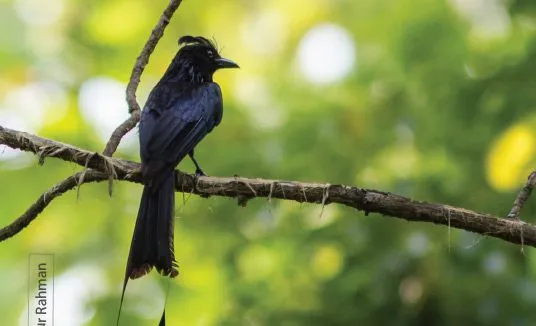
Masudur Rahman
Born in 1967, Masudur Rahman is a dedicated wildlife photographer based in Chittagong, Bangladesh. Since rekindling his passion for the craft in 2007, he has focused his lens on the diverse avian life of his home country, frequently contributing his work and insights to local publications. As an active member of the Chittagong Bird Club, Rahman views photography as a vital medium for creative expression and social advocacy, consistently traveling to remote regions to document the natural beauty of the region's wildlife.
Resonance Score Breakdown
Transparency Note: The resonance score (11.9/20) is calculated based on social engagement metrics collected before the award announcement.
Expert Photography Reviews · 8
The Weight of Grace
Why do we mistake stillness for an absence of effort? We look at the natural world and assume that because a creature does not speak, it does not labor.
Read the reflection →The Weight of Silence
There is a particular stillness that arrives before the wind shifts. It is not the absence of sound, but the presence of something waiting. In the deep woods, where the light struggles to reach the floor, creatures exist in the periphery of our perception.
Read the reflection →Reviews & Comments
Share your thoughts about this award-winning photograph. Your reviews contribute to the community engagement score.
1/250sec at f/6.3 with a 420mm equivalent focal length. That shutter speed is dangerously slow for a bird this restless. Rahman’s gamble paid off, but it’s a razor’s edge. The ISO 320 keeps the sensor clean, preserving the iridescent sheen on those tail feathers. I’ve spent hours tracking these drongos; it’s exhausting work. He nailed the focus on the eye despite the thin depth of field. It’s technically sound, if a bit reckless.
One doesn’t capture a Drongo by simply wandering into Kaptai with a long lens. The plumage here is too clean, the focus too deliberate. It’s clear Rahman spent days enduring the humidity, waiting for that precise, elegant turn of the tail. I’ve spent enough damp mornings in the brush to know the ache in his shoulders. It’s a quiet, disciplined piece of work. He didn’t just find this bird; he earned its company.
At f/6.3, the Canon’s focal plane is razor-thin, yet it’s resolved the Drongo’s iridescent plumage with startling clarity. I’m genuinely moved by how the 420mm effective focal length renders the racket-tipped feathers against that creamy, out-of-focus canopy. It’s a masterclass in managing diffraction limits while isolating a subject in such dense, chaotic light. The bokeh is a function of pure precision here; it’s rare to see such elusive morphology captured with this much scientific grace.
The forest recedes. It’s a blur of soft, green breath. The bird sits. It doesn’t demand the frame. It simply exists within the quiet. I’ve spent minutes watching the tail feathers cut through the stillness. They’re lines of ink on paper. Nothing here is accidental. The empty corner is not empty. It’s the weight of the air itself. I feel a sudden, sharp calm looking at it. The silence is finally allowed to speak.
The plumage isn’t merely black; it’s a deep, obsidian velvet that drinks the light, reminiscent of the somber, brooding shadows in a Caravaggio. I’m breathless at how the iridescent sheen catches the forest’s emerald breath, a subtle shift toward the bruised violet of a storm-tossed sky. It’s a chromatic dialogue between the bird’s ink-stained silhouette and the soft, diffused verdancy of Kaptai, creating a harmony that feels, quite frankly, like a quiet, holy revelation.
Before the eye identifies the bird, something in the chest tightens. It’s the stillness of those elongated, racket-tipped feathers that triggers a sudden, held-breath response. I’ve spent years watching wildlife, yet this iridescent black silhouette feels like a secret kept by the Kaptai canopy. When I return to it, the silence of the forest follows me. It doesn’t just capture a drongo; it anchors a fleeting, nervous energy deep within my own pulse.
We look at this Drongo and we don’t just see a bird; we see a sentinel of the Kaptai canopy. It’s perched with such intentional stillness, as if it’s waiting for the forest to finish its sentence before it dares to move. I’m struck by the weight of that gaze. It’s a quiet, piercing intelligence that makes me feel like an intruder in its private, iridescent world. This is a portrait that asks to be returned to.
Most wildlife shots are just trophies, but this one lingers. I’ve seen thousands of bird portraits where the subject is lost in the foliage, yet Rahman’s Drongo cuts through the chaos with surgical precision. The way those racket-tipped feathers slice the negative space creates a graphic tension that’s rare in avian work. It’s hauntingly still. Honestly, I found myself holding my breath. It’s that rare frame that’ll still feel vital in thirty years.