Nehru Boat Race by Achintya Guchhait
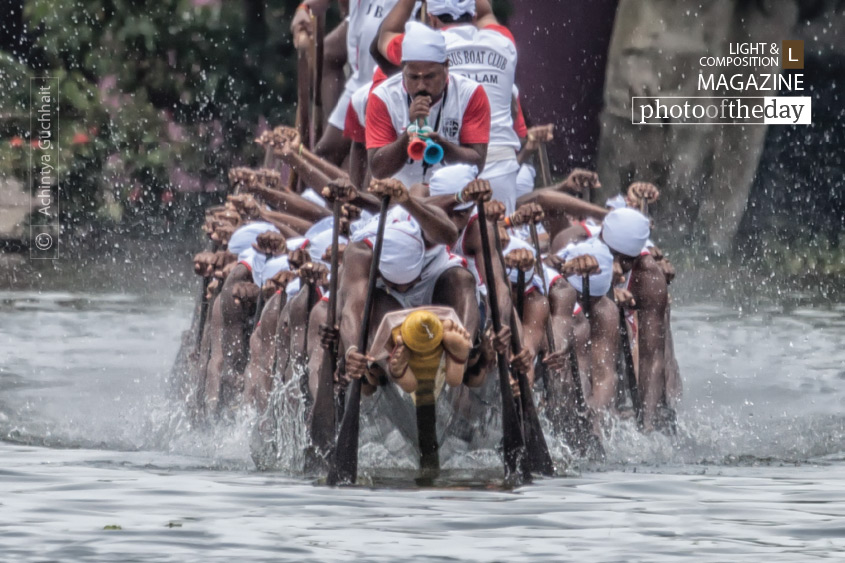
The Nehru Boat Race is a spectacle of rhythm and power, and this photograph captures the precise moment of coordinated intensity as a team maneuvers through the waters of Alappuzha. By utilizing a long focal length, the photographer isolated the synchronized motion of the rowers, emphasizing the raw energy and collective discipline required for the race. The image stands out for its ability to freeze a fleeting, high-stakes moment, transforming a traditional cultural event into a dynamic study of human effort and fluid motion. It is a compelling testament to the photographer's keen eye for timing and composition.
Achintya Guchhait
Based in Bangalore, India, Achintya Kumar Guchhait is a dedicated traveler and photographer who finds beauty in the coexistence of humanity and the natural world. A techie by profession, he transitioned from early experiments with analog cameras to a serious pursuit of digital photography, eventually becoming a Getty contributor. His work is defined by a candid approach to capturing life in common places, ranging from cultural events to human-centric portfolios and weddings. He remains a perpetual student of the craft, constantly refining his technical skills through observation and diverse field experience.
Resonance Score Breakdown
Transparency Note: The resonance score (13.0/20) is calculated based on social engagement metrics collected before the award announcement.
Expert Photography Reviews · 6
The Weight of the Stroke
There is a rhythm to survival that requires more than just muscle. It requires the surrender of the self to the collective. When many move as one, the individual pulse is silenced, replaced by the heavy, rhythmic thrum of a single purpose.
Read the reflection →The Rhythm of Becoming
Can a single heartbeat be shared by a hundred souls? We often mistake solitude for independence, believing that our strength is measured by how much we can carry alone. Yet, there is a profound, ancient truth hidden in the act of moving in unison.
Read the reflection →Reviews & Comments
Share your thoughts about this award-winning photograph. Your reviews contribute to the community engagement score.
Most sports photography is just noise, but this frame captures the exact second where individual effort dissolves into a single, rhythmic machine. I’ve seen thousands of race shots, yet the compression from the 400mm lens here forces the viewer into the boat’s claustrophobic intensity. It’s the sheer, desperate synchronization of those paddles that hits me—it makes my own lungs ache. Thirty years from now, people won’t just see a race; they’ll feel the collective heartbeat.
We look at these rowers and we don’t just see a race; we see a collective heartbeat. Achintya Guchhait didn’t just watch the water; he listened to the rhythm of their exertion. It’s in the tension of their shoulders and the focus in their eyes. I’ve spent hours staring at their synchronized grit, and honestly, it makes my own pulse quicken. It’s a portrait of a community breathing as one. This is a photograph that demands our respect.
The water churns, a violent, rhythmic pulse. It’s a tracking shot frozen in time. With that 400mm lens, Guchhait compresses the space, turning the rowers into a single, breathing machine. I can practically hear the oars hitting the surface. The shutter speed at 1/800sec was the right call; it keeps the tension sharp without killing the fluidity. It’s breathless. I’ve watched a thousand race sequences, but this frame? It’s the one the editor keeps. Pure kinetic poetry.
1/800sec at f/5.6, 400mm. ISO 200. It’s a calculated gamble. The shutter speed is sufficient to arrest the oars, but f/5.6 at 400mm creates a razor-thin plane of focus. It’s technically risky, yet the depth of field holds the lead rower’s strain perfectly. I’ve seen enough motion blur to last a lifetime, but this? It’s sharp where it counts. The decision to isolate the action was correct. It’s a cold, precise execution of intent.
At 400mm, the compression of the focal plane renders the water’s surface tension into a crisp, rhythmic texture. The 1/800s shutter speed effectively halts the chaotic diffraction of light across the spray, revealing individual droplets that the human eye simply can’t resolve in real-time. It’s a clinical dissection of kinetic energy. I’m genuinely moved by how the lens captures the precise micro-contrast of the rowers’ straining muscles; it’s a beautiful, violent collision of physics and human grit.
The frame doesn’t collapse under the weight of the oars. It’s a rigid geometry of kinetic force. The long focal length compresses the spatial tension, forcing the rowers into a singular, rhythmic plane. It’s tight. It’s precise. I’ve rarely seen such discipline in a chaotic event. The negative space above the water acts as a necessary fulcrum, balancing the intensity below. It’s a rare moment where the structure actually holds the motion in place.