In and Out by Achintya Guchhait
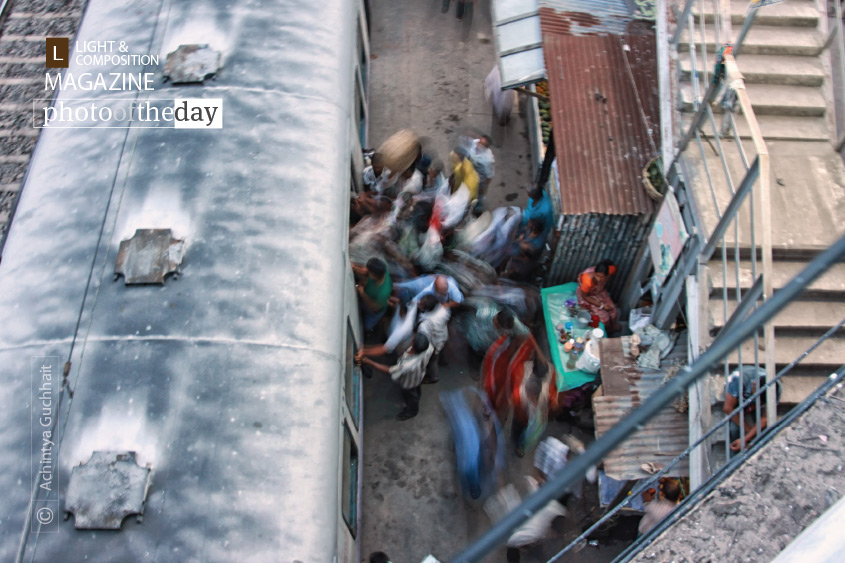
Captured at a bustling station in Madhyamgram, this image freezes the fleeting, rhythmic chaos of a train about to depart. By utilizing a long exposure, the photographer masterfully contrasts the stillness of the platform with the blurred, kinetic energy of commuters moving in and out of the carriage. This creative decision transforms a mundane transit moment into a compelling study of human motion and urban life. The photograph is award-worthy for its technical precision in balancing light and movement, effectively conveying the transient nature of travel and the constant, rhythmic pulse of daily existence in India.
Achintya Guchhait
Based in Bangalore, India, Achintya Kumar Guchhait is a dedicated photographer who balances a professional career in technology with a deep-seated passion for visual storytelling. His work is defined by a keen interest in human coexistence and the candid beauty found in everyday environments. A lifelong student of the craft, he has evolved from early experiments with film to becoming a Getty contributor, constantly refining his technical approach while traveling to document the authentic rhythms of life. His portfolio reflects a versatile eye, spanning street photography, portraiture, and event documentation.
Resonance Score Breakdown
Transparency Note: The resonance score (13.6/20) is calculated based on social engagement metrics collected before the award announcement.
Expert Photography Reviews · 5
The Rhythm of Passing
We are always in a state of transition, caught in the gentle friction between where we have been and where we are going. Life is rarely a static portrait; it is a river of arrivals and departures, a constant folding of one moment into the next.
Read the reflection →The Rhythm of Passing Through
I missed my train this morning. I was standing on the platform, fumbling with my bag, when the doors hissed shut and the world simply pulled away from me. For a second, I felt a sharp sting of frustration.
Read the reflection →Reviews & Comments
Share your thoughts about this award-winning photograph. Your reviews contribute to the community engagement score.
We stand on this Madhyamgram platform, watching the blur of lives rushing toward somewhere else. Achintya didn’t just capture motion; he listened to the frantic rhythm of the commute. The stillness of the platform against that kinetic smear of commuters feels like a heartbeat skipping. It’s haunting, really. I find myself holding my breath, waiting for the train to finally leave. It’s a portrait of our collective transience, and it’s a photograph that asks to be returned to.
The frame’s geometry relies on the train’s rigid horizontal axis to anchor the chaotic blur of commuters. It’s a precarious balance. The 19mm focal length stretches the platform, forcing a tension between the static architecture and the kinetic smear of motion. I’m genuinely unsettled by how the composition refuses to resolve the human figures into anything but ghosts. It doesn’t offer comfort, yet the structural discipline holds the frame together against the encroaching visual noise.
The frame vibrates. It’s a one-second exposure that captures the frantic, rhythmic pulse of Madhyamgram. The train is a ghost, a blur of kinetic energy bleeding into the static platform. I love the way the commuters anchor the chaos; they’re the only things that don’t dissolve. It’s a perfect cut that never happened. The shutter speed was a gamble, but it paid off. This is the frame the editor keeps to ground the entire sequence.
The platform holds its breath. A blur of commuters dissolves into the architecture of the station. It’s a rush of ghosts against the static concrete. I’ve spent minutes watching the stillness of the platform edge. It doesn’t compete with the motion. It anchors it. Nothing here is accidental. The empty corner is not empty. It’s a quiet exhale. I feel a sudden, sharp ache for the train that has already left. It’s beautiful.
1sec at f/9, ISO 400, 19mm. A calculated gamble. The aperture choice forces a shutter speed that barely captures the kinetic blur of the crowd. It’s a tightrope walk. Most would’ve blown the highlights, but the exposure holds. I’ve seen enough motion blur to know when it’s lazy, yet this feels deliberate. It’s technically sound, even if the 500D’s sensor struggles with the dynamic range. I’m actually impressed by the restraint shown here. It works.