Sisters on the Shore by Sean Lowcay
Inspired by a long-held dream born from a childhood poster, Sean Lowcay captured these iconic long-tail boats on the shores of Koh Phi Phi. The photograph serves as a personal milestone, transforming a decades-old vision of warmth and escapism into a tangible reality. By focusing on the rhythmic lines and vibrant presence of the boats against the coastal backdrop, the photographer creates a serene, evocative scene. The image is award-worthy for its ability to bridge the gap between nostalgic longing and lived experience, rendered with a clean, balanced composition that invites the viewer into a moment of quiet, tropical reflection.
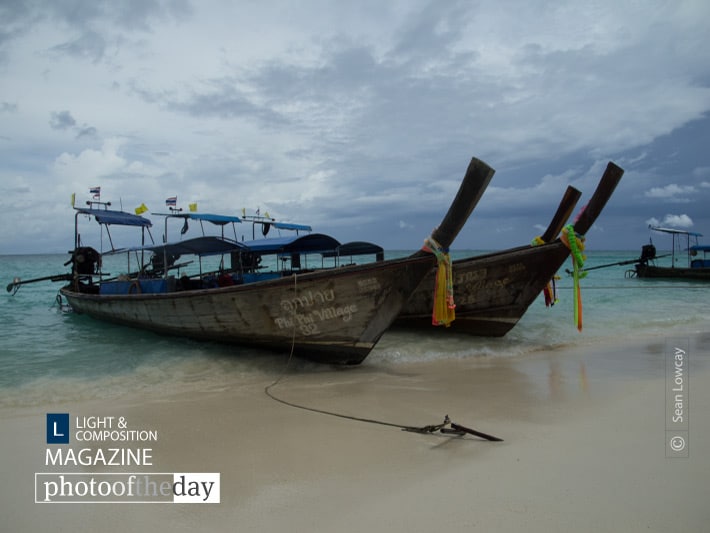
Exposure 1/1000sec @ f/4.4 | ISO 80 | Focal Length 5.2mm
Sean Lowcay
Born and raised in New Zealand, Sean Lowcay relocated to Singapore in 2006, where he has dedicated his lens to capturing the diverse landscapes and cultures of Asia. His photographic journey began in childhood with an Instamatic camera, evolving over the years into a sophisticated practice defined by a dreamy, enigmatic aesthetic. Specializing in street, portrait, and fashion photography, Lowcay draws creative inspiration from classic cinema and the human condition. His work is celebrated for its inherent beauty and mystery, successfully balancing artistic expression with commercial appeal.
Resonance Score Breakdown
Transparency Note: The resonance score (14.0/20) is calculated based on social engagement metrics collected before the award announcement.
Expert Photography Reviews · 8
The Weight of a Long-Held Dream
I remember sitting in a dusty attic in Bristol, staring at a travel brochure pinned to the wall. I was twelve, and the blue of the water in that picture seemed impossible, a shade of teal that didn't exist in my grey, rain-slicked world.
Read the reflection →Salt on the Tongue
The air near the water has a specific weight, a heavy dampness that clings to the skin like a second, invisible layer of linen. I remember the taste of it—the sharp, metallic tang of salt that settles on the lips long before you even reach the tide.
Read the reflection →Reviews & Comments
Share your thoughts about this award-winning photograph. Your reviews contribute to the community engagement score.
1/1000sec at f/4.4, ISO 80, 5.2mm. A wide-angle sensor pushing its limits. The shutter speed is overkill for static boats, yet it freezes the water’s texture with clinical precision. I’ve spent years staring at these sensors; they’re usually noisy, but here, the low ISO keeps the grain at bay. It’s a sharp, calculated capture. I actually find the lack of motion blur refreshing. It’s a cold, precise execution of a warm, nostalgic dream. Correct choices.
The frame breathes. Those long-tail boats aren’t just anchored; they’re waiting for a cue that never comes. It’s a wide shot, a master establishing the rhythm of the tide. I’ve spent years chasing this kind of stillness. The composition holds the horizon with a steady hand, refusing to cut away. It’s a quiet, tropical exhale. Honestly, looking at it makes me want to pack my gear and just disappear into that blue. It’s perfect.
The turquoise of these Thai shallows, a shade reminiscent of Vermeer’s most luminous lapis lazuli, vibrates against the sun-bleached, ochre-stained hulls of the long-tail boats, creating a chromatic tension that feels almost tactile. It’s a sensory feast that makes my heart ache for the salt-heavy air of the Andaman. One finds here a Morandi-esque stillness, where the saturated pigments don’t merely decorate the shore but define the very soul of this tropical, sun-drenched, and deeply nostalgic dream.
Most travel photography is just visual noise, but this holds up. Of the thousands of boat shots I’ve reviewed, this succeeds because the rhythmic, diagonal tension of the hulls anchors the frame against the vast, indifferent tide. It’s not just a postcard; it’s a quiet, geometric ache. I’ll admit, looking at those weathered bows makes me want to drop everything and leave. It’s a rare, honest capture of a dream that actually survived the journey.
The tide recedes. Two boats rest on the sand. They don’t crowd the frame. Instead, they anchor the vastness of the shore. I’ve spent minutes watching the light hit the wood. It’s quiet here. The space between the hulls isn’t just distance; it’s a breath. Nothing here is accidental. The empty corner isn’t empty. It’s a pause. I feel a sudden, sharp ache for that stillness. It’s a rare, honest kind of silence.
The long-tail boats anchor the frame, establishing a rigid geometric rhythm against the horizon’s soft recession. It’s a disciplined arrangement of mass. The diagonal prows slice the picture plane, creating a spatial tension that prevents the scene from dissolving into mere tropical sentiment. I’m genuinely irritated by the distracting clutter at the periphery, yet the central alignment holds. It’s a precise, structural success that doesn’t rely on the photographer’s nostalgia to justify its existence.
Before the eye identifies the long-tail boats, something in the chest softens. It’s the stillness of the tide, that rhythmic pull against the hull. I feel a phantom warmth on my skin, a sudden, quiet ache for a place I’ve never been. Returning a year later, the blue doesn’t just sit there; it demands a slower breath. It’s a rare, tactile peace that lingers, following me into the dark long after I’ve turned away.
We look at these long-tail boats and we don’t just see wood and water; we see the sisters they carry. Sean waited for the tide to whisper its secrets before he clicked the shutter. It’s a quiet, rhythmic conversation between the shore and the sea. I feel a sudden, sharp ache for the warmth of that sand. It’s a photograph that asks to be returned to, because it’s really a story about finally arriving home.