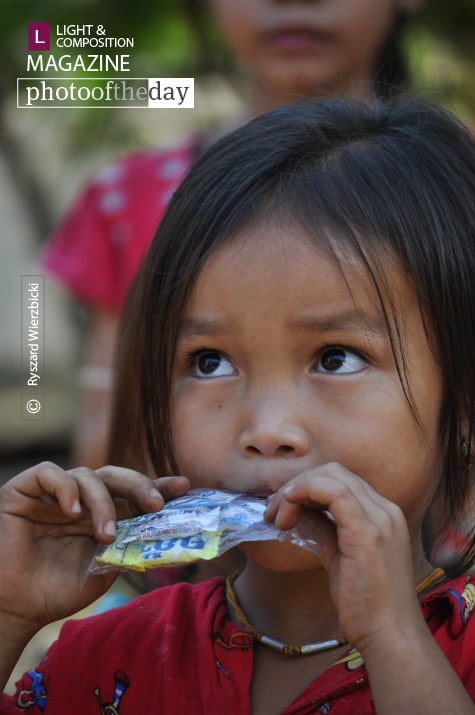
Laotan Girl by Ryszard Wierzbicki
Captured in December 2012 along the Nam Ou river in Nong Khiaw, Laos, this candid portrait emerged from a unique expedition to an otherwise inaccessible village. Seeking to connect with the local community, the photographer arrived by boat, armed with school supplies and sweets that drew a curious crowd of children. The resulting image captures a fleeting, authentic moment of childhood wonder. The photograph is award-worthy for its raw, human connection and the photographer’s ability to bridge cultural divides, turning a simple gesture of kindness into a poignant, beautifully composed visual narrative of life in a remote Laotian landscape.
Ryszard Wierzbicki
Born in 1963 and a graduate of the University of Gdańsk, Ryszard Wierzbicki transitioned from a career in social sciences and marketing to a life defined by global exploration. Since emigrating to the United Kingdom in 2006, he has dedicated his time to travel photography and volunteering with organizations supporting orphans in South-East Asia. As a PADI scuba instructor and a passionate documentarian of remote cultures, Wierzbicki balances his professional life as a marketing advisor with his commitment to capturing the human spirit through his lens.
Resonance Score Breakdown
Transparency Note: The resonance score (14.2/20) is calculated based on social engagement metrics collected before the award announcement.
Expert Photography Reviews · 6
The Quiet Language of Wonder
I spent this morning trying to fix a broken shelf in the hallway. My hands were covered in dust, and I was getting frustrated because the screws wouldn't catch. Then, my neighbor’s young daughter walked by and stopped to watch.
Read the reflection →The Quiet Bloom of Wonder
There is a particular kind of stillness that belongs only to the very young. It is not an absence of movement, but a state of total presence, where the world is encountered without the weight of expectation.
Read the reflection →Reviews & Comments
Share your thoughts about this award-winning photograph. Your reviews contribute to the community engagement score.
1/250sec at f/5, 135mm. It’s a tight compression that isolates the subject from the riverbank clutter. The shutter speed is adequate, but f/5 at 135mm leaves the depth of field razor-thin. It’s risky. Focus is sharp on the eyes, which is the only thing that saves this shot from being a blurry mess. I’ve seen enough soft portraits to appreciate the precision here. The technical discipline actually holds the narrative together. It’s a rare, clean execution.
We look at her, and we see the Nam Ou river reflected in a gaze that hasn’t yet learned to hide. Ryszard didn’t just point his lens; he brought gifts and sat in the dust until the girl forgot he was a stranger. It’s that quiet patience that catches the light in her eyes. I’ve stared at this for an hour, and honestly, it makes my own heart ache for a world that still feels this honest.
Before the eye identifies the girl, something in the chest tightens. It’s that sudden, sharp recognition of unburdened curiosity. I’ve looked at this portrait a dozen times, and each return feels like a quiet collision with my own forgotten childhood. The way she holds that gaze—it doesn’t just ask for attention; it demands a pulse. When I close my eyes, her face lingers, a soft, persistent ache that reminds me how easily we lose our wonder.
The river bank recedes. It leaves her alone in the frame. I’ve spent minutes watching her eyes. They don’t look for the camera. They look for the space beyond it. It’s quiet here. The blurred reeds behind her aren’t just background. They are the breath between heartbeats. I feel a sudden, sharp ache for that stillness. Nothing here is accidental. The empty corner is not empty. It’s where the silence lives.
The shutter clicks, and the Nam Ou river freezes. It’s a perfect long take. That 135mm compression pulls the girl from the background, isolating her wonder like a lead actress in a tight close-up. I’ve seen a thousand candid shots, but this one holds. The focus is sharp, the rhythm is quiet, and honestly, it makes me miss the simplicity of a single, honest frame. The cut would’ve been a mistake; she’s exactly where she belongs.
Shadows here don’t merely frame the girl; they swallow the periphery, forcing us to confront the fragility of her gaze. It’s a quiet, heavy isolation. I’ve stared at the way the darkness clings to her features, and it honestly unsettles me—it’s as if the light she’s bathed in is already receding. Wierzbicki hasn’t just captured a child; he’s captured the encroaching silence of a world that doesn’t care to be seen. It’s hauntingly, brutally honest.