Halong Bay by Ryszard Wierzbicki
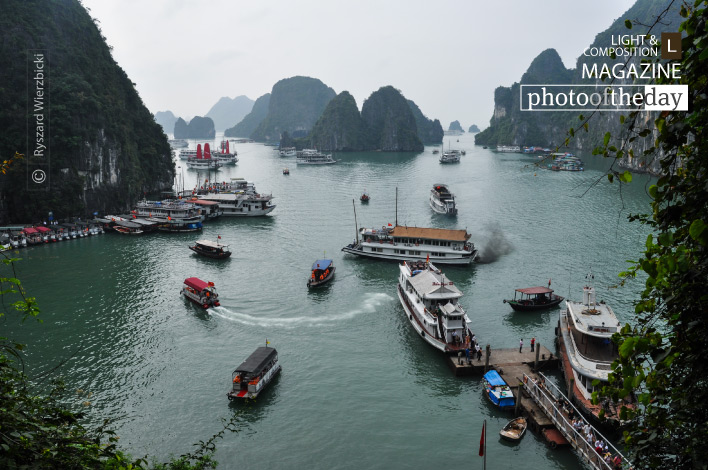
Captured in April 2014, this photograph immortalizes the ethereal beauty of Halong Bay, Vietnam. The photographer, drawn to the site’s status as a natural wonder, composed the shot from the unique vantage point of a cave entrance on one of the bay's islands. By framing the iconic limestone karsts through this natural aperture, the image emphasizes the scale and serenity of the landscape. The composition is award-worthy for its masterful use of framing and depth, turning a romantic travel moment into a timeless, atmospheric study of one of the world's most breathtaking maritime vistas.
Ryszard Wierzbicki
Born in 1963 and a graduate of the University of Gdańsk, Ryszard Wierzbicki transitioned from a career in social sciences and marketing to become a dedicated traveler and photographer after relocating to the United Kingdom in 2006. Now based in Swindon, he balances his professional life as a marketing advisor with a deep passion for exploring South-East Asia, where he actively volunteers with orphanages. Through his established travel forums and his work as a tour organizer, Wierzbicki documents his global adventures, blending his technical expertise in photography with a profound commitment to humanitarian causes.
Resonance Score Breakdown
Transparency Note: The resonance score (13.6/20) is calculated based on social engagement metrics collected before the award announcement.
Expert Photography Reviews · 8
The Threshold of Silence
I remember sitting in a small, damp grotto off the coast of a different island, watching the tide pull away from the shore. My guide, a man named Nguyen, didn't say a word for nearly an hour.
Read the reflection →The Threshold of Silence
We spend our lives building walls, brick by heavy brick, convinced that the boundary is where the world ends. We forget that a wall is also a frame, a way of narrowing the infinite so that we might finally see it.
Read the reflection →Reviews & Comments
Share your thoughts about this award-winning photograph. Your reviews contribute to the community engagement score.
The aperture of the cave acts as a lens flare of stone, pulling the eye into the deep, emerald silence of the bay. It’s a tracking shot that stops dead. I’ve spent hours watching the light shift on these karsts, but here, the stillness is heavy. The framing creates a claustrophobic tension that makes the open water feel like a sudden, breathless release. It’s the frame the editor keeps because the cut would have been a mistake.
The limestone karsts emerge from the mist in a muted, bruised celadon, echoing the quiet, dusty stillness of a Morandi study. It’s the way the light bleeds through the cave’s jagged aperture, dissolving into the pale, milky turquoise of the bay, that truly steals my breath. One feels the humidity clinging to the lens, a soft, atmospheric weight that turns the horizon into a dream of water and stone, suspended in eternal, liquid grace.
At f/13, the Nikon’s sensor pushes toward the diffraction limit, yet the limestone textures remain remarkably crisp. The cave’s dark aperture creates a high-contrast transition that tests the lens’s micro-contrast capabilities. I’m genuinely moved by how the light bleeds across those jagged edges; it’s a delicate dance of photons that the human eye simply can’t resolve in such stillness. It’s not just a view; it’s a precise calibration of atmosphere and optical physics. Truly haunting.
Before the eye identifies the limestone karsts, something in the chest tightens. The cave’s dark, jagged aperture acts as a physical constraint, forcing a held-breath moment before the expanse of the bay opens up. I’ve felt that sudden, cool relief in my own lungs. It’s a quiet, claustrophobic ache that lingers. When I return to this, the shadows feel heavier, like a memory of a place I’ve never actually been, but somehow recognize.
We stand in the cool dark of the cave, looking out at the limestone giants. Wierzbicki didn’t just capture a view; he waited for the silence between the stone and the sea. It’s a portrait of a landscape that has been listening for centuries. I feel a sudden, quiet ache in my chest looking at those jagged silhouettes. We aren’t just tourists here; we’re guests in a conversation that started long before we arrived. It’s hauntingly beautiful.
Framing through a cave aperture is a tired trope, yet here it works. One suspects Wierzbicki didn’t just stumble upon this vantage point during a casual cruise. He’s clearly spent hours in the damp, waiting for the mist to settle just so against those karsts. I’ve shivered in enough limestone grottos to recognize the commitment required. It’s a quiet, earned perspective. He didn’t just take the shot; he sat with the bay until it yielded.
The aperture of the cave creates a rigid, dark frame that forces the eye toward the limestone karsts. It’s a classic framing device, yet the spatial tension holds. The jagged silhouette of the foreground rock provides necessary weight against the atmospheric haze. It doesn’t rely on sentiment. I’ve grown tired of travel tropes, but the geometric discipline here is undeniable. The composition demands attention because the negative space actually functions. It’s a rare, structural success.
The cool, damp stone of the cave mouth frames the bay, pulling my eyes toward the distant, hazy karsts. Ryszard stood here in the quiet, waiting for the light to soften against the water. It’s a patient gaze. I feel a sudden, sharp ache in my chest remembering the stillness of such places. He didn’t rush the shutter; he listened to the silence of the limestone, letting the atmosphere settle into the frame before he finally let go.