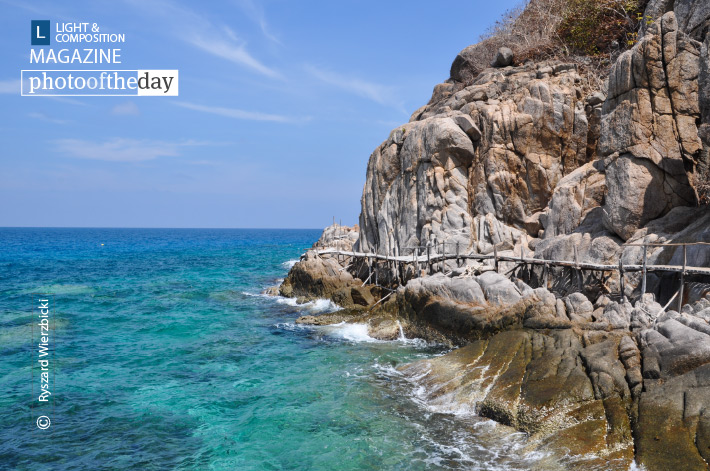
Rocky Shore by Ryszard Wierzbicki
Captured from the rugged heights of a smaller island, this photograph showcases the unique geography of Nangyuan Island, Thailand, where two rocky landmasses are linked by a pristine sandy path. The photographer carefully navigated the climb to secure a panoramic vantage point, highlighting the interplay between the dramatic stone formations and the turquoise bay below. This image is award-worthy for its masterful composition and the clarity with which it captures the island's distinctive topography, offering viewers a breathtaking perspective of this secluded tropical paradise.
Ryszard Wierzbicki
Born in 1963 and a graduate of the University of Gdańsk, Ryszard Wierzbicki transitioned from a diverse career in education and marketing to become a dedicated traveler and photographer after relocating to the United Kingdom in 2006. His work is deeply influenced by his extensive travels through South-East Asia and his commitment to charitable causes, including his volunteer work with Thai and Burmese orphans. Currently based in Swindon, he balances his professional life as a marketing advisor and tour organizer with a profound passion for photography and scuba diving.
Resonance Score Breakdown
Transparency Note: The resonance score (13.8/20) is calculated based on social engagement metrics collected before the award announcement.
Expert Photography Reviews · 3
The Bridge We Cannot Walk
Why do we feel a sudden ache when we see two things pulled together, yet kept apart by the very element that defines them?
Read the reflection →The Architecture of Distance
In the early days of cartography, mapmakers often filled the empty spaces of the ocean with drawings of sea monsters or intricate, swirling compass roses. They were not merely decorating; they were admitting that there is a profound discomfort in the unknown.
Read the reflection →Reviews & Comments
Share your thoughts about this award-winning photograph. Your reviews contribute to the community engagement score.
Most landscape entries this year felt like postcards, but Wierzbicki’s shot of Nangyuan actually holds weight. The way the jagged foreground rock frames that impossibly thin sandbar forces the eye to navigate the geography rather than just glance at it. It’s the tension between the sharp, dark stone and the soft, turquoise water that makes me want to be there. I’d bet in thirty years, this specific vantage point will feel like a lost, quiet dream.
The jagged stone of Nangyuan doesn’t merely sit; it anchors the frame against the encroaching turquoise. I find myself shivering at the sheer indifference of that rock. It’s a brutal, silent geometry. Wierzbicki has allowed the shadows to swallow the details of the cliffside, and it’s there, in that obsidian void, that the island truly breathes. It doesn’t invite us to visit. It demands we acknowledge the weight of the earth beneath our fragile, fleeting gaze.
The diagonal thrust of the sandbar creates a necessary fulcrum, anchoring the disparate rocky masses. It’s a rigid geometry that prevents the frame from collapsing into mere tropical cliché. The spatial tension between the foreground stone and the distant peak is precise. I’m genuinely unsettled by how the turquoise water threatens to overwhelm the structural integrity of the composition. It doesn’t quite lose its balance, but it’s a precarious, calculated gamble that barely holds.