Hide and Seek by Nilla Palmer
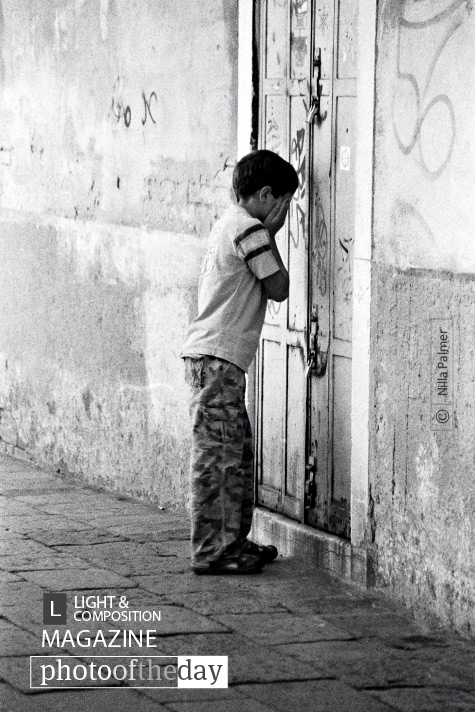
In the labyrinthine alleyways of Venice, Nilla Palmer captures a timeless moment of childhood innocence as a group of boys engages in a game of hide and seek. Set against the backdrop of ancient, weathered architecture, the scene highlights the enduring nature of friendship. By utilizing the classic aesthetic of Ilford FP4 black-and-white film, the photographer strips away modern distractions, focusing instead on the raw, candid interaction between the subjects. This image is award-worthy for its masterful composition and its ability to transform a fleeting, everyday activity into a poignant, cinematic narrative of human connection.
Nilla Palmer
Based in Brisbane, Australia, Nilla Palmer is a dedicated freelance photographer whose work spans over two decades and five continents. Specializing in candid, street, and documentary photography, she expertly navigates between digital and film mediums to capture raw, authentic representations of reality. Her objective is to document life’s truths without artificial intervention, resulting in evocative imagery that often challenges the viewer's perspective on the world around them.
Resonance Score Breakdown
Transparency Note: The resonance score (12.0/20) is calculated based on social engagement metrics collected before the award announcement.
Expert Photography Reviews · 4
The Rough Grain of Memory
The smell of damp stone always brings me back to the feeling of moss against my palms. It is a cold, velvet friction, a secret kept by the walls that have stood long enough to forget the sun.
Read the reflection →The Echo of Footsteps
I remember a narrow passage in a city built on water where the walls seemed to lean in, whispering secrets of centuries past. I was ten, chasing a friend named Marco through the damp, salt-crusted stone corridors.
Read the reflection →Reviews & Comments
Share your thoughts about this award-winning photograph. Your reviews contribute to the community engagement score.
Before the eye identifies the boys in the Venetian alley, something in the chest tightens. It’s the sudden, sharp recognition of a forgotten game. The grain of the film mimics the grit of those ancient walls, pulling me into the shadows where they’re hiding. I’ve felt that exact, breathless anticipation—the fear of being found. A year later, I still return to this frame, feeling the damp chill of the stone against my own skin.
Venice is a graveyard of cliché, yet here, the boys’ frantic posture against the crumbling stone avoids the usual tourist trap. I’ve seen thousands of street shots, but this one sticks because the tension isn’t in the architecture; it’s in the boy’s hunched shoulder, bracing for discovery. It makes me ache for my own lost afternoons. It’s not just a game; it’s the quiet, desperate urgency of childhood that will still matter in thirty years.
The frame’s geometry is tight, anchored by the vertical thrust of the Venetian masonry. It’s a rigid architecture that forces the eye toward the central convergence. The negative space doesn’t merely exist; it dictates the subjects’ isolation. I’ve rarely seen such precise spatial tension in a candid frame. The boys’ placement creates a fulcrum that balances the heavy, weathered textures. It’s cold, calculated, and frankly, it’s the only way to photograph a city this chaotic.
Minolta X300, 210mm, ISO 125. Compression is the only way to flatten Venice’s chaotic geometry. You’ve isolated the boys against the stone, forcing the architecture to frame the action rather than swallow it. It’s a sharp, disciplined choice. I’ve spent years loathing the soft focus of street candid shots, but this works. The film grain doesn’t hide the precision here. It’s technically sound. Honestly, the focus on the boy’s posture actually made me stop and look.
Thank you for the comment and all the shares; much appreciated!
Another superbly captured image from Nilla.