The Royal Look by Subhashish Nag Choudhury
Captured during a tiger safari at Bannerghata National Park, this striking portrait of the Bengal tiger known as Lakshman showcases the raw majesty of India’s wildlife. The photographer utilized a 163mm focal length to isolate the subject, drawing the viewer into an intimate encounter with the animal's intense gaze. By balancing the technical demands of wildlife photography with a keen eye for the tiger's regal posture, the image captures a fleeting, powerful moment in the wild. This photograph is award-worthy for its exceptional composition and the profound connection it establishes between the viewer and the subject, highlighting the beauty of nature through a disciplined, artistic lens.
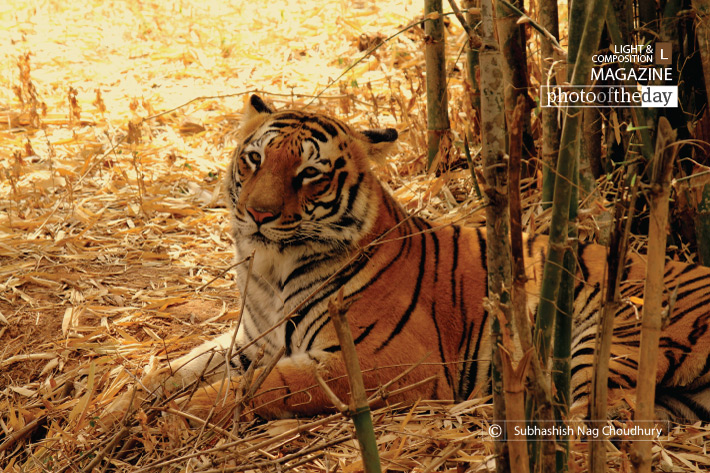
Subhashish Nag Choudhury
Based in Kolkata, India, Subhashish Nag Choudhury balances a professional career in information technology with a deep-seated passion for the visual arts. His photographic journey is defined by a versatile approach, encompassing nature, wildlife, landscape, and macro photography, alongside experimental artistic projects. Driven by a desire to explore the world and capture the unique moments he witnesses, he views photography as a perfect synthesis of technical precision and creative expression. His work consistently seeks to document the world through a personal, observant lens.
Resonance Score Breakdown
Transparency Note: The resonance score (11.6/20) is calculated based on social engagement metrics collected before the award announcement.
Expert Photography Reviews · 6
The Weight of the Gaze
Can we ever truly look at another being without imposing our own history upon them? We often mistake the act of observing for the act of understanding, as if by naming a creature or cataloging its features, we have somehow mastered its essence.
Read the reflection →The Weight of a Gaze
I was walking through the park this morning when a stray cat stopped dead in its tracks. It didn't run or hide. It just sat there, staring right through me with such an intense, unblinking focus that I felt like I had to apologize for being in its path.
Read the reflection →Reviews & Comments
Share your thoughts about this award-winning photograph. Your reviews contribute to the community engagement score.
The tiger’s gaze holds a weight that only comes from hours of stillness. He stood here in the cooling hour, waiting for the light to soften against that golden fur. It’s not just a portrait; it’s a quiet conversation between predator and observer. I’ve felt that same shiver when the wild finally decides to reveal itself. The f/10 aperture keeps the focus sharp, yet it’s the tiger’s regal, unhurried presence that truly commands the frame.
Most wildlife portraits are just trophies, but Lakshman’s gaze here feels heavy with a history I can’t quite name. I’ve seen thousands of tigers, yet the way the light catches his whiskers against that muted, blurred forest floor forces a pause. It’s the stillness that wins it for me. It’s not just a cat; it’s a presence that’ll still command a room in thirty years. I’d hang this in my own home without hesitation.
The gaze holds the frame. It’s heavy. Lakshman doesn’t look at the lens; he looks through it. The surrounding foliage retreats into shadow. I’ve never felt so small in a gallery. The tiger’s stillness creates a vacuum. It pulls the air from the room. Nothing here is accidental. The empty corner is not empty. It’s a pause. A breath. The silence between the stripes is where the power lives. It’s enough.
Lakshman’s gaze doesn’t invite; it interrogates. In the heavy, suffocating darkness flanking his face, I feel the tiger’s ancient, predatory patience. It’s not merely a portrait, but a confrontation with the void. Most wildlife photography is too bright, too eager to please, but here, the shadows hold the weight of the jungle’s silence. I’ve stared into those eyes for an hour, and I’m still unsettled by how much of the beast remains hidden in the black.
At f/10, the diffraction limit hasn’t yet softened the tiger’s whiskers, allowing the sensor to resolve textures the naked eye would miss. The focal plane is razor-thin, isolating that piercing gaze with clinical precision. I’m genuinely moved by how the light catches the iris; it’s a visceral, optical intimacy. While the 163mm compression flattens the depth, it’s the sheer clarity of the fur’s micro-contrast that makes this portrait feel like a physical encounter with the wild.
The tiger’s gaze locks the picture plane, anchoring the frame with brutal efficiency. It’s a study in geometric containment. The vertical alignment of the whiskers against the blurred foliage creates a necessary spatial tension, preventing the subject from collapsing into mere sentiment. I’ve rarely seen such rigid control in a wildlife portrait. The composition doesn’t just hold; it commands. It’s a cold, calculated triumph of structure over the chaos of the natural world.