The Lens of Authenticity by Zahraa Al Hassani
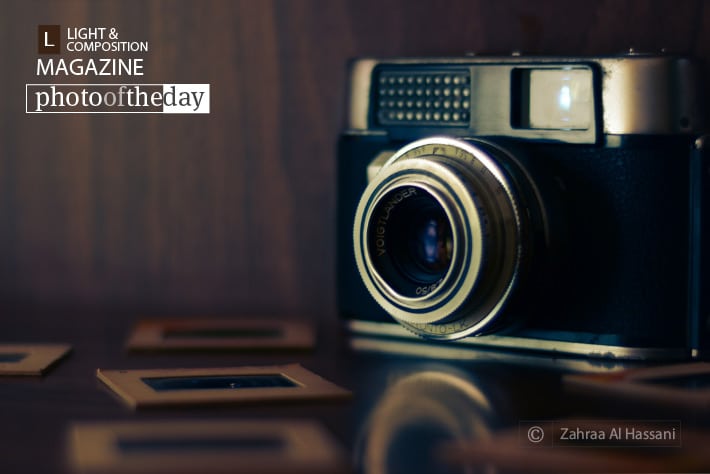
In this evocative still life, the photographer turns her lens toward her personal collection of vintage cameras and photographic antiques. By isolating a single analog piece from her treasured hoard, she captures the tactile beauty and historical weight of the equipment that defines her craft. The composition utilizes a shallow depth of field to draw the viewer into the intricate details of the camera, emphasizing the authenticity of the mechanical form. This image stands as an award-worthy testament to the photographer's deep reverence for the tools of her trade and her ability to find profound beauty in the quiet, static objects of her daily life.
Zara Otaifah
Based in Baghdad, Iraq, Zahraa Al Hassani balances a successful career as a senior graphic designer at Zain Telecommunications with a dedicated pursuit of fine art photography. A graduate of the University of Technology in Baghdad, she leverages her extensive design background to refine her photographic perspective, often using her images to enhance visual communication projects. Her work is deeply influenced by her fascination with vintage equipment and a commitment to acquiring knowledge from the traditions of purist photography.
Resonance Score Breakdown
Transparency Note: The resonance score (13.0/20) is calculated based on social engagement metrics collected before the award announcement.
Expert Photography Reviews · 3
The Weight of Memory
We keep things. Not because they are useful, but because they hold the shape of a time that has already slipped away. A heavy metal casing, a glass eye that once saw what we no longer can.
Read the reflection →The Weight of Memory
I remember sitting in my grandfather’s study, surrounded by heavy, leather-bound books and the faint, metallic scent of old machinery. He had a collection of brass compasses and fountain pens that he never actually used, yet he polished them every Sunday morning.
Read the reflection →Reviews & Comments
Share your thoughts about this award-winning photograph. Your reviews contribute to the community engagement score.
The shallow depth of field isolates the lens, yet the composition lacks a definitive fulcrum. It’s a precarious balance. The negative space doesn’t anchor the mechanical mass; it merely drifts. I’ve grown tired of this soft-focus reliance, as it obscures the structural integrity of the frame. While the texture of the metal holds a certain cold authority, the arrangement feels unresolved. It’s technically competent, but the frame doesn’t quite hold the weight of its own ambition.
Shadow isn’t merely the absence of light here; it’s the mechanical soul retreating into the dark. Al Hassani’s lens doesn’t just document; it mourns the tactile weight of an era slipping away. I’ve stared at these gears, and honestly, the encroaching blackness makes my chest tighten. It’s a quiet, heavy resistance against the digital void. When the aperture narrows, the shadow doesn’t hide the camera—it forces us to confront the silence of a dying machine.
The light here doesn’t just fall; it lingers, tracing the cold metal of a forgotten shutter. She stood in the quiet of a Baghdad afternoon, listening to the silence these relics hold. I’ve felt that same ache, that heavy stillness when the world stops moving. It’s not just a camera; it’s a vessel for ghosts. Looking at this, I feel a sudden, sharp longing for the slow, deliberate weight of film. It’s a beautiful, patient prayer.