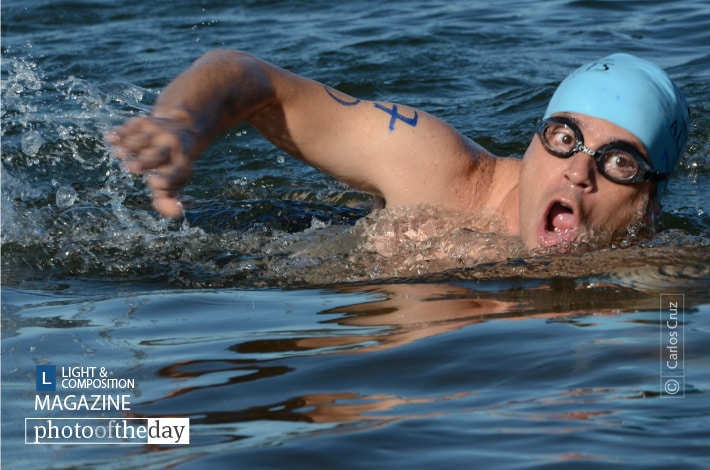
Freestyle Breathing by Carlos Cruz
Captured during a triathlon in Nova Lima, Brazil, this striking image of freestyle breathing showcases the intensity of athletic performance. To achieve the perfect perspective, the photographer waded into the lagoon, submerging half of their body to capture the athlete at the precise moment of rotation for a breath. This immersive approach allows the viewer to experience the race from within the water, highlighting the raw physical effort and fluid motion of the swimmer. The technical precision and the unique, low-angle vantage point elevate this shot, transforming a standard sporting event into a compelling study of human endurance.
Carlos Cruz
Based in Belo Horizonte, Brazil, Carlos Cruz developed his photographic foundation through a deep fascination with adventure sports, including surfing, mountain biking, and triathlon racing. His work is defined by a commitment to constant innovation and a desire to capture the vibrant energy of athletes in motion. While he has transitioned his primary professional focus toward fashion photography and portraiture, his portfolio remains a testament to his ability to blend technical precision with the dynamic spirit of his subjects.
Resonance Score Breakdown
Transparency Note: The resonance score (11.3/20) is calculated based on social engagement metrics collected before the award announcement.
Expert Photography Reviews · 6
The Surface of Things
We spend our lives navigating the air, a medium so thin we forget it exists until the wind pushes against us. But water is different. It is a weight, a resistance, a constant reminder that we are held by something other than gravity.
Read the reflection →The Rhythm of the Surface
I remember swimming in the lake behind my grandfather’s house in July. The water was always darker than you expected, thick with silt and the memory of rain. You learn quickly that you cannot fight the water; you have to negotiate with it.
Read the reflection →Reviews & Comments
Share your thoughts about this award-winning photograph. Your reviews contribute to the community engagement score.
Most sports photography is disposable, but I’d keep this. Of the thousands of race shots I’ve reviewed, few capture the claustrophobia of the water like this. By submerging, Cruz turns a routine triathlon into a visceral struggle for oxygen. It’s the water’s surface tension, slicing across the athlete’s face, that makes me hold my breath too. It’s not just a race; it’s the raw, ugly, necessary act of survival that will still resonate in thirty years.
Wading into a lagoon to catch a swimmer’s breath is a messy business, but it’s the only way to get the perspective right. Most would have stayed dry on the bank, hoping for a lucky frame. Cruz didn’t. He committed to the water, shivering for the sake of a decent angle. I’ve spent enough hours in freezing currents to respect that level of discomfort. It’s a proper bit of work, earned in the silt.
The water doesn’t just surround the swimmer. It holds them. I’ve waded into lagoons before, and I know that cold, heavy silence. The rotation is a sharp break in the surface. It’s a rupture. Nothing here is accidental. The empty corner is not empty. It’s the weight of the lake. I feel my own breath catch, watching that single, desperate inhale. It’s quiet. It’s enough. The rest of the world has simply ceased to exist.
At f/16, the diffraction limit begins to soften the micro-contrast, yet here, it’s a deliberate choice. By placing the focal plane precisely on the water’s surface tension, Cruz captures the meniscus breaking against the swimmer’s jaw. It’s a gorgeous, tactile rendering of fluid dynamics. I’m genuinely moved by how the light refracts through those droplets; it’s a perspective the human eye simply can’t resolve in real-time. It’s not just a race; it’s pure, suspended physics.
The water tension breaks. It’s a violent, rhythmic inhale, caught at the exact frame where the athlete’s rotation hits peak velocity. I’ve spent years watching swimmers, but this low-angle perspective makes me hold my own breath. Cruz didn’t just document a race; he submerged the lens to find the edit point. It’s raw, kinetic, and perfectly timed. The cut would’ve been a mistake. This is the frame the editor keeps to define the entire sequence.
1/320sec at f/16, 200mm. Stopping down to f/16 on a D7000 invites diffraction, yet it’s the only way to hold focus at that focal length while wading. It’s a calculated risk that pays off. The shutter speed is just enough to freeze the water droplets without losing the kinetic energy of the stroke. I’ve spent hours in the water with a camera; it’s miserable work. Cruz’s technical discipline here is frankly impressive. He nailed the exposure.