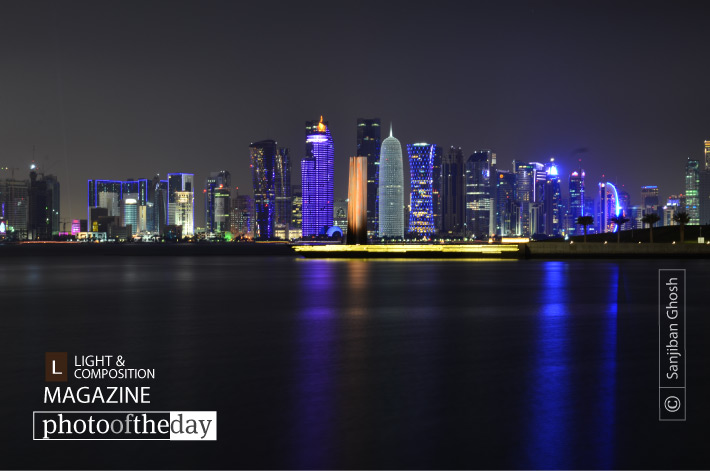
City Lights by Sanjiban Ghosh
Captured from the serene park adjacent to the Museum of Islamic Arts in Doha, this photograph masterfully frames the vibrant downtown skyline. By utilizing a long 30-second exposure at f/16, the photographer transformed the city lights into a brilliant tapestry reflecting across the calm waters of the bay. This deliberate technical choice emphasizes the architectural grandeur and rhythmic pulse of the urban landscape. The image is award-worthy for its impeccable balance of light and composition, turning a familiar metropolitan view into a sophisticated, painterly study of nocturnal elegance and structural harmony.
Sanjiban Ghosh
Based in Doha, Qatar, Sanjiban Ghosh is an engineer who balances his professional career with a dedicated passion for photography. His work focuses primarily on architecture, night scenes, travel, and landscapes, driven by a desire to document the cultural beauty of the world. A self-taught artist, Ghosh transitioned from point-and-shoot beginnings to mastering DSLR equipment, consistently refining his technical skills to share the wonderful events and environments he encounters with a global audience.
Resonance Score Breakdown
Transparency Note: The resonance score (14.1/20) is calculated based on social engagement metrics collected before the award announcement.
Expert Photography Reviews · 8
The Pulse of Stillness
We often mistake the city for a place of noise, a frantic collection of lives rushing toward tomorrow. But when the sun retreats and the shadows lengthen, the stone and steel begin to breathe in a different rhythm.
Read the reflection →The Architecture of Echoes
Night is a mirror that forgets the day. When the sun retreats, the world sheds its skin of color and noise, leaving behind only the skeletons of our ambition. We build these towers of glass and steel, reaching for a sky that does not know our names, yet in the dark, they soften.
Read the reflection →Reviews & Comments
Share your thoughts about this award-winning photograph. Your reviews contribute to the community engagement score.
Thirty seconds at f/16 suggests a photographer who didn’t mind the humidity or the mosquitoes near the Museum of Islamic Arts. It’s a clean, deliberate exposure. One suspects the water didn’t settle quite this perfectly on the first attempt; it rarely does. I’ve spent enough nights shivering in the dark to appreciate the discipline here. It’s a quiet, earned frame. Ghosh clearly waited for the city to stop breathing. It’s a respectable bit of work.
At f/16, the diffraction limit begins to soften the fine architectural edges, yet it’s exactly what creates those crisp, starburst light-diffraction patterns across the Doha skyline. The 30-second exposure effectively integrates the water’s surface, turning turbulence into a perfect, low-pass filter. I’m genuinely moved by how the sensor captures these photons; it’s a clinical, beautiful collision of physics and urban geometry. It doesn’t just record the city—it resolves the light into a singular, luminous pulse.
The ink-black void of the Doha bay dissolves into a liquid, electric violet, reminiscent of Turner’s most feverish maritime studies, where the city’s luminescence bleeds into the water like spilled oil. It’s a chromatic seduction that catches one’s breath; I’ve rarely seen such a velvety, bruised indigo anchor a skyline. The light doesn’t merely sit upon the surface, it hums with a quiet, Morandi-esque restraint that makes the entire frame feel impossibly, hauntingly alive.
We look at these lights and we don’t just see a skyline; we see the pulse of a city that hasn’t slept. Sanjiban Ghosh let the water hold the secret of Doha for thirty seconds, and it’s quiet, isn’t it? It feels like a conversation held in the dark. I find myself leaning in, searching for the people behind those glowing windows. It’s a portrait of a place that’s waiting for us to listen.
Most night shots of Doha are just postcards, but this one lingers. The thirty-second exposure doesn’t just smooth the water; it turns the bay into a dark, velvet anchor for the chaos above. I’ve seen thousands of skyline shots, yet the way the light bleeds into the ripples here feels intentional, almost rhythmic. It’s a quiet, sophisticated study of urban ambition. Honestly, looking at it makes me want to sit by that water tonight.
The shutter stays open for thirty seconds, and the city breathes. It’s a long take, a wide shot that refuses to cut away. The water turns to glass, holding the skyline’s pulse in a perfect, static reflection. I’ve stood in that park, and honestly, it makes me miss the quiet hum of Doha at midnight. Ghosh didn’t just snap a view; he directed the light. It’s the frame the editor keeps because the rhythm is flawless.
The water here doesn’t just reflect the skyline; it breathes with it. I’ve spent enough nights by the bay to know the stillness Sanjiban waited for. He stood there for thirty seconds, letting the city’s pulse bleed into the dark, liquid glass. It’s a quiet, meditative surrender to the night. Looking at those long, shimmering ribbons of light, I feel a sudden, sharp ache for the silence that must have draped over Doha while he waited.
30 seconds at f/16, ISO 100, 50mm. Stopping down to f/16 on a D5100 invites diffraction, softening the fine architectural lines of Doha’s skyline. It’s a blunt instrument for a delicate subject. The long exposure flattens the water into a synthetic sheet, stripping away the bay’s actual texture. I’ve seen this exact long-exposure trope a thousand times. It’s technically competent, sure, but it’s sterile. I find myself wishing for a sharper, more honest aperture.