Parenthood by Ryszard Wierzbicki
Captured during an October journey to the Swayambhunath temple in Kathmandu, Nepal, this image documents a poignant moment of wildlife interaction. As the photographer ascended the hill, he encountered the local monkey population, often fed by passing tourists. The shot highlights the natural, maternal instincts of the primates against the backdrop of the sacred site. Through a careful selection of focal length and exposure, the photographer successfully isolated the tender connection between parent and offspring, creating a compelling narrative of parenthood that transcends species. The image is award-worthy for its intimate framing and the raw, authentic emotion captured in a bustling, spiritual environment.
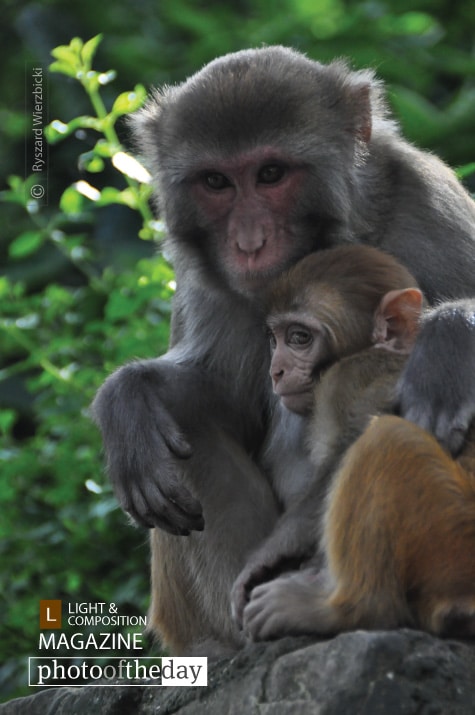
Exposure 1/250sec @ f/6.3 | ISO 1600 | Focal Length 200mm
Ryszard Wierzbicki
Born in 1963 and a graduate of the University of Gdańsk, Ryszard Wierzbicki transitioned from a career in social sciences and marketing to a life defined by exploration and photography. After relocating to the United Kingdom in 2006, he dedicated his time to traveling through South-East Asia, where he frequently volunteers with charitable organizations supporting orphans. Now based in Swindon, he balances his professional life as a marketing advisor and tour organizer with a deep-seated passion for photography and scuba diving, documenting the diverse cultures and wildlife he encounters across the globe.
Resonance Score Breakdown
Transparency Note: The resonance score (13.4/20) is calculated based on social engagement metrics collected before the award announcement.
Expert Photography Reviews · 8
The Architecture of Belonging
We are all born into a tangle of limbs and breath, seeking the warmth that anchors us to the earth. There is a quiet, ancient geometry in the way a life clings to another, a silent pact written in the curve of a spine or the protective arch of a hand.
Read the reflection →The Weight of the Hold
To carry another is to understand the gravity of existence. We are born with a grip, a reflex that says: do not let go. It is the first lesson of the living.
Read the reflection →Reviews & Comments
Share your thoughts about this award-winning photograph. Your reviews contribute to the community engagement score.
The frame’s geometry is compromised by the chaotic background of the Swayambhunath temple. While the maternal focal point holds, the surrounding clutter bleeds into the negative space, diluting the subject’s mass. It’s a missed opportunity for total isolation. I’ve seen enough sentimentality in wildlife photography to last a lifetime, yet the precise alignment of the primate’s gaze against the blurred stone architecture creates a necessary, sharp tension. It doesn’t quite resolve, but it’s nearly there.
The camera breathes. It’s a tight, telephoto cut that isolates the primate’s gaze, turning a bustling temple hill into a quiet, domestic interior. The focus is razor-sharp on the maternal instinct, ignoring the chaos of Swayambhunath entirely. I’ve seen a thousand wildlife shots, but this one hits differently; it’s the stillness of the embrace that gets me. Wierzbicki knew exactly when to hold the shutter. It’s the frame the editor keeps because the story is already finished.
Most wildlife shots from Swayambhunath are cluttered, noisy distractions. What separates this from the thousands I’ve reviewed is the restraint. By isolating the mother’s grip against the blurred temple stone, Wierzbicki forces us to confront the raw, frantic vulnerability of survival. It’s a quiet, aching reminder that love isn’t just a human construct. I’ll admit, the tenderness in that tiny hand makes me catch my breath. In thirty years, this intimacy will still matter.
Before the eye identifies the primate, something in the chest tightens. It’s the raw, frantic grip of the infant against the mother’s fur that triggers a sudden, sharp recognition of vulnerability. I’ve returned to this frame three times today, and each time, the Swayambhunath dust seems to settle in my own throat. It doesn’t matter that they’re monkeys; the weight of that protective hold is a universal ache I feel deep in my own marrow.
1/250sec at f/6.3, ISO 1600, 200mm. The D5000 sensor struggles here. ISO 1600 introduces significant luminance noise, muddying the primate’s fur texture. It’s a compromise. At 200mm, the narrow depth of field isolates the subjects, which is the right call. I’ve spent too long looking at digital grain, but the intimacy of the interaction almost makes me forget the technical shortcomings. It’s a functional capture. The optics didn’t fail the moment, even if the sensor did.
The frame holds a breath. Swayambhunath’s chaos dissolves into the grey fur of the mother. She doesn’t look at us. She looks at the small life against her chest. I’ve spent years watching frames fill with noise, but here, the silence is heavy. It’s a quiet ache. Nothing here is accidental. The empty corner is not empty. It’s the space where the world stops. I find myself holding my own breath, too. It’s enough.
At 200mm and f/6.3, the Nikon’s sensor struggles against the diffraction limit, yet it’s captured the primate’s fur with surprising acuity. The focal plane sits perfectly on the mother’s eye, isolating her from the chaotic Swayambhunath bokeh. I’m genuinely moved by how the lens resolves the fine, tactile texture of the infant’s grip. It’s a rare moment where the optics don’t just record light; they reveal the raw, biological architecture of affection. It’s truly beautiful.
We look at this mother monkey and we see the weight of the world in her grip. Ryszard didn’t just snap a frame; he waited for the silence between the chaos of Swayambhunath. It’s a portrait of instinct, raw and unadorned. I’ve spent my life listening to stories, and I feel a lump in my throat here. It’s the way she holds her child—it’s a language we all speak, regardless of the species.