Bench Sitters by Ryszard Wierzbicki
Captured at the historic Boudhanath stupa in Kathmandu, this image documents a quiet, human moment amidst the bustling energy of one of Nepal's most sacred sites. The photographer observed a group of women engaged in conversation on a bench, their presence providing a grounded, intimate contrast to the surrounding activity. By focusing on these individuals, the image captures the authentic rhythm of daily life in a spiritual setting. The photograph is award-worthy for its ability to isolate a candid, relatable narrative within a complex, culturally rich environment, demonstrating a keen eye for spontaneous human connection.
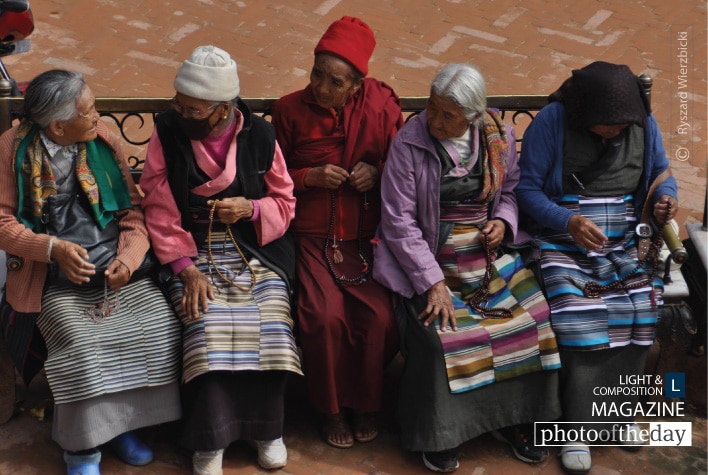
Exposure 1/500sec @ f/5.6 | ISO 220 | Focal Length 100mm
Ryszard Wierzbicki
Born in 1963 and a graduate of the University of Gdańsk, Ryszard Wierzbicki transitioned from a diverse career in education and marketing to become a dedicated traveler and photographer after relocating to the United Kingdom in 2006. His work is deeply influenced by his extensive explorations of South-East Asia and his commitment to humanitarian efforts with organizations like Stu and the Kids. As a PADI scuba instructor and founder of the travel forums Instant Travelling and World Around, Wierzbicki balances his professional life as a marketing advisor with a profound passion for documenting the world's diverse cultures.
Resonance Score Breakdown
Transparency Note: The resonance score (13.6/20) is calculated based on social engagement metrics collected before the award announcement.
Expert Photography Reviews · 6
The Architecture of Waiting
In the quiet corners of a city, there is a particular posture that belongs only to those who have nowhere else to be. It is not the rigid stance of the commuter or the frantic pace of the merchant; it is a softening of the shoulders, a settling of the weight.
Read the reflection →The Weight of Shared Silence
I sat on a park bench this morning, waiting for a friend who was running late. Beside me, two elderly strangers were talking in low, rhythmic tones. I couldn't understand a word they said, but the cadence of their voices felt like a lullaby.
Read the reflection →Reviews & Comments
Share your thoughts about this award-winning photograph. Your reviews contribute to the community engagement score.
In the shadow of the great stupa, these women aren’t just resting; they’re weaving a tapestry of shared history. We look at their faces and we understand that the conversation is the real monument here. Ryszard didn’t just point his lens; he waited for the rhythm of their friendship to settle. It’s a quiet, grounding grace that makes me want to sit beside them. This is a photograph that asks to be returned to.
The air at Boudhanath carries a weight that doesn’t lift, even when the sun is high. Ryszard waited for the moment the stupa’s gaze met these women. I’ve felt that stillness myself, where the noise of the world just dissolves. It’s a quiet grace. Seeing them huddled there, I’m reminded that faith isn’t found in the architecture, but in the shared breath of those sitting on a simple bench. It’s a beautiful, humble surrender.
It’s a decent enough capture, though one wonders if the shutter was pressed during a passing stroll or a deliberate vigil. The composition holds, yet I’m left questioning the commitment. Did he sit there for hours, or just happen upon the bench? I’ve spent enough days in the cold to spot the difference. Still, the quiet intimacy of those women is genuinely moving. It’s a rare, soft moment in a place that usually demands far more.
The frame breathes. It’s a quiet cut in a frantic sequence, the moment the director yells cut but the actors stay in character. I love the way the women anchor the frame against the stupa’s blur; it’s a masterclass in stillness. The 100mm focal length compresses the space, turning the background into a soft, textured bokeh. It’s the shot the editor keeps because it’s the only one that feels like a real conversation.
Boudhanath’s light is usually a frantic, blinding prayer, but here, the shadows beneath the bench hold the real weight. They aren’t mere absences; they’re the silence where these women’s lives actually reside. I’ve stared at the way their forms anchor the frame, and it’s unsettling—it feels like watching a secret being kept from the sun. Most photographers fear this depth, but Wierzbicki lets the darkness breathe. It’s a heavy, necessary stillness I find deeply haunting.
At 100mm and f/5.6, the Nikon’s sensor resolves the women’s textures with surprising fidelity. The focal plane is razor-thin, isolating their expressions from the stupa’s chaotic geometry. I’m genuinely moved by how the lens handles the diffraction of light across their weathered skin; it’s a tactile, human truth the naked eye usually misses. It doesn’t matter that the glass isn’t top-tier; the optics have captured a fleeting, quiet intimacy that feels almost microscopic in its emotional precision.