A Maasai Student by Ryszard Wierzbicki
Captured in September 2011 within a remote Maasai village in the Ngorongoro region, this poignant portrait offers a rare glimpse into a local classroom. The photographer utilized the natural framing of a gap between the timber walls of the hut to isolate the student, creating an intimate connection amidst the humble learning environment. The image is award-worthy for its masterful use of light and composition, which transforms a simple educational moment into a powerful narrative of curiosity and resilience. By focusing on the student’s expression, the photographer captures the universal essence of childhood learning in a challenging, yet culturally rich, setting.
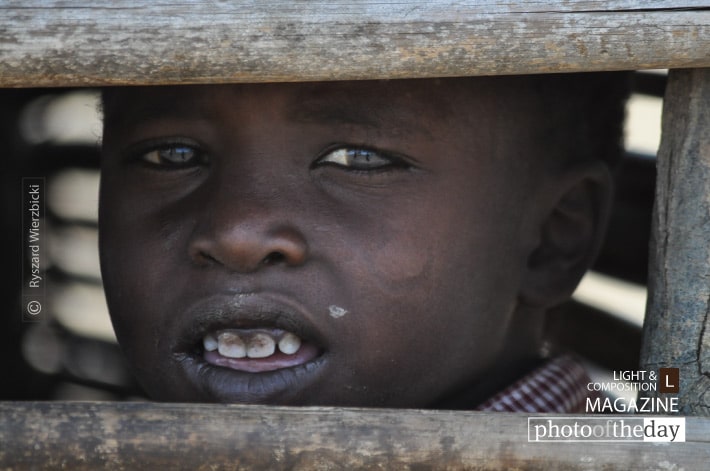
Exposure 1/750sec @ f/5.6 | ISO 800 | Focal Length 200mm
Ryszard Wierzbicki
Born in 1963 and a graduate of the University of Gdańsk, Ryszard Wierzbicki transitioned from a diverse career in social sciences and marketing to become a dedicated traveler and photographer. After relocating to the United Kingdom in 2006, he channeled his passion into documenting global cultures and volunteering with charitable organizations for orphans in South-East Asia. As the founder of the travel and photography forums Instant Travelling and World Around, Wierzbicki balances his professional life as a marketing advisor with a deep commitment to exploring and capturing the human experience through his lens.
Resonance Score Breakdown
Transparency Note: The resonance score (14.0/20) is calculated based on social engagement metrics collected before the award announcement.
Expert Photography Reviews · 6
The Quiet Weight of Learning
I remember sitting in a primary school classroom in rural Wales, the radiator clanking against the wall while the rain drummed a relentless rhythm on the tin roof. My teacher, Mr. Evans, used to say that the most important work happens in the silence between questions.
Read the reflection →The Architecture of Attention
In the quiet corners of a room, light behaves like a patient guest. It does not demand entry; it waits for the smallest fissure, a splintered board or a gap in the thatch, to announce its presence.
Read the reflection →Reviews & Comments
Share your thoughts about this award-winning photograph. Your reviews contribute to the community engagement score.
1/750sec at f/5.6, ISO 800, 200mm. It’s a tight squeeze. The shutter speed is overkill for a static subject, but it’s necessary to combat the vibration of that 18-200mm lens at full extension. ISO 800 on a D5000 introduces noise that eats the texture of the timber. I’ve seen better sensor management, yet the isolation works. The compression at 200mm forces the focus. It’s technically flawed, but I can’t stop looking at his eyes.
The ochre of the mud walls, reminiscent of a Morandi still life, anchors this portrait in a dusty, sun-drenched warmth that feels almost tactile against the student’s skin. It’s the interplay of that deep, earthy terracotta with the cool, shadowed recess of the hut that truly moves me; I’m breathless at how the light catches the eye, turning a simple classroom into a sanctuary of amber radiance where the colour itself whispers of resilience and quiet, unfolding grace.
Before the eye identifies the student, something in the chest tightens. That sliver of light from the timber gap forces a narrow, focused intimacy. It’s a quiet activation of the nerves. I’ve returned to this gaze three times today, and each time, the boy’s stillness pulls my own breath into a shallow rhythm. It’s not just a portrait; it’s a mirror of our own fragile curiosity. I feel a sudden, sharp ache for his solitude.
The timber walls don’t just frame the student; they imprison the light, forcing it to negotiate with the darkness. It’s a claustrophobic brilliance. When I look at the boy’s eyes, I’m struck by a sudden, cold ache—the realization that he’s learning to see the world through a crack in his own reality. Wierzbicki doesn’t offer us a portrait; he offers a confrontation. The shadow here isn’t an absence, it’s the silence where his future waits.
The light cuts through that timber gap like a spotlight on a stage. It’s a tight, claustrophobic frame, yet the student’s gaze pulls the entire world into focus. I’ve spent years watching frames like this; it’s the silence before the dialogue starts. The 200mm compression flattens the background, keeping the tension locked right on those eyes. It’s a beautiful, aching stillness. I honestly felt my own breath catch. This is the shot the editor keeps.
At 200mm, the lens compresses the hut’s timber aperture, forcing a shallow depth of field that isolates the student’s pupils. I’m struck by the micro-contrast here; the diffraction limit hasn’t softened the iris’s intricate radial fibers. It’s a rare, sharp intersection of optics and humanity. While the f/5.6 aperture introduces slight chromatic aberration at the edges, the focus remains surgically precise. It’s breathtaking how the glass captures that fleeting, fragile spark of intellectual hunger.