Sunset Brother by Ryszard Wierzbicki
Captured during a journey between Phonsavan and Luang Prabang, this poignant image reflects the quiet responsibilities of childhood in rural Laos. As the sun dipped below the horizon, the photographer observed a young girl tenderly watching over her brother while their parents attended to daily farm duties. This candid moment highlights the universal bond of sibling care amidst the backdrop of a fading sunset. The photograph is award-worthy for its authentic emotional resonance and the photographer’s ability to frame a deeply human, culturally significant narrative within a fleeting, atmospheric landscape.
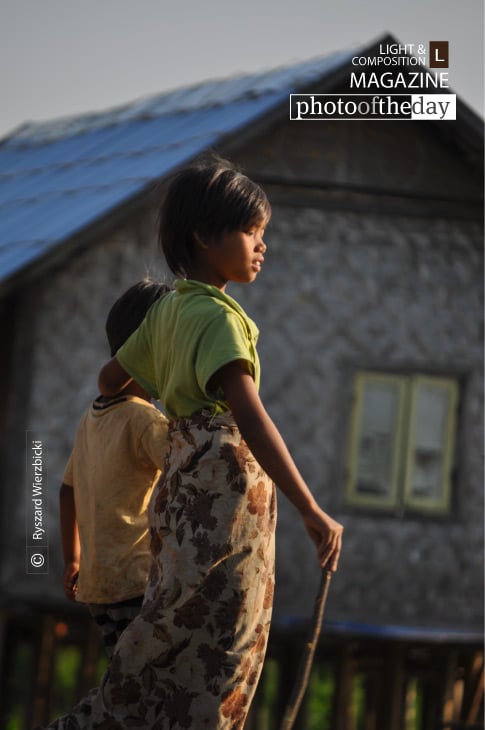
Exposure 1/750sec @ f/6.7 | ISO 200 | Focal Length 200mm
Ryszard Wierzbicki
Born in 1963 and originally from Poland, Ryszard Wierzbicki is a dedicated traveler and photographer currently based in Swindon, United Kingdom. After a diverse career in social sciences, education, and marketing, he transitioned into a life of exploration, focusing his lens on the cultures and landscapes of South-East Asia. His work is deeply influenced by his background in child care and his commitment to charitable causes, such as supporting orphans in Thailand and Burma. Through his photography and travel forums, he shares his passion for documenting the human experience across the globe.
Resonance Score Breakdown
Transparency Note: The resonance score (11.4/20) is calculated based on social engagement metrics collected before the award announcement.
Expert Photography Reviews · 8
The Architecture of Care
We are born into a web of small, invisible threads, each one a tether to another soul. To be the keeper of someone else’s quiet is a heavy, beautiful burden—a weight that anchors us to the earth long before we understand the gravity of our own lives.
Read the reflection →The Weight of Small Hands
The smell of damp earth after a long day of sun is a heavy, sweet perfume that clings to the skin. It is the scent of labor, of soil turned over by tired hands, and the cooling breath of evening settling into the valleys.
Read the reflection →Reviews & Comments
Share your thoughts about this award-winning photograph. Your reviews contribute to the community engagement score.
Before the eye identifies the children, something in the chest softens. It’s the weight of that golden light, a heavy, amber stillness that forces a shallow breath. I feel a sudden, sharp ache for the quiet gravity in the girl’s posture. When I return to this a year later, the sunset hasn’t faded; it’s settled into my own memory of duty. It’s not just a scene; it’s the physical sensation of being held.
Most travel photography is just scenery with a prop. Of the thousands I’ve reviewed, this one survives because of the girl’s posture. She isn’t posing; she’s anchoring her brother against the vast, indifferent light of a Laotian dusk. It’s the weight of her hand on his shoulder that gets me—I felt a genuine ache seeing that small, protective grip. It’s not just a sunset; it’s a quiet, permanent record of a childhood defined by duty.
It’s easy to snap a sunset; it’s quite another to wait until the light humbles the landscape to find the human story within it. Wierzbicki didn’t just pass through; he lingered long enough for the siblings to forget he was there. I’ve spent enough hours shivering on hillsides to know that intimacy isn’t found in a hurry. It’s a quiet, earned moment. I find myself genuinely moved by the stillness he captured in that fading light.
The light here doesn’t just fall; it lingers, heavy with the day’s exhaustion. He stood in the cooling hour, waiting for the horizon to soften. I find my own breath catching at the way the girl’s silhouette holds her brother, a quiet anchor against the fading gold. It’s not just a travel snap; it’s a prayer of stillness. He didn’t rush the shutter. He listened until the land itself decided it was time to rest.
The horizon pulls the light away. It’s a heavy, golden descent. The girl sits, a small anchor in the vast, darkening field. She doesn’t move. She doesn’t need to. The space around them is thick with the coming night. I’ve felt that stillness before, the weight of watching over someone you love. Nothing here is accidental. The empty corner is not empty. It’s a breath held in the tall grass. It’s enough.
The ochre of the Laotian dust, bruised by the violet of a dying sun, creates a chromatic ache that’s impossible to ignore. It’s a palette reminiscent of Turner’s late, atmospheric dissolution, where the siblings’ silhouettes dissolve into the amber haze of a fading day. I’m truly moved by the way the light clings to their skin, a soft, honeyed glow that feels like a whispered secret against the encroaching, velvet dark of the coming night.
At 200mm, the compression of the focal plane renders the background bokeh as a soft, atmospheric wash, isolating the subjects with clinical precision. The f/6.7 aperture avoids the diffraction limit, keeping the children’s textures sharp against the fading light. I’m genuinely moved by how the lens resolves the fine, stray hairs against the sunset’s glow. It’s a rare moment where the physics of glass perfectly captures the quiet, fragile weight of human connection.
The horizon line bisects the frame with clinical indifference, forcing the subjects into the lower register. It’s a precarious balance. The weight of the child’s silhouette anchors the composition, yet the negative space above feels dangerously thin. I’ve grown tired of such sentimental framing, but the tension here holds. The light doesn’t soften the geometry; it defines the edges. It’s a rigid architecture of care. The frame works because it refuses to collapse into mere anecdote.