Qutb’s Inscriptions by Munish Singla
Captured in the historic heart of New Delhi, this photograph highlights the architectural grandeur of the Qutb Minar, India's tallest stone tower. By focusing on the intricate Arabic and Nagari inscriptions etched into the red and buff sandstone, the photographer draws attention to the layered history embedded within the structure. The composition utilizes a 50mm focal length to isolate the textures of the ancient masonry, balancing the interplay of light and shadow against the monument's verticality. This image is award-worthy for its technical clarity and its ability to transform a well-known historical landmark into a compelling study of cultural heritage and artistic detail.
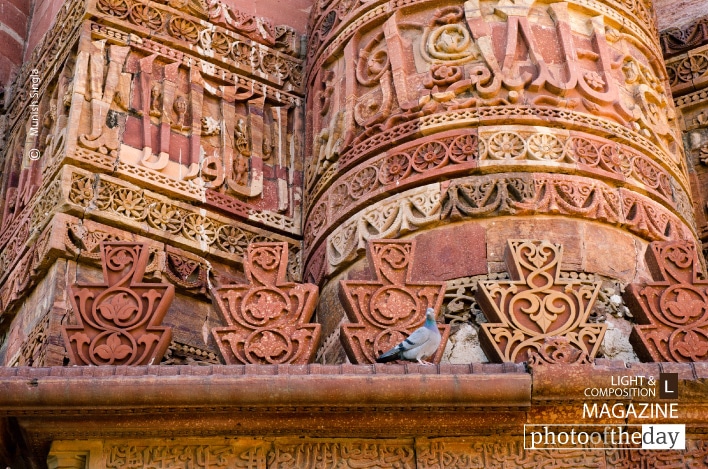
Munish Singla
Based in Los Angeles, California, Munish Singla is a software engineer who balances his technical career with a profound passion for photography. As a self-taught artist who began his journey only recently, he views the camera as a powerful instrument for exploring the human experience, from joy and peace to pain and madness. Singla refuses to be confined by a single genre, instead striving to capture the diverse emotions of the world while continuously refining his craft and expanding his creative horizons.
Resonance Score Breakdown
Transparency Note: The resonance score (11.8/20) is calculated based on social engagement metrics collected before the award announcement.
Expert Photography Reviews · 8
Whispers in the Stone
I spent this morning tracing the cracks in my kitchen wall. They have been there for years, but today, for some reason, I really looked at them. They look like a map of a place I have never been, or perhaps a language I have forgotten how to read.
Read the reflection →The Weight of Stone
We carve our names into the earth, hoping the stone will hold what we cannot. It is a quiet vanity. We believe that by marking the surface, we anchor ourselves to a time that has already forgotten us.
Read the reflection →Reviews & Comments
Share your thoughts about this award-winning photograph. Your reviews contribute to the community engagement score.
Sandstone shadows. The weight of history pressed into stone. It’s quiet here. I’ve spent minutes tracing these inscriptions, finding the rhythm in the cracks. The frame doesn’t crowd the eye. It lets the light breathe against the rough texture. Nothing here is accidental. The empty corner is not empty. It’s a pause. I feel a sudden, sharp ache for the centuries lost between these lines. Silence. It’s the only thing that remains.
The ochre of this sandstone, a shade reminiscent of Morandi’s dust-choked palettes, vibrates against the deep, shadow-drenched recesses of the inscriptions, creating a rhythmic pulse that feels almost liturgical. It’s a tactile, sun-baked warmth that I’ve found myself yearning to touch, a chromatic resonance where the light doesn’t merely illuminate the stone but breathes life into the ancient, weathered calligraphy, turning the rigid masonry into a soft, glowing skin of history that simply hums with quiet, enduring grace.
The stone here doesn’t just hold history; it breathes. Munish waited for the sun to graze these carvings, coaxing the shadows to reveal the depth of every etched letter. I’ve spent enough time in the silence of old ruins to recognize that stillness. He stood there, patient as the sandstone itself, listening to the light. It’s a quiet, holy intimacy. Looking at these textures, I feel a sudden, sharp ache for the centuries that have passed.
It’s a decent study of sandstone, though one wonders if the photographer simply walked up and clicked. The light is flat, suggesting a lack of the necessary, shivering wait for the sun to carve those inscriptions into relief. I’ve spent enough mornings in the cold to know when a shot was earned and when it was merely taken. It’s technically sharp, but it lacks the grit of a man who’s truly committed to the stone.
At f/8, the Nikon’s sensor captures the sandstone’s micro-relief with startling fidelity. The 50mm focal plane sits perfectly across the Nagari script, avoiding the diffraction limit that often softens such intricate masonry. I’m genuinely moved by how the light rakes across those weathered edges; it’s a tactile revelation of history. It doesn’t just document the Qutb; it resolves the very grain of time. I’ve rarely seen stone rendered with such crisp, forensic, and hauntingly beautiful precision.
Before the eye identifies the sandstone, something in the chest tightens. It’s the weight of centuries pressing against the ribs. I’ve spent minutes tracing those Nagari curves, and my pulse slows to match the stillness of the stone. When I return to this, I don’t see architecture; I feel the phantom grit of history under my own fingertips. It’s a quiet, heavy intimacy that follows me home, lingering in the dark like a held breath.
Most architectural shots of the Qutb Minar are just postcards. What separates this from the thousands I’ve reviewed is the tactile intimacy of the sandstone. By isolating these inscriptions, Singla forces us to read the stone rather than just admire the height. It’s a quiet, deliberate choice. I’ll admit, the texture makes me want to reach out and touch the history myself. In thirty years, this focus on the minute will outlast any wide-angle spectacle.
The frame’s verticality is rigid, yet it’s the rhythmic repetition of the sandstone inscriptions that anchors the composition. The 50mm lens compresses the depth, forcing the eye into a claustrophobic intimacy with the masonry. It’s a disciplined study of texture. I’m genuinely unsettled by how the shadow cuts the frame, creating a sharp, diagonal fulcrum. The negative space doesn’t exist here; it’s entirely consumed by the weight of history. It holds, barely.