Monk Hooligans by Ryszard Wierzbicki
Captured near the iconic U Bein Bridge in Amarapura, this evocative image documents a candid moment of childhood innocence within a spiritual setting. The photographer observed young monks engaged in playful, spirited wrestling, their youthful energy contrasting sharply with their traditional saffron robes. By focusing on this universal display of play, the image bridges the gap between the sacred and the mundane, highlighting that even within the confines of a monastery, children remain children. The composition captures the raw, unscripted movement of the boys, earning recognition for its authentic documentary approach and the photographer's ability to find humanity in quiet, everyday interactions.
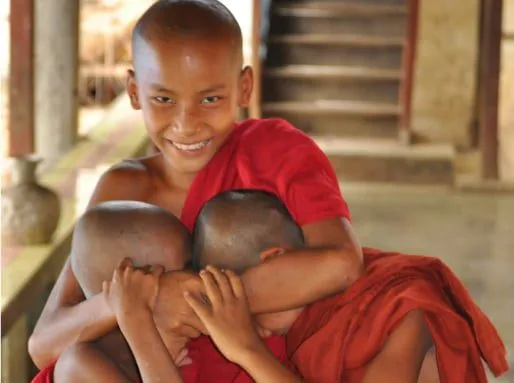
Exposure 1/60sec @ f/4 | ISO 800 | Focal Length 55mm
Ryszard Wierzbicki
Born in Poland in 1963, Ryszard Wierzbicki transitioned from a career in social sciences and marketing to a life dedicated to global exploration and photography. After relocating to the United Kingdom in 2006, he shifted his focus toward documenting the diverse cultures of South-East Asia, often volunteering his time to support local orphanages. A passionate traveler and PADI instructor, Wierzbicki channels his experiences into his photography, seeking to capture the authentic spirit of the people and places he encounters during his extensive travels.
Resonance Score Breakdown
Transparency Note: The resonance score (12.1/20) is calculated based on social engagement metrics collected before the award announcement.
Expert Photography Reviews · 8
The Weight of Robes
I watched my nephew yesterday as he tried to play tag in his Sunday suit. He was supposed to be sitting still, but the grass was too green and the afternoon was too long.
Read the reflection →The Weight of Saffron
We often mistake stillness for the only language of the sacred. We imagine holiness as a statue, carved from marble and kept far from the dust of the road.
Read the reflection →Reviews & Comments
Share your thoughts about this award-winning photograph. Your reviews contribute to the community engagement score.
The frame is chaotic, yet the saffron robes provide a necessary chromatic anchor. The spatial tension between the grappling figures creates a fulcrum that barely holds the composition together. It’s messy, but the diagonal thrust of the limbs prevents a total collapse into sentimentality. I’ve grown weary of such unrefined energy, yet the geometry of the bridge in the background offers a rigid, structural relief. It’s a precarious balance, but it doesn’t quite fall apart.
Those saffron robes, burning with the intensity of a Turner sunset, collide with the dusty, muted ochre of the earth, creating a chromatic friction that’s simply intoxicating. It’s a visceral, rhythmic dance of pigment where the sacred doesn’t just sit alongside the mundane; it bleeds into it. I’m utterly breathless watching these boys tumble, their robes blurring into a singular, vibrant flame against the quiet, Morandi-esque stillness of the Burmese light. It’s truly divine.
Before the eye identifies the saffron blur, a sudden lightness catches in my chest. It’s the kinetic friction of limbs that triggers the response; I’m reminded of my own scraped knees. Returning to this a year later, the sacred context fades, leaving only the raw, unscripted friction of childhood. It doesn’t matter that they’re monks. I’ve felt that same wild, breathless urgency in my own life, and it’s that recognition that keeps me looking.
The light here isn’t the dramatic gold of sunset, but the soft, diffuse glow of an Amarapura afternoon. It’s quiet, even amidst the wrestling. I’ve spent enough hours waiting for the world to reveal its secrets to know Ryszard didn’t rush this. He stood in the dust, breathing with them, until the saffron robes blurred into a dance. It’s a beautiful, fleeting collision of the sacred and the wild. I find myself smiling at their joy.
Most documentary work from Myanmar relies on the tired trope of the stoic, meditative monk. I’ve seen thousands of those, and they’re already fading from memory. Wierzbicki’s frame succeeds because it’s messy. The blurred limbs and genuine, unposed chaos of these boys wrestling in saffron robes makes me laugh every time I see it. It’s a rare, humanizing friction. Thirty years from now, we won’t care about the bridge; we’ll care that these kids were just kids.
At f/4, the 55mm focal plane is razor-thin, isolating the boys’ kinetic energy against a soft, creamy bokeh. The Nikon’s sensor struggles slightly with ISO 800 noise, yet the chromatic aberration along the saffron robes adds a raw, organic texture. I’m genuinely moved by how the lens resolves the dust motes caught in the light; it’s a fleeting, physical collision of optics and childhood. It doesn’t just capture a moment; it preserves the very physics of their joy.
Saffron robes blur against the dust. The boys wrestle, limbs tangled in a knot of kinetic energy. It’s chaotic, yet the frame holds them. I’m drawn to the expanse of earth behind them. It’s quiet. The vast, blurred ground allows their play to breathe. Nothing here is accidental. The empty corner is not empty. It’s the silence that makes me ache for their fleeting youth. They’ve found a stillness in the middle of a storm.
It’s easy to snap a shutter when the light hits the U Bein Bridge, but these boys didn’t just appear for the camera. Wierzbicki clearly spent the morning—or perhaps several—loitering in the dust until the robes became incidental to the wrestling. I’ve spent enough time waiting for subjects to forget I’m there to know the cost of this candidness. It’s a rare, honest bit of play. One suspects he earned every frame of it.