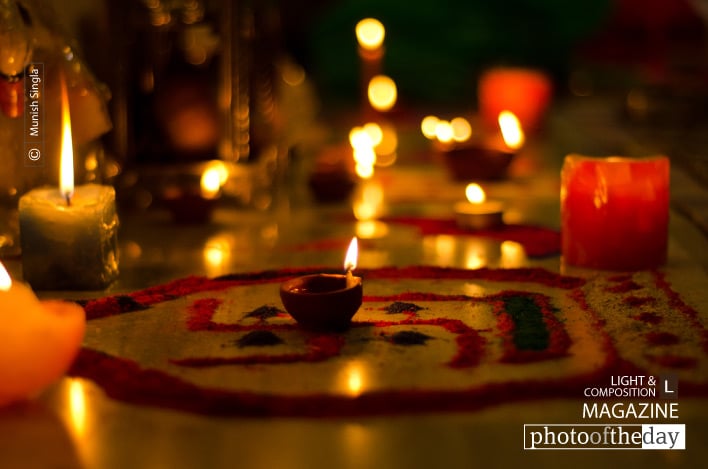
Diya and Rangoli by Munish Singla
Captured during the vibrant Diwali festival, this photograph highlights the intimate beauty of traditional celebrations. The image focuses on the glowing diyas and intricate Rangoli patterns, which serve as powerful symbols of the triumph of good over evil. By utilizing a shallow depth of field, the photographer isolates the warm, flickering light of the clay lamps against the colorful backdrop of the floor art. This composition is award-worthy for its ability to transform a domestic, cultural ritual into a poignant still life, capturing the essence of peace and joy through careful framing and a soft, evocative play of light.
Munish Singla
Based in Los Angeles, California, Munish Singla is a software engineer who balances his technical career with a profound passion for photography. As a self-taught artist who began his journey only recently, he views the camera as a limitless tool for exploring the human experience. Singla avoids genre constraints, striving instead to document the diverse spectrum of global emotions—from joy and peace to pain and madness—while continuously refining his craft through dedicated practice and an open, inquisitive creative spirit.
Resonance Score Breakdown
Transparency Note: The resonance score (11.3/20) is calculated based on social engagement metrics collected before the award announcement.
Expert Photography Reviews · 8
The Architecture of a Flame
Why do we feel the need to light a fire when the world grows dark? Perhaps it is not the absence of sun that we fear, but the silence that follows the fading of the day.
Read the reflection →The Architecture of Small Flames
There is a quiet physics to the way we mark the passage of time. We do not measure our lives solely in years or the turning of seasons, but in the small, deliberate rituals we perform to hold back the dark.
Read the reflection →Reviews & Comments
Share your thoughts about this award-winning photograph. Your reviews contribute to the community engagement score.
Before the eye identifies the clay, something in the chest softens. The shallow depth of field creates a physiological pull, drawing me into that flickering, amber warmth. It’s an invitation to stillness. When I return to this a year later, the Rangoli’s blurred geometry feels like a half-remembered dream. I’ve always found that glow unsettlingly quiet, as if the light is breathing. It doesn’t just document a ritual; it anchors a fleeting, fragile sense of peace.
The ochre glow of the diya’s flame, reminiscent of a Turner sunset trapped in clay, bleeds into the Rangoli’s crushed-petal pigments with a warmth that makes my own heart ache. It’s a chromatic symphony where the saffron dust doesn’t merely sit; it vibrates against the shadows. One finds the depth of field so shallow that the blurred, indigo-tinged floor feels like a Morandi canvas, soft and hushed, holding the light in a fragile, golden embrace.
The flickering warmth of these diyas isn’t just light; it’s a quiet conversation with the earth. Munish waited for the flame to settle, letting the Rangoli’s geometry anchor the chaos of the festival. I’ve spent enough evenings in the dark to recognize that stillness. It’s a humble, sacred focus. When I look at the soft blur of the colors, I feel a sudden, sharp ache for the peace that only a slow, deliberate vigil can provide.
Light here doesn’t merely illuminate; it struggles against the encroaching void of the floor. By isolating the diya’s flame, Singla forces us to confront the fragility of our own rituals. It’s a quiet, desperate defiance. I’ve stared at these flickering edges for an hour, feeling the cold weight of the darkness pressing in. We aren’t just looking at a festival; we’re watching the light fight for its very existence against an inevitable, silent erasure.
At f/1.6, the focal plane is razor-thin, barely containing the clay rim of the diya. It’s a bold choice; the bokeh isn’t just a blur, it’s a function of aperture that renders the Rangoli’s pigments into soft, chromatic spheres. I’m genuinely moved by how the diffraction of light across those granular surfaces creates such ethereal warmth. It’s a precise, optical dance that pushes the D7000 to its limits, revealing a quiet, glowing intimacy I’ve rarely seen.
1/400sec at f/1.6, ISO 500, 50mm. A razor-thin plane of focus. It’s a gamble that pays off, isolating the diya’s flame against the chaotic geometry of the Rangoli. Most would’ve stopped down, losing the texture to background noise. Singla didn’t. It’s technically precise, though I’m unsettled by the aggressive bokeh clipping the pattern’s edges. Still, the light control is correct. It’s a sharp, calculated strike against the clutter. I’ve seen worse technical choices win prizes.
The flame flickers. It’s a small, orange pulse against the blur of pigment. I’ve spent minutes watching the dust motes drift through the dark. The Rangoli doesn’t scream; it recedes. It’s a quiet geometry. I feel a sudden, sharp ache for the stillness of a home I’ve never visited. Nothing here is accidental. The empty corner is not empty. It holds the breath of the room. It’s enough.
Most festival photography relies on the chaos of crowds, but this shot succeeds by retreating into the quiet. By pinning the focus to a single flame at f/1.6, Singla forces us to confront the intimacy of the ritual. It’s a rare, disciplined choice. I’ve seen thousands of Diwali shots, but this one stays because it captures the warmth I actually feel when I light a candle myself. It’s a small, glowing anchor in a fleeting world.