Concrete Jungle by Joy Dasgupta
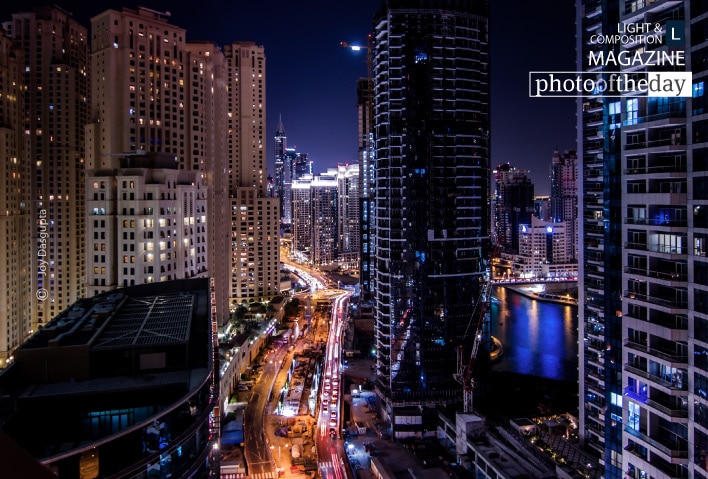
Captured from the Jumeirah Beach Residence in Dubai, this long-exposure photograph masterfully documents the architectural scale of the world's largest single-phase residential development. By utilizing a ten-second exposure at f/13, the photographer transforms the dense cluster of forty towers into a glowing, rhythmic urban landscape. The image captures the interplay between the structured geometry of the high-rises and the soft, ambient light of the night, highlighting the sheer density of the environment. This work is award-worthy for its technical precision in night photography and its ability to turn a massive, utilitarian urban space into a compelling, atmospheric composition.
Joy Dasgupta
Born in India in 1977 and a graduate of Calcutta University, Joy Dasgupta has resided in the United Arab Emirates for the past seven years. A self-taught photographer, he views the craft as a profound source of personal fulfillment and a medium for exploring diverse human perspectives. His work is defined by a commitment to continuous learning and a belief that photography is an intuitive art form centered on unique personal framing and the pursuit of technical excellence.
Resonance Score Breakdown
Transparency Note: The resonance score (12.7/20) is calculated based on social engagement metrics collected before the award announcement.
Expert Photography Reviews · 6
The Architecture of Echoes
In the early days of urban planning, architects often spoke of the city as a living organism, a body with veins of transit and lungs of open space.
Read the reflection →The Weight of Glass
We build upward to escape the earth. We stack stone and steel, layer upon layer, until the ground is a memory and the sky is merely a ceiling we have not yet reached. There is a coldness in this height.
Read the reflection →Reviews & Comments
Share your thoughts about this award-winning photograph. Your reviews contribute to the community engagement score.
Dubai’s towers press against the frame. They’ve crowded the sky. I’m looking for a breath, a moment of stillness in the glass. It’s dense. It’s loud. Yet, the black void between the structures pulls at me. It’s the only place to rest. Nothing here is accidental. The empty corner is not empty. It’s the silence I’ve been hunting for all night. I’d stay here longer, if only the city would let me be.
The electric amber of these towers bleeds into the night like a Morandi still life gone rogue, a feverish, synthetic gold that makes my pulse quicken with a strange, urban vertigo. It’s not merely light; it’s a hum of artificial warmth against the bruised, ink-stained violet of the Arabian sky. I’m utterly seduced by how the palette doesn’t just describe the architecture, but rather, it breathes a restless, neon-soaked vitality into the concrete.
Ten seconds at f/13 is a safe bet for a tripod-bound tourist, yet here the geometry holds. It’s clean, certainly, but I can’t help but wonder if the photographer ever stepped away from the tourist trail to find a perspective that didn’t feel quite so pre-packaged. It’s technically competent, though it lacks the grit of a long, cold vigil. I’ve spent nights shivering for less, and frankly, I’d have preferred a bit more soul.
Most urban night shots are just postcards, but this one captures the claustrophobia of Dubai’s ambition. The ten-second exposure turns the Jumeirah towers into a rigid, glowing cage. I’ve seen thousands of cityscapes, yet this one makes me feel genuinely small, almost trapped by the geometry. It’s the way the light bleeds into the concrete that keeps it relevant. Thirty years from now, people will look at this and finally understand our obsession with vertical density.
10sec at f/13, ISO 100, 13mm. The aperture choice is aggressive, forcing diffraction, yet it’s the only way to render those light streaks with such clinical rigidity. The 7D sensor handles the long exposure well, though I’m annoyed by the slight chromatic aberration on the building edges. It’s a cold, calculated trade-off. I’ve spent enough time in Dubai to know the heat, but this image’s icy, geometric precision actually makes me shiver. It’s technically sound.
Before the eye identifies the towers, a sudden stillness settles in the chest. It’s the weight of those ten seconds, the way the light bleeds into a hum of artificial static. I feel a strange, cold vertigo looking at these glowing monoliths; it’s like staring into a hive that never sleeps. When I return to this, I’m struck by the loneliness of that geometry. It’s a beautiful, suffocating rhythm that follows me into the dark.