Faith by Yasef Imroze
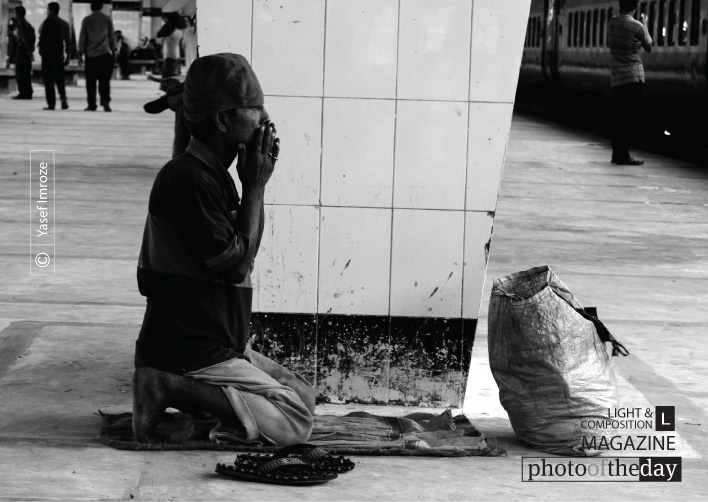
Captured amidst the bustling energy of Kamalapur railway station in Dhaka, this poignant image highlights a moment of profound spiritual stillness. While commuters hurried past, the photographer was struck by a man deeply immersed in his Namaz, seemingly untouched by the surrounding chaos. The composition emphasizes the contrast between the transient nature of the station and the enduring power of personal devotion. This photograph is award-worthy for its ability to isolate a quiet, humanizing narrative within a dense urban environment, serving as a powerful visual meditation on the nature of faith and intentionality in the face of life's obstacles.
Yasef Imroze
Originally from Dhaka, Bangladesh, Yasef Imroze Ifaz is currently pursuing his undergraduate studies at Macquarie University in Australia. Though photography began as a recent hobby, he has developed a keen eye for close-up and landscape imagery, often focusing on capturing the natural beauty of his homeland. His work reflects a shifting perception of the world around him, and he aspires to document his future global travels through the lens, finding immense joy in the creative process.
Resonance Score Breakdown
Transparency Note: The resonance score (11.8/20) is calculated based on social engagement metrics collected before the award announcement.
Expert Photography Reviews · 7
The Stillness Between Trains
The world moves in a blur of iron and steam. We are taught to run, to catch the departure, to fear the empty platform. Speed is the currency of the modern age; to stop is to be left behind.
Read the reflection →The Anchor in the Current
We are all caught in the slipstream of the urgent. Life pulls at our sleeves, a relentless tide of departures and arrivals, of clocks ticking against the pulse of our own restlessness.
Read the reflection →Reviews & Comments
Share your thoughts about this award-winning photograph. Your reviews contribute to the community engagement score.
The ochre of the station’s concrete, reminiscent of a weathered Morandi still life, anchors the man’s prayer in a dust-choked, sepia-toned silence that I find utterly devastating. It’s the way the light catches the fabric, turning the deep, bruised indigo of his garment into a sanctuary against the frantic, blurred motion of the commuters, that truly captures the soul; one can’t help but feel the weight of his solitude amidst such relentless, indifferent transit.
At f/8, the D7000 resolves the station’s chaotic textures with clinical precision, yet it’s the focal plane’s isolation that truly arrests me. The diffraction of light across the man’s prayer mat is, in the strictest physical sense, extraordinary. I’m genuinely moved by how the 65mm focal length renders the surrounding blur; it’s a masterclass in managing depth of field to extract stillness from such kinetic noise. It’s rare to see optics serve the soul so perfectly.
Kamalapur’s concrete ribs swallow the light, yet here, the shadows don’t merely frame the prayer; they anchor it. Imroze understands that faith isn’t found in the brightness of the station, but in the dark, heavy silence surrounding the man’s bowed head. It’s a brutal, necessary isolation. I’ve stared at these deep, ink-stained corners for an hour, and I’m struck by a cold, sudden ache—the realization that we are all just ghosts waiting for a train.
Most street photography is noise, but Yasef’s frame holds a rare, heavy silence. While others chase the blur of Kamalapur’s commuters, he anchored his lens on the man’s singular, prayerful posture. It’s the contrast between the sharp, geometric lines of the station and the soft, bowed head that hits me; I’ve seen thousands of urban shots, but this one actually makes me stop breathing for a second. It’s a quiet, enduring anchor in a frantic world.
Before the eye identifies the man at Kamalapur, something in the chest tightens. It’s a sudden, visceral stillness. The chaos of the station dissolves, leaving only the rhythm of his prostration. I’ve returned to this frame a dozen times, and each time, my own breath hitches in sympathy with his solitude. It’s not just devotion; it’s the way he anchors the frame, forcing my pulse to slow down to match his quiet, unwavering surrender.
The frame’s geometry is its saving grace. The subject’s verticality anchors the chaotic horizontal blur of Kamalapur station, creating a necessary fulcrum. It’s a rigid architecture that prevents the scene from collapsing into mere sentiment. The negative space around the figure doesn’t just exist; it demands silence. I’ve rarely seen such disciplined isolation in a transit hub. The composition holds, though it’s a narrow victory. Without that structural rigor, the narrative would simply dissolve into noise.
Kamalapur is a storm of motion. Yet, he’s carved a pocket of stillness against the concrete. The blur of commuters doesn’t touch him. It’s a sharp, necessary friction. I’ve stood in stations like this, feeling the noise vibrate in my teeth, but he’s found the center. Nothing here is accidental. The empty corner is not empty. It’s the weight of his breath. It’s the pause. I feel my own pulse slow just looking at him.