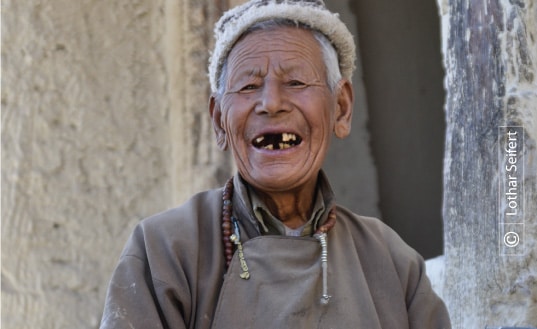
A Man from Ladakh by Lothar Seifert
Captured on the steps of a monastery in the Indus Valley, this portrait of a Ladakhi man captures a moment of profound human connection. Despite his modest circumstances, the subject radiates a welcoming warmth, offering a genuine pose that reflects his Buddhist faith and gentle spirit. The photographer’s ability to bridge the cultural and economic divide through the lens creates an intimate, dignified study of character. This image is award-worthy for its authentic emotional resonance and the photographer's respectful approach to portraiture, which transforms a simple encounter into a compelling narrative of solidarity and grace in the high Himalayas.
Lothar Seifert
Born in 1955, Lothar Seifert is a German design engineer based in a small village in Upper Lusatia. His deep passion for travel, particularly across Nepal, Kashmir, and Ladakh, has shaped his expertise in portrait and road photography, often highlighting his solidarity with impoverished communities. Beyond his professional engineering career, Seifert dedicates himself to humanitarian efforts, including schooling support for children in Nepal, while using his photography to advocate for environmental conservation and cultural understanding.
Resonance Score Breakdown
Transparency Note: The resonance score (11.7/20) is calculated based on social engagement metrics collected before the award announcement.
Expert Photography Reviews · 7
The Texture of Time
The smell of dry earth after a long drought is a scent that clings to the back of the throat, tasting faintly of minerals and ancient stone.
Read the reflection →The Weight of a Life
How much of our history is written in the lines of our own skin? We often treat the body as a vessel that simply carries us through the day, forgetting that it is also a map of every sun we have endured and every winter we have survived. Time does not merely pass; it settles.
Read the reflection →Reviews & Comments
Share your thoughts about this award-winning photograph. Your reviews contribute to the community engagement score.
The ochre of the monastery walls, reminiscent of a weathered Morandi still life, anchors this portrait in a dusty, sun-drenched silence that I find utterly intoxicating. It’s the way the man’s skin, burnt by the high-altitude sun, harmonizes with those earthy pigments, creating a chromatic intimacy that feels like a shared breath. One doesn’t merely look at these tones; one feels them settling into the marrow, a quiet, golden resonance that lingers long after the gaze shifts.
The monastery steps pull the eye toward the edge. He sits in the frame’s lower third. Above him, the stone wall stretches into a vast, pale void. It’s a quiet weight. I’ve spent minutes watching the way the light catches his weathered skin, yet I keep returning to the shadow behind him. Nothing here is accidental. The empty corner is not empty. It’s a breath. I feel a sudden, sharp stillness in my own chest.
1/400sec at f/4.2, ISO 400. The shutter speed is overkill for a static portrait, but it freezes the subject’s weathered skin with clinical precision. At f/4.2, the Sigma lens renders the monastery background soft enough to isolate him without losing the context of his environment. It’s a calculated, efficient choice. I’ve seen enough blurry portraits to appreciate this sharpness. The technical execution doesn’t distract; it simply gets out of the way. It’s correct.
Most portraits I review are mere transactions, but Seifert’s work lingers. It’s the crinkle around the man’s eyes that anchors this; he isn’t performing for the camera, he’s simply existing in the thin mountain air. I’ve seen thousands of travel portraits, yet this one avoids the trap of exoticism. It’s the quiet humility of his posture against those weathered monastery steps that gets me. Thirty years from now, we’ll still feel the warmth of that genuine, unforced smile.
Before the eye identifies the weathered skin, something in the chest hitches. It’s the stillness of the Indus Valley settling into your own pulse. I’ve returned to this man’s gaze for years; it doesn’t demand, it simply waits. When I look at him, my own breath slows to match his mountain rhythm. It’s a quiet, heavy grace that follows me into sleep, reminding me that connection is just a shared, silent exhale.
The monastery steps swallow the light, yet Seifert’s subject remains tethered to the stone. It’s a fragile existence, carved by high-altitude sun. I’m unsettled by how the shadows cling to his weathered skin, refusing to offer comfort. We’re told this is warmth, but I see a man resisting the void. He doesn’t invite us in; he endures our gaze. It’s a haunting, heavy silence. I’ve rarely felt such cold, beautiful defiance in a portrait.
The high-altitude sun hits the monastery stone with a harsh, unforgiving clarity, yet this man’s face remains softened by a quiet, inner stillness. He stood there, waiting for the light to settle into the deep lines of his skin. I’ve felt that same thin, cold air in my lungs, and it’s humbling. He isn’t just posing; he’s listening to the mountain. It’s a rare, sacred patience that makes me want to put my camera down entirely.