Story of Forest Kids by Rahat Azim Chowdhury
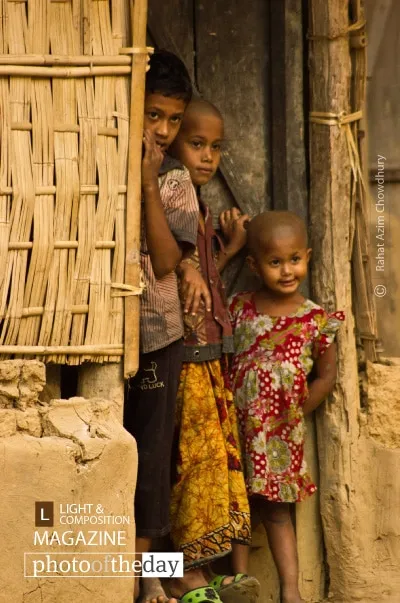
In the heart of Bangladesh’s Rema Kalenga Wildlife Sanctuary, the photographer captured a poignant glimpse into the lives of local children who call the dense forest home. Despite a lack of formal facilities, these children navigate the wilderness with ease, observing visitors with a blend of curiosity and silent questioning. By utilizing a long focal length to maintain a candid distance, the photographer successfully framed their resilient spirit and daily reality. This image is award-worthy for its authentic documentary approach, transforming a fleeting encounter with forest youth into a compelling narrative that highlights the intersection of human lifestyle and untamed nature.
Rahat Azim Chowdhury
Born in 1984, Rahat Azim Chowdhury is a Dhaka-based computer engineer who transitioned into photography through a deep-seated passion for nature and human lifestyle. Mentored by fellow photographer Nazmul Shanji and further refined by formal training at the PRISM Photography Institute, he specializes in candid, street, and documentary portraiture. Driven by a desire to explore the social patterns and architectural landscapes of the developing world, he strives to create a unique visual signature that prioritizes artistic integrity and storytelling over commercial gain.
Resonance Score Breakdown
Transparency Note: The resonance score (5.5/20) is calculated based on social engagement metrics collected before the award announcement.
Expert Photography Reviews · 4
The Rooted Pulse
There is a rhythm to the woods that we often forget when we measure our days by the ticking of a clock. In the deep green, time does not move in a straight line; it circles, like the growth of a tree or the slow turning of the seasons.
Read the reflection →The Unmapped Geography of Childhood
There is a quiet, persistent myth that childhood is a state of waiting—a long, sun-drenched hallway we must traverse before we reach the rooms of adulthood. We imagine these years as a preparation, a rehearsal for the real work of living.
Read the reflection →Reviews & Comments
Share your thoughts about this award-winning photograph. Your reviews contribute to the community engagement score.
The forest breathes. It’s a dense, green wall. The children stand small against the weight of the trees. I’ve felt that same stillness in the Rema Kalenga sanctuary. It’s heavy. The long lens pulls them close, yet they remain distant. They don’t belong to the frame; they belong to the shadows. Nothing here is accidental. The empty corner is not empty. It’s the silence of the woods. I find myself holding my breath.
Most documentary work from this region settles for mere observation, but Chowdhury’s choice to shoot at 255mm creates a necessary, respectful distance. It’s that compression that forces the forest to swallow the children whole, emphasizing their isolation. I’ve seen thousands of portraits, yet the guarded, piercing look in their eyes still makes me catch my breath. It’s not just a snapshot; it’s a haunting record of a childhood defined by the wild, not by the classroom.
Shadows here don’t merely frame the forest; they swallow the children’s edges, pulling them into the Rema Kalenga’s ancient, indifferent throat. It’s a haunting erasure. I’ve stared at their faces, and I’m unsettled by how the darkness seems to claim them before they’ve even grown. They aren’t just living in the woods; they’re being consumed by the silence of the trees. It’s a brutal, beautiful surrender to the void. I find myself shivering, truly.
One suspects the shutter was clicked from a distance, perhaps too comfortably. While the composition holds, I’m left wondering if the photographer actually spent time in the mud with these children or merely observed them from the safety of a long lens. It’s a decent capture, but it lacks the grit of a true encounter. I’ve spent enough days in the damp to know when someone hasn’t quite earned their seat at the table.