Frame in frame by Minh Nghia Le
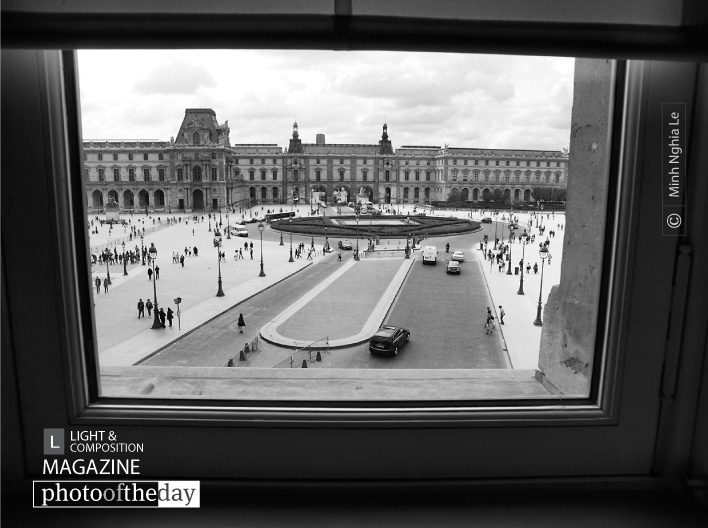
Captured within the historic halls of the Louvre Museum, this photograph masterfully utilizes the museum's architecture to create a compelling visual narrative. By framing the intricate details of the past through a window, the photographer establishes a profound connection between the viewer and the timeless beauty of the setting. The composition is deliberate and thoughtful, turning a simple architectural element into a sophisticated lens through which to view history. This image stands out for its structural precision and the evocative way it bridges the gap between the observer and the storied environment of Paris.
Minh Nghia Le
Based in Singapore, Minh Nghia Le is a dedicated photographer who balances a professional career with a deep-seated passion for the visual arts. His photographic practice is primarily rooted in street photography and portraiture, disciplines that inform his broader work in travel and wedding imagery. Viewing photography as a vital language for personal expression, he strives to document his unique perspective on the world, constantly seeking to articulate his experiences and observations through the lens.
Resonance Score Breakdown
Transparency Note: The resonance score (11.0/20) is calculated based on social engagement metrics collected before the award announcement.
Expert Photography Reviews · 3
The Distance Between Us
We spend our lives looking through glass. We stand in one room and watch the next, tracing the edges of things we cannot touch. There is a safety in this separation.
Read the reflection →The Architecture of Looking
We are taught from childhood that to see is to possess. We look at a mountain and feel we have climbed it; we look at a painting and feel we have understood the artist’s hand. But there is a secondary, more honest way of seeing: the act of looking through.
Read the reflection →Reviews & Comments
Share your thoughts about this award-winning photograph. Your reviews contribute to the community engagement score.
At f/5.6, the Zuiko glass resolves the Louvre’s stone textures with a crispness that pushes against the diffraction limit. The focal plane is razor-thin, isolating the window’s geometry while the background bokeh softens into a beautiful, atmospheric blur. It’s a precise optical dance. I’m genuinely moved by how the light cascades across those ancient surfaces; it’s as if the lens has peeled back the air itself, revealing a clarity our eyes simply can’t hold on their own.
The Louvre’s stone doesn’t just frame history; it entombs it. By pulling the viewer into this rigid, geometric aperture, Le forces us to confront the silence between the past and our own fleeting gaze. I’ve felt this cold weight before, standing in those halls, feeling small against the crushing permanence of marble. It’s a stark, uncompromising study in exclusion. The shadows here aren’t merely dark; they’re the heavy, suffocating lungs of a museum that’s finally stopped breathing.
1/500sec at f/5.6, ISO 400 on an E520. It’s a safe, clinical choice for a static architectural frame. The depth of field holds the foreground and background in a rigid, predictable lock. It’s technically sound, though I’ve always found the 4/3 sensor’s noise at ISO 400 a bit grating in the shadows. Still, the exposure is precise. It’s a clean execution. I can’t fault the math, even if it doesn’t stir me.