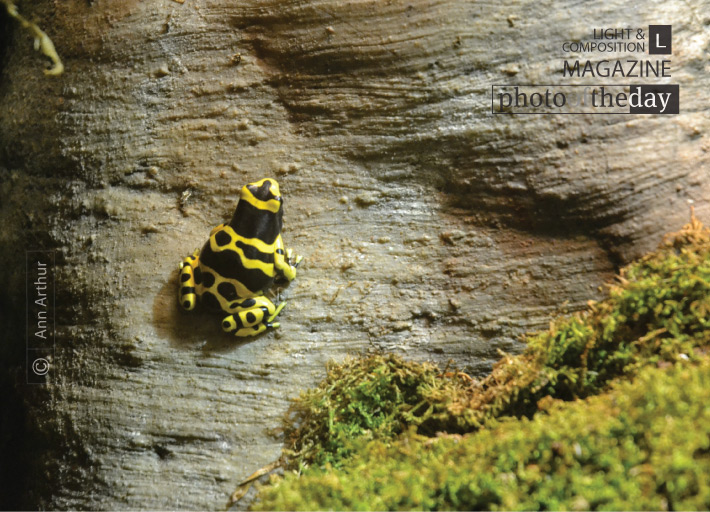
Yellow-banded Poison Dart by Ann Arthur
The photographer was drawn to the striking, vibrant coloration of the Yellow-banded Poison Dart frog, a creature whose beauty serves as a deceptive warning of its potent toxicity. Captured at the Georgia Aquarium, the image highlights the evolutionary brilliance of aposematic signaling, where bold patterns deter potential predators in the wild. By focusing on the frog’s intricate details, the photographer successfully balances the subject's lethal nature with its aesthetic allure. This award-winning shot demonstrates a keen eye for wildlife, turning a potentially dangerous subject into a compelling, high-contrast study of natural defense mechanisms.
Ann Arthur
Born in Kuching, Malaysia, Ann Arthur is a hospitality professional currently based in Birmingham, Alabama. Her photographic journey began during her university years, evolving from a simple event-based hobby into a dedicated pursuit of travel, landscape, and artistic photography. Though largely self-taught, Arthur captures the world through a unique lens, viewing her work as a transformative tool that allows her to explore diverse perspectives and hidden details within her surroundings.
Resonance Score Breakdown
Transparency Note: The resonance score (11.0/20) is calculated based on social engagement metrics collected before the award announcement.
Expert Photography Reviews · 8
The Warning in the Beauty
Why does nature insist on dressing its most dangerous secrets in such vibrant, inviting colors? We are conditioned to believe that beauty is an invitation, a sign of safety or a promise of warmth.
Read the reflection →The Warning in the Glow
I was walking through the garden this morning when I saw a bright red berry tucked under a leaf. My first instinct was to reach for it, to see if it was sweet, but I stopped myself.
Read the reflection →Reviews & Comments
Share your thoughts about this award-winning photograph. Your reviews contribute to the community engagement score.
Most wildlife shots from the Georgia Aquarium are cluttered, but this one isolates the frog’s lethal geometry against a dark, velvet void. It’s the contrast between those sharp, yellow bands and the murky background that keeps me looking. I’ve seen thousands of macro shots, yet this one feels like a warning I can’t ignore. It’s not just a record of a specimen; it’s a reminder that beauty is often a calculated, dangerous defense. I’m glad it exists.
That electric, sulfurous yellow against the deep, obsidian void of the frog’s skin creates a tension that’s almost violent, echoing the dangerous, saturated stillness one finds in a Morandi still life. It’s a chromatic warning, a visceral scream of pigment that makes my own pulse quicken with a strange, primal dread. One doesn’t merely look at this creature; one feels the cold, calculated lethality of its hue vibrating against the dark, liquid silence of the aquarium.
1/80sec at f/4.5, ISO 3200, 70mm. It’s a technical disaster. ISO 3200 on a D3100 sensor creates noise that eats the frog’s texture. The shutter speed is too slow for a handheld macro, and the depth of field is insufficient. I’ve spent years looking at these files, and this one makes my teeth ache. You can’t fix a lack of light with software. The intent was there, but the math simply doesn’t add up.
At f/4.5, the focal plane is razor-thin, barely containing the frog’s ocular curvature. It’s a precarious balance; the ISO 3200 noise creates a granular texture that almost mimics the amphibian’s porous skin. I’m genuinely moved by how the lens resolves those vibrant yellow bands against the glass’s subtle diffraction. It doesn’t just capture a creature; it forces us to confront the physics of aposematism. It’s a brilliant, clinical dissection of lethal beauty that I can’t stop studying.
Before the eye identifies the frog, a sharp, electric stillness hits the chest. That neon yellow against the obsidian black doesn’t just signal danger; it triggers a primal, visceral recoil. I’ve found my pulse quickens every time I return to this frame. It’s a beautiful, lethal tension that lingers in the back of my throat long after I look away. It’s the kind of visual warning that makes you feel entirely, breathlessly alive.
The aquarium glass hums with a sterile, artificial glow, yet this tiny creature holds a stillness that feels ancient. I’ve spent lifetimes waiting for light to settle on a mountain, but here, the light is trapped, forced to reveal the frog’s lethal, vibrant geometry. It’s a quiet, pulsing warning. Looking at those yellow bands, I feel a sudden, sharp ache for the wild, untamed places where such beauty doesn’t need a tank to survive.
The glass holds the frog. It’s a bright, toxic yellow against the dark, wet stone. I find myself holding my breath. The frame is crowded, yet the stillness remains. It’s a quiet warning. I’d prefer more room for the shadows to breathe, but the color demands attention. Nothing here is accidental. The empty corner is not empty. It’s a pause. A moment of danger, suspended in the light. It’s enough.
Nature’s warning is rarely this loud, yet it’s the silence of the surrounding black that truly unnerves me. Arthur’s frog glows with a synthetic, almost radioactive intensity, but it’s the encroaching void that defines the creature’s isolation. I’ve stared at these yellow bands until they blur, feeling the cold weight of a predator trapped in a glass cage. It doesn’t invite us in; it demands we keep our distance. It’s a beautiful, lethal, and lonely truth.