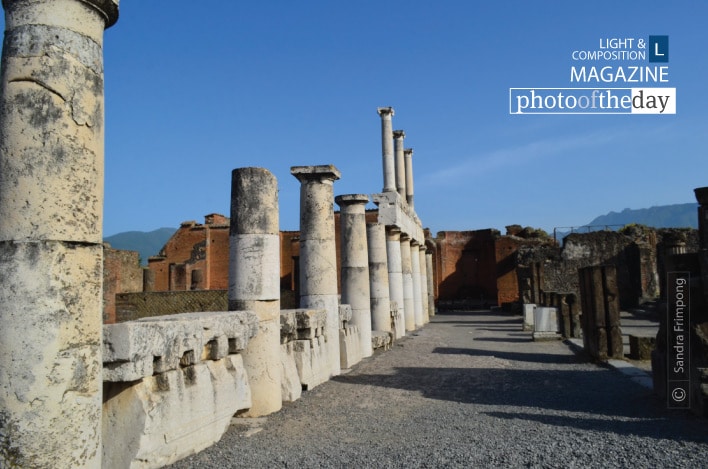
Forum Columns of Pompeii by Sandra Frimpong
Captured amidst the hauntingly preserved ruins of Pompeii, this photograph focuses on the ancient forum columns that once stood at the heart of daily life. The photographer sought to transcend the typical tourist gaze, reflecting instead on the lives of the average citizens, both enslaved and free, who inhabited this town before the catastrophic eruption of Mount Vesuvius in 79 A.D. By framing the weathered stone against the expansive sky, the image bridges the gap between past and present. Its award-worthy quality lies in this poignant historical narrative, transforming a site of tragedy into a respectful, evocative study of human history.
Sandra Frimpong
Born and raised in Ghana, Sandra Frimpong later moved to the United States, where her service in the U.S. Navy provided a global platform for her creative pursuits. Now residing in Italy, she balances her professional career with a dedicated passion for photography, which she began exploring four years ago. Her work is defined by a desire to capture the overlooked details of daily life and the intimate moments of families within her community. Through ongoing formal education and international travel, she continues to refine her artistic vision across diverse cultural landscapes.
Resonance Score Breakdown
Transparency Note: The resonance score (12.5/20) is calculated based on social engagement metrics collected before the award announcement.
Expert Photography Reviews · 6
The Echo of Stone
Time does not move in a straight line; it gathers in the cracks of things left behind. We often think of ruins as endings, as places where the story has been silenced by the weight of years.
Read the reflection →Echoes in the Stone
I was walking past the old library downtown this morning, the one with the heavy iron gates that always seem to be locked. I stopped to tie my shoe and noticed a small, hand-painted sign tucked into the brickwork, half-faded by the sun.
Read the reflection →Reviews & Comments
Share your thoughts about this award-winning photograph. Your reviews contribute to the community engagement score.
Most architectural shots of Pompeii are just postcards of rubble. What separates this from the thousands I’ve reviewed is the low-angle perspective. By pushing the columns against that vast, indifferent sky, Frimpong forces us to feel the crushing weight of time. It’s haunting. I felt a genuine chill looking at how the stone shadows stretch toward the viewer. It’s not just a ruin; it’s a reminder that we’re all just temporary tenants on this earth.
The verticality of these columns anchors the frame, creating a rigid geometry against the void of the sky. It’s a precise arrangement of mass. The negative space doesn’t merely surround the stone; it exerts a pressure that forces the eye toward the fulcrum of the central pillar. I’ve rarely seen such disciplined spatial tension. It’s cold, it’s calculated, and frankly, it’s the only way to photograph ruins without descending into the sentimental rot of history.
The ochre of these weathered columns, reminiscent of a sun-drenched Morandi still life, bleeds into the cerulean expanse with such aching fragility that it’s impossible not to feel the ghost of a Pompeian afternoon. One finds the limestone’s dusty, calcified warmth clashing against the sky’s cool, indifferent depth, creating a chromatic tension that’s truly haunting. I’ve wept at such light before; it’s a quiet, devastating dialogue between the permanence of stone and the fleeting, bruised violet of history.
Before the eye identifies the stone, a sudden stillness settles in the chest. The columns don’t just occupy space; they pull the air from the room, forcing a shallow, rhythmic breath. I’ve returned to this frame three times today, and each time, the weight of that empty sky feels heavier, almost suffocating. It’s a strange, hollow ache—the realization that we’re merely ghosts haunting someone else’s history. It doesn’t leave me when I turn away.
The stone here doesn’t just hold history; it holds the silence of a sudden end. I’ve stood in such places, feeling the weight of the air when the sun hits the ruins just right. Sandra waited for the light to soften, letting the columns breathe against that vast, indifferent sky. It’s a quiet ache, really. Looking at these weathered pillars, I find myself holding my own breath, listening for the ghosts that haven’t left yet.
Stone columns shouldn’t feel this heavy. Frimpong forces us to confront the void where life once pulsed, yet she’s terrified of the true dark. By overexposing the sky, she bleaches the tragedy into a postcard. I’d have preferred the shadows to swallow the stone, to let the ruin ache in the absence of light. It’s a polite study, but it doesn’t bleed. I feel a cold, hollow frustration looking at what could have been a haunting silence.