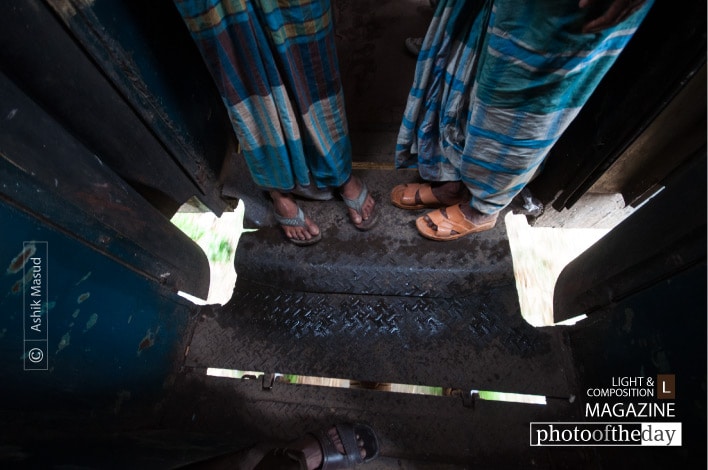
Standing in Between by Ashik Masud
Captured amidst the crowded transit systems of Bangladesh, this photograph highlights the precarious reality of daily travel for those living in poverty. Ashik Masud documents the desperate necessity that forces commuters to ride between train carriages, a common yet harrowing sight due to extreme population density. The composition masterfully balances the raw, gritty nature of the subject matter with a sharp technical execution, capturing the tension of the moment. This image is award-worthy for its powerful social commentary, transforming a routine struggle into a poignant narrative that invites the viewer to reflect on the human condition and the resilience of those navigating life on the margins.
Ashik Masud
Based in Dhaka, Bangladesh, Ashik Masud is a dedicated documentary photographer and IT professional who captures the vibrant, energetic essence of his homeland. His work focuses on the intersection of people and their environments, utilizing a colorful visual language to foster cross-cultural understanding. As a self-taught artist, Masud believes in the power of immersive practice, consistently striving to represent the authentic spirit of the Bangladeshi people through his observant and respectful lens.
Resonance Score Breakdown
Transparency Note: The resonance score (14.2/20) is calculated based on social engagement metrics collected before the award announcement.
Expert Photography Reviews · 5
The Threshold of Elsewhere
We are taught from childhood that a doorway is a place of transition, a thin membrane between the known and the unknown. We step through, expecting the floor to remain solid, expecting the walls to hold their shape.
Read the reflection →The Space Between
I missed my bus this morning by a heartbeat. I stood on the curb, watching the tail lights fade into the gray morning mist, feeling that familiar, sharp sting of frustration.
Read the reflection →Reviews & Comments
Share your thoughts about this award-winning photograph. Your reviews contribute to the community engagement score.
Of the thousands of transit photos I’ve reviewed, most are just noise. What separates this from the pack is the claustrophobic geometry of the carriage gap. That wide-angle distortion doesn’t just capture the crowd; it forces you into the crushing weight of their commute. I felt a genuine shiver looking at the man’s grip on that rusted railing. It’s a brutal, honest document that will still be haunting viewers in thirty years. It’s earned its place.
The light here isn’t the golden warmth of a landscape, but the harsh, unforgiving glare of a midday sun that offers no shadows to hide in. He stood there, waiting for the train to shudder into that precise, precarious alignment. It’s a heavy, breathless scene. I feel a sudden, sharp ache in my chest looking at these men suspended between carriages. They aren’t just commuting; they’re clinging to the very edge of existence itself.
One doesn’t capture this sort of tension from a comfortable distance. Masud clearly spent hours in the grit of that platform, waiting for the precise moment the carriage gap aligned with the human desperation clinging to it. I’ve spent enough time in the rain to know when someone’s truly committed to the scene. It’s a harrowing view, and frankly, it makes my own cold mornings in the hills feel rather trivial. He earned this one.
The ochre of the rusted iron, reminiscent of a weathered Turner hull, clashes violently against the bruised, slate-grey sky of Kishoreganj, creating a chromatic friction that makes my heart ache with the sheer weight of human endurance. It’s a palette of industrial decay, where the muted, dusty tones of the commuters’ garments bleed into the metallic gloom, and honestly, the way the light clings to those desperate, suspended figures feels like a haunting, modern-day Morandi.
The wide-angle distortion pulls the carriage frame into a suffocating geometry. It’s a rigid cage of steel and shadow. The subject’s placement at the fulcrum forces a brutal spatial tension against the encroaching blur of the background. I’m genuinely unsettled by how the vertical lines collapse inward, trapping the figure in a claustrophobic geometry. The composition doesn’t just document; it locks the viewer into the frame’s own structural exhaustion. It’s a cold, precise victory of form.