A Different World by Jana Z
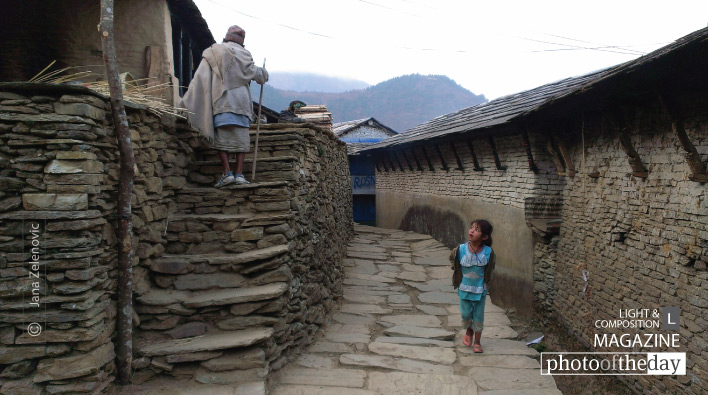
Captured within the remote hills of Nepal’s Annapurna conservation area, this image documents a poignant moment of childhood simplicity. The photographer observed a young girl navigating her village, where life maintains a steady, traditional pulse far removed from urban demands. By focusing on the genuine joy and contentment of the local children, who find wonder in simple objects like rocks and branches, the image highlights a profound human connection. This photograph is award-worthy for its authentic storytelling and its ability to transport the viewer into a different world, celebrating the quiet dignity of a life lived in harmony with nature.
Jana Z
Originally from Slovenia and now based in Geneva, Switzerland, Jana Z discovered her passion for photography in 2010 as a means to document the diverse landscapes and people encountered during her travels. Her creative journey evolved from early experiments with an Olympus e420 to the more advanced Nikon D700, reflecting a deepening commitment to her craft. Beyond the lens, she finds inspiration in a multifaceted life that includes playing the piano, learning new languages, and baking, all of which inform her observant and empathetic approach to street photography.
Resonance Score Breakdown
Transparency Note: The resonance score (13.9/20) is calculated based on social engagement metrics collected before the award announcement.
Expert Photography Reviews · 5
The Geography of Small Things
In the high, thin air of the mountains, the scale of a human life often feels like a pebble tossed into a vast, silent lake.
Read the reflection →The Architecture of Small Things
We spend our lives building cathedrals of ambition, forgetting that the world is held together by the smallest, most fragile hinges. A stone turned over in the dirt, a stick held like a scepter, the way light catches the dust of a path—these are the true foundations.
Read the reflection →Reviews & Comments
Share your thoughts about this award-winning photograph. Your reviews contribute to the community engagement score.
The ochre dust of Manang clings to the girl’s skin like the earth-toned pigments of a Morandi still life, yet it’s the startling, bruised violet of her garment that truly arrests the senses. It’s a jarring, beautiful dissonance against the muted Himalayan stone, and I’ve found myself quite breathless at how this singular, saturated hue anchors the entire frame, pulling the eye into a quiet, chromatic rapture that feels, quite simply, like a prayer.
The air in Manang is thin, and it demands a stillness I’ve rarely found elsewhere. Jana didn’t rush this. She waited until the light softened against those stone walls, listening to the quiet rhythm of the girl’s play. It’s a humble, sacred moment. Looking at the way the shadows cling to the earth, I feel a sudden, sharp ache for that simplicity. She didn’t just capture a child; she captured the land’s own patient breath.
It’s a curious choice to capture such stillness with a mobile phone, yet the result isn’t entirely dismissible. One wonders how long Jana sat in that Manang dust before the girl stopped noticing the lens. I’ve spent enough hours shivering in those high passes to recognize the patience required here. It’s not a technical marvel, but it’s earned. I find myself missing that thin, cold air. She didn’t just pass through; she stayed.
Most street photography from the Annapurna region relies on the exoticism of the landscape, but Jana Z avoids that trap. It’s the girl’s unselfconscious grip on that simple stick that anchors the frame. I’ve seen thousands of portraits of children, yet this one lingers because it doesn’t beg for pity. It’s honest. I actually felt a pang of envy for her quiet focus. In thirty years, we’ll still be looking for this kind of peace.
The frame’s geometry is surprisingly tight. The subject’s placement against the stone wall creates a necessary fulcrum, balancing the negative space of the village path. It’s a rigid architecture that prevents the scene from dissolving into mere sentiment. I’ve grown weary of such ethnographic tropes, yet the vertical alignment of the doorway provides a structural anchor that actually holds. It’s a rare instance where the composition doesn’t collapse under the weight of its own narrative.
Congratulations! Dear Jana Z, for the shooting and showcasing “A Different World”. I wish and dream to do photographic exploration all around Nepal and its most beautiful landscapes…people…festivals…life styles….culture..arts…crafts….from the high Himalayas…mountains to urban and rural villages and cities…