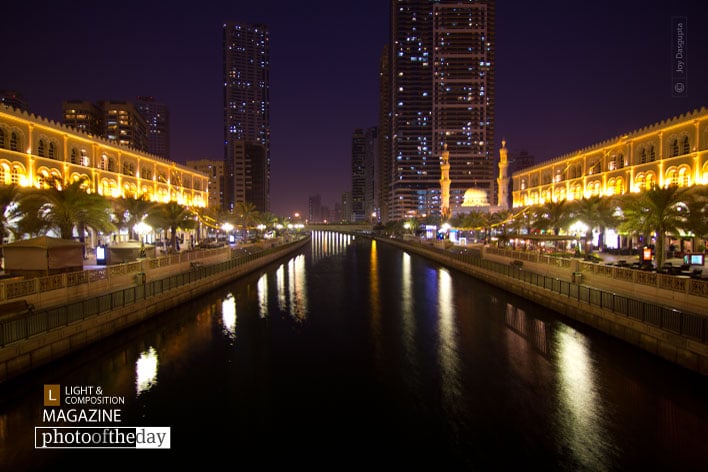
Qanat al Qasba Mosque by Joy Dasgupta
Captured during the photographer's inaugural year of exploration, this image highlights the serene, illuminated beauty of the mosque at Qanat al Qasba in Sharjah. Drawn to the city's architectural grace, the photographer utilized a long exposure to capture the vibrant night lighting, transforming the structure into a glowing landmark against the evening sky. This piece is award-worthy for its technical precision in low-light conditions and its ability to convey the quiet, spiritual atmosphere of a city that was, at the time, a new discovery for the artist.
Joy Dasgupta
Born in India in 1977 and a graduate of Calcutta University, Joy Dasgupta has resided in the United Arab Emirates for the past seven years. An active member of both the Emirates Photography Club and the Kolkata Photographers Club, he views photography as a profound source of personal satisfaction and a lifelong artistic pursuit. Inspired by the masters of the craft, Dasgupta continuously challenges himself to refine his technical skills and develop his unique perspective through every frame he captures.
Resonance Score Breakdown
Transparency Note: The resonance score (13.6/20) is calculated based on social engagement metrics collected before the award announcement.
Expert Photography Reviews · 7
The Architecture of Silence
There is a particular quality to the night that invites the soul to settle. When the sun retreats, the world sheds its frantic edges, and we are left with the soft hum of shadows and the quiet geometry of our own existence.
Read the reflection →The Architecture of Silence
In the desert, the night does not simply fall; it arrives with a weight that demands a different kind of listening. We are accustomed to the noise of the day, the clutter of objects and the frantic pace of our own shadows.
Read the reflection →Reviews & Comments
Share your thoughts about this award-winning photograph. Your reviews contribute to the community engagement score.
Five seconds at f/2.8 is a polite request to the night, not a demand. It’s a clean capture, certainly, but it feels like a tourist’s first date with a city. I’ve spent enough nights shivering in the dark to know the difference between a lucky snap and a hard-won frame. One wonders if the photographer ever returned when the air wasn’t so cooperative. It’s pretty, but I’m left wanting a bit more grit.
The mosque glows. It’s a soft anchor in the dark. The water holds the reflection, but it’s the black sky that pulls me in. I feel a sudden, sharp ache for the stillness of Sharjah. Nothing here is accidental. The empty corner is not empty. It’s a breath held in the night. Dasgupta trusts the silence. I’ve spent minutes just watching the light bleed into the void. It’s enough.
Most night photography relies on the crutch of long-exposure gloss, but here, the 11mm distortion actually anchors the mosque, pulling the viewer into the frame rather than pushing them away. It’s a rare instance where technical restraint meets architectural reverence. I’ve seen thousands of Sharjah cityscapes, yet this one lingers because it doesn’t try too hard. It’s quiet. Honestly, looking at those soft, glowing reflections, I find myself wishing I were standing on that bridge tonight.
The frame’s geometry is compromised. While the long exposure stabilizes the light, the architectural mass lacks a necessary anchor. The vertical lines lean, fracturing the picture plane’s intended equilibrium. It’s a missed opportunity for true spatial tension. I’d have preferred a tighter alignment to the mosque’s central axis. The negative space doesn’t breathe; it merely drifts. It’s technically competent, yet the composition fails to hold the weight of its own ambition. It’s frustratingly static.
Before the eye identifies the mosque, the chest tightens. That five-second exposure pulls the ambient light into a hum, a vibration that settles behind my ribs. It’s an architectural exhale. I’ve returned to this blue glow three times today, and each time, the stillness feels heavier, almost liquid. It doesn’t just capture Sharjah; it captures the exact frequency of solitude. I find myself holding my breath, waiting for the water to ripple, but it never does.
At f/2.8, the Tokina’s wide aperture struggles with the diffraction limit at the frame’s periphery, yet the light’s interaction with the mosque’s geometry is hypnotic. I’m genuinely moved by how the five-second exposure renders the water’s surface as a perfect, low-pass filter for the architecture’s glow. It’s a delicate balance; the chromatic aberration near the edges doesn’t distract—it feels like the lens is breathing, capturing a stillness that my own eyes simply couldn’t resolve.
The mosque’s luminescence against the velvet void recalls the nocturnal stillness of a Morandi study, where the gold of the minaret bleeds into the indigo of the Sharjah night like ink in water. It’s a chromatic ache I’ve felt before in the hushed, gilded shadows of a Vermeer. One finds the interplay of warm, artificial amber against that deep, bruised violet sky utterly intoxicating, a quiet symphony of light that simply refuses to be ignored.