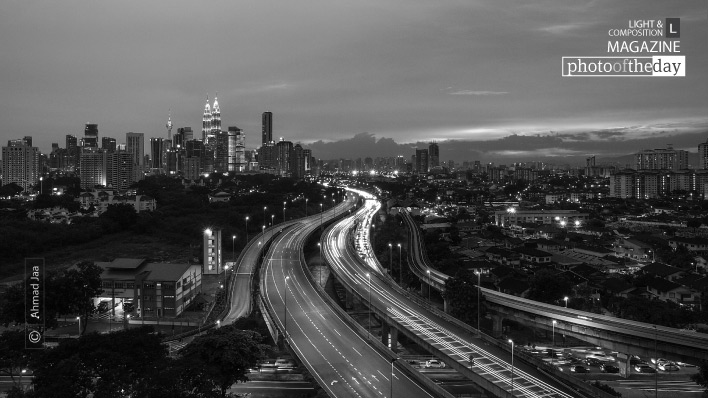
Monotone from Jelatek by Ahmad Jaa
Captured during the twilight hours in Kuala Lumpur, this photograph transforms the city's evening commute into a rhythmic display of light. By utilizing a long exposure, the photographer masterfully renders the steady flow of vehicle headlights and taillights into vibrant, monochromatic trails that cut through the urban landscape. The composition emphasizes the geometric patterns inherent in the Jelatek cityscape, showcasing a sophisticated balance between static architecture and dynamic motion. This image is award-worthy for its technical precision in night photography and its ability to elevate a mundane daily commute into a compelling, abstract visual narrative of city life.
Ahmad Jaa
Based in Kuala Lumpur, Malaysia, Ahmad Jaa began his photographic journey in 2008, finding his true creative stride by 2011. As a self-taught artist, he maintains an open approach to his craft, refusing to be confined by genre while harboring a particular fascination for geometry and structural form. For Jaa, photography serves as a profound medium for self-discovery, allowing him to express his inner perspective with sincerity. He remains dedicated to continuous learning and technical refinement, constantly seeking to evolve his unique vision through the lens.
Resonance Score Breakdown
Transparency Note: The resonance score (12.9/20) is calculated based on social engagement metrics collected before the award announcement.
Expert Photography Reviews · 4
The Hum of the Veins
The smell of hot asphalt after a summer rain is a thick, metallic perfume that clings to the back of the throat. It is the scent of a city exhaling.
Read the reflection →The Persistence of Flow
If we were to strip away the architecture of our lives, would we find that we are merely the paths we trace? We spend our days tethered to the belief that we are static beings, anchored by names and histories, yet we are constantly in a state of becoming.
Read the reflection →Reviews & Comments
Share your thoughts about this award-winning photograph. Your reviews contribute to the community engagement score.
Kuala Lumpur’s concrete veins pulse with a frantic, artificial blood. Jaa’s long exposure doesn’t just record traffic; it captures the erasure of the individual within the machine. I’ve stared at these light trails until my eyes ached, feeling the cold, geometric indifference of the city pressing against my own mortality. It’s a haunting, hollow beauty. The shadows here aren’t merely dark; they are the silent, hungry voids waiting to swallow the commuters whole. It’s terrifyingly precise.
Of the thousands of long-exposure cityscapes I’ve reviewed, most are just technical exercises in light trails. What separates this from the pack is the rigid, almost brutalist geometry of the Jelatek overpass. It’s not just a commute; it’s a pulse. I’ll admit, the cold, clinical precision of the light streaks against that concrete makes me feel strangely lonely. In thirty years, this won’t just be a record of traffic; it’ll be a haunting relic of urban rhythm.
The frame’s geometry holds firm against the blur of the Jelatek commute. Light trails slice the picture plane with clinical intent, anchoring the static architecture against the kinetic drift. It’s a rigid, calculated architecture that keeps the chaos from spilling over. I’ve rarely seen such disciplined spatial tension in a long exposure. The fulcrum of the frame doesn’t buckle under the weight of the motion. It’s cold, precise, and frankly, it’s a relief to see.
Before the eye identifies the Jelatek commute, something quiets in the chest. The long exposure doesn’t just blur light; it syncs with my own pulse, turning the city’s frantic rhythm into a steady, hypnotic hum. I’ve returned to these monochromatic trails a dozen times, and each time, they feel like a fading memory of a place I’ve never been. It’s a strange, lonely comfort—the way the stillness of the architecture anchors my wandering, restless mind.