Escort by Nilla Palmer
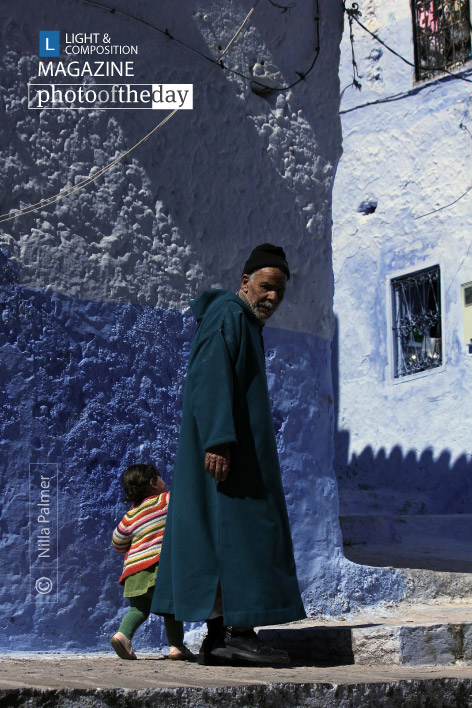
In the labyrinthine blue corridors of Chefchaouen, the photographer captures a poignant moment of vulnerability and guidance. Amidst the disorienting paths that seem to swallow time, the image highlights a small child navigating the complex urban landscape under the watchful eye of an escort. The composition masterfully balances the stark, iconic architecture of the city with the human element of the scene. This photograph is award-worthy for its evocative storytelling, transforming a simple street encounter into a universal narrative about protection, discovery, and the timeless nature of travel in one of the world’s most enchanting settings.
Nilla Palmer
Based in Brisbane, Australia, Nilla Palmer has cultivated a deep passion for global exploration and visual storytelling over the past 27 years. Her photographic journey evolved from early experiences with 110mm and 35mm film to a sophisticated mastery of digital techniques. Driven by a desire to capture fleeting, impactful moments, she focuses on creating evocative imagery that inspires audiences to discover the beauty of distant lands. Her work serves as a bridge between cultures, inviting viewers to experience the world through her unique and thoughtful lens.
Resonance Score Breakdown
Transparency Note: The resonance score (12.9/20) is calculated based on social engagement metrics collected before the award announcement.
Expert Photography Reviews · 8
The Architecture of Guidance
We are all born into labyrinths, small creatures standing before walls that seem to reach the sky. The world is a vast, echoing corridor of blue shadows and sharp corners, where the ground beneath our feet feels both solid and strangely uncertain.
Read the reflection →The Salt of Guidance
The smell of damp limestone always brings me back to the feeling of a hand in mine—not a firm grip, but a loose, trusting tether. It is the scent of cool, shadowed walls that have never known the direct heat of the sun.
Read the reflection →Reviews & Comments
Share your thoughts about this award-winning photograph. Your reviews contribute to the community engagement score.
Blue walls press inward. The child is small, a sliver of movement against the stone. I’ve spent minutes watching the shadow stretch across the cobalt floor. It’s quiet. The escort doesn’t crowd the frame. They’ve left enough room for the silence to breathe. Nothing here is accidental. The empty corner is not empty. It’s a pause. I feel a sudden, sharp ache for the stillness they’ve found in that labyrinth. It’s enough.
At f/7.1, the focal plane renders the textured plaster of Chefchaouen with clinical sharpness, pushing the sensor’s resolution to its limit. I’m genuinely moved by how the diffraction of light across those blue surfaces creates a soft, almost tactile transition into the shadows. It’s a rare moment where the lens doesn’t just record the scene, but resolves the very atmosphere of the corridor. The child’s silhouette is perfectly defined, proving that even modest glass captures profound truth.
Before the eye identifies the blue walls, something in the chest tightens. It’s the sudden, sharp recognition of being small in a world that doesn’t care if you’re lost. I feel a phantom tug on my own sleeve, a reflex from a childhood I’d forgotten. When I return to this, the blue feels colder, more indifferent. Palmer captures that specific, breathless vulnerability of needing a hand to hold when the architecture itself seems to be closing in.
The cerulean wash of Chefchaouen isn’t merely pigment; it’s a suffocating, liquid embrace, reminiscent of the bruised, atmospheric depths in a Turner seascape. One feels the cool, chalky vibration of those walls pressing against the skin, a monochromatic ache that makes my own heart stutter. It’s a claustrophobic, beautiful drowning in cobalt, where the child’s presence acts as a necessary, warm interruption, a fragile anchor amidst the relentless, tidal pull of that infinite, sapphire labyrinth.
Chefchaouen is a tourist trap that usually yields nothing but snapshots of blue walls. One suspects most photographers spent an hour here before retreating to a café. Yet, Palmer’s frame suggests she actually walked until her boots gave out. The timing of that child’s stride against the shadow is sharp, precise, and frankly, it’s a relief to see. I’ve spent enough miserable afternoons in similar alleys to know she didn’t just find this; she earned it.
The blue walls collapse inward, creating a claustrophobic geometry that demands attention. The child’s placement at the lower-left fulcrum provides the only necessary anchor against the overwhelming verticality of the corridor. It’s a rigid, disciplined frame. I’ve grown weary of sentimental street scenes, but the spatial tension here is undeniable. The architecture doesn’t just house the subjects; it dictates their movement. It’s a rare instance where the frame holds its weight without collapsing into mere narrative noise.
The blue walls of Chefchaouen don’t just reflect light; they swallow it, turning the air into a cool, liquid silence. I’ve stood in such corridors, waiting for the shadows to yield. Nilla felt the stillness here, the way the child’s small hand finds its anchor. It’s a quiet, sacred geometry. Looking at this, I feel a sudden, sharp ache for the simplicity of being led through the unknown. The light here isn’t captured; it’s invited.
Of the thousands of street shots I’ve reviewed, most drown in Chefchaouen’s blue walls. They’re just postcards. What separates this is the tension between the child’s hesitant stride and the escort’s firm, shadowed posture. It’s a quiet, heavy geometry. I felt a genuine ache in my chest looking at that small hand reaching out. It’s not just a travel snap; it’s a permanent record of human fragility against an ancient, indifferent labyrinth. That’s why it endures.