Ice Cold Hay by Tisha Clinkenbeard
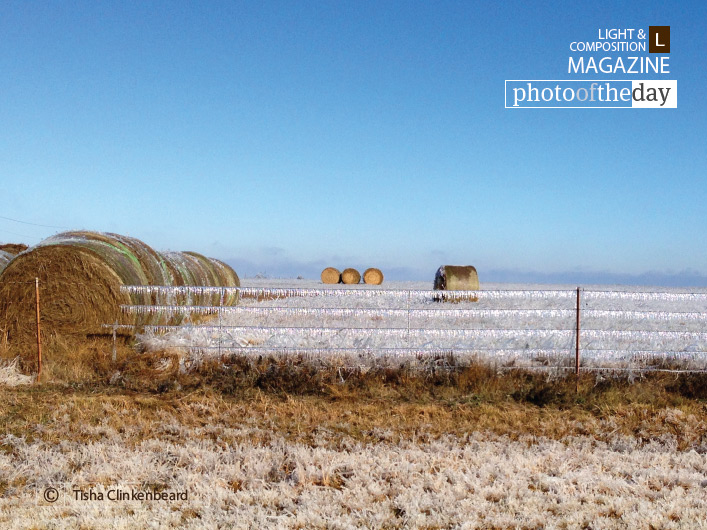
Captured in the aftermath of a devastating ice storm, this image depicts a quiet, frozen pasture in Sumner, Texas. The photographer encountered the scene while traveling, struck by the contrast between the brilliant, shining sun and the lingering, icy destruction coating the hay, grass, and fencing. By documenting this juxtaposition of natural beauty and environmental hardship, the image serves as a poignant record of a local weather event. Its award-worthy quality lies in the photographer’s ability to find stillness and visual harmony within a landscape recently transformed by the harsh, crystalline grip of winter.
Tisha Clinkenbeard
Based in Powderly, Texas, Tisha Clinkenbeard is a dedicated photographer whose work has been featured in prestigious venues such as The Fine Arts Center of Hot Springs and the Black Box Gallery in Portland. Her artistic journey began long before the advent of modern digital technology, fostering a deep-seated passion for documenting the world as she wanders. Through her photography blog, Found Round & About, she shares her unique perspective on the landscapes and moments she encounters, consistently capturing the beauty of her surroundings with an observant and creative eye.
Resonance Score Breakdown
Transparency Note: The resonance score (13.4/20) is calculated based on social engagement metrics collected before the award announcement.
Expert Photography Reviews · 5
The Weight of Stillness
The frost does not ask for permission. It arrives in the night, a silent thief that coats the world in a brittle, glass skin. We are taught to fear the cold, to see it as an ending, yet there is a strange mercy in the way it stops everything.
Read the reflection →The Glass Garden
Winter is a patient architect. It arrives without a sound, wrapping the world in a brittle, transparent skin that turns the familiar into something untouchable.
Read the reflection →Reviews & Comments
Share your thoughts about this award-winning photograph. Your reviews contribute to the community engagement score.
Most entries in this category rely on dramatic sunsets, but Tisha’s work succeeds because it’s quiet. The iPhone’s sensor captured the crystalline texture of the frozen hay with a sharpness that feels almost tactile. I’ve seen thousands of storm photos, yet this one lingers. It’s the way the light hits the ice—it makes me shiver just looking at it. That’s the mark of an image that will still matter in thirty years. It’s honest, cold, and perfect.
Ice doesn’t merely coat the hay; it entombs the landscape in a brittle, suffocating silence. I’m struck by how the light here isn’t a gift, but a cold interrogation of the frozen stalks. It’s a cruel brilliance. Where the shadows retreat, they leave behind a void that feels heavier than the ice itself. It’s a haunting reminder that nature doesn’t care for our comfort. I find it difficult to look away from such beautiful, crystalline indifference.
The frost doesn’t scream. It settles. A field in Sumner, held in glass. I’ve stood in this cold before, watching the light catch the edges of the hay. It’s quiet. The sky pulls back, leaving room for the ice to breathe. Nothing here is accidental. The empty corner is not empty. It’s a pause. I feel my own pulse slow down just looking at it. A rare, crystalline stillness. It’s enough.
The iPhone 5’s tiny sensor struggles with the diffraction limit here, yet the f/2.4 aperture captures the ice’s crystalline structure with surprising acuity. The light’s refraction through these frozen hay stalks creates a chaotic, brilliant bokeh that’s genuinely haunting. I’m struck by how the lens resolves the micro-textures of the frost against the sun’s glare. It’s a fragile, cold beauty that makes me shiver; the physics of this winter light is simply breathtaking to behold.
1/2500sec at f/2.4, ISO 50, 4.12mm. The iPhone 5 sensor isn’t built for this dynamic range, yet the exposure holds. That shutter speed is overkill, but it freezes the crystalline structure of the ice effectively. I’m actually impressed the highlights didn’t clip into oblivion against that Texas sun. It’s a clinical capture of a chaotic event. The technical constraints were respected. It’s a rare moment where the hardware didn’t get in the way of the cold.