Sharjah Light Festival by Joy Dasgupta
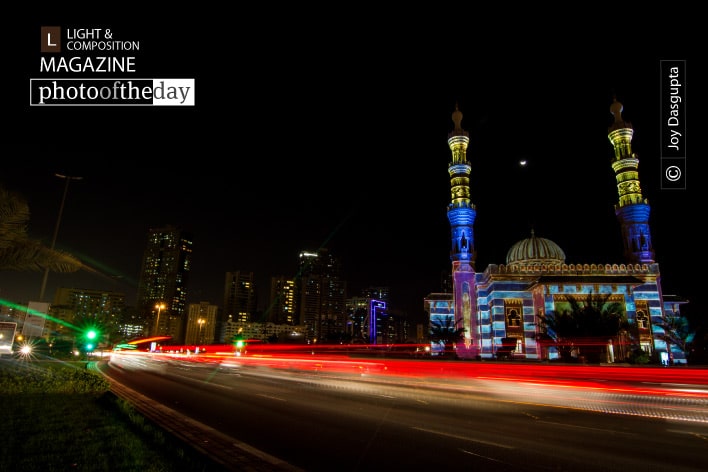
Captured during the vibrant Sharjah Light Festival, this image showcases the Al Majaz Mosque transformed by a spectacular display of light and color. The photographer utilized a long exposure of ten seconds to capture the intricate illumination of the landmark against the night sky, emphasizing the architectural grandeur of the mosque. The composition highlights the harmony between modern light installations and traditional design, creating a serene yet dynamic atmosphere. This photograph is award-worthy for its technical precision in low-light conditions and its ability to capture the ephemeral magic of a city-wide celebration, turning a cultural landmark into a glowing centerpiece of artistic expression.
Joy Dasgupta
Born in India in 1977 and a graduate of Calcutta University, Joy Dasgupta has resided in the United Arab Emirates for the past seven years. A self-taught photographer, he views the craft as a profound source of personal fulfillment and a unique lens through which to interpret the world. His work is characterized by a commitment to constant learning and a belief in the power of individual perspective, drawing inspiration from master photographers while striving to refine his technical skills with every new frame.
Resonance Score Breakdown
Transparency Note: The resonance score (14.2/20) is calculated based on social engagement metrics collected before the award announcement.
Expert Photography Reviews · 6
The Architecture of Silence
Night is not merely the absence of the sun; it is a canvas where the world reveals its true, quiet character. When the rush of the day dissolves, the structures we inhabit begin to breathe in a different rhythm.
Read the reflection →The Architecture of Echoes
Can stone ever truly hold the weight of a prayer, or does it merely provide a vessel for the silence that follows? We build our monuments to endure, stacking heavy materials against the sky as if to anchor our fleeting presence to the earth.
Read the reflection →Reviews & Comments
Share your thoughts about this award-winning photograph. Your reviews contribute to the community engagement score.
Light here isn’t illumination; it’s a violent imposition upon the architecture. By forcing ten seconds of exposure, Dasgupta flattens the mosque into a neon ghost, stripping away the sanctuary’s inherent mystery. I’m left cold by this spectacle. Where is the darkness that allows a building to breathe? It’s a loud, frantic performance that mistakes brightness for depth. I’d trade all this synthetic color for one honest, heavy shadow that actually knows how to keep a secret.
The electric violet bleeding into the mosque’s stone facade evokes a feverish, nocturnal Vermeer, where the shadows aren’t merely absent light but a velvet indigo that swallows the horizon. It’s a chromatic collision that makes my pulse quicken, as if the architecture itself were exhaling a sigh of liquid neon. One finds the interplay between the harsh, synthetic magenta and the deep, tidal-water blue absolutely intoxicating, a rare, shimmering alchemy that feels like a dream.
At f/13, the Tokina 11-16 reaches its diffraction limit, yet here it’s a calculated trade-off. The ten-second exposure allows the sensor to integrate the mosque’s complex light projections, rendering the architectural geometry with clinical sharpness. I’m genuinely moved by how the diffraction spikes around the light sources transform the structure into a crystalline lattice. It’s a rare instance where optical physics doesn’t just record a building; it elevates the stone into pure, radiant frequency. It’s breathtaking.
Ten seconds of stillness. Joy waited while the night air settled around the Al Majaz Mosque, letting the long exposure breathe life into those glowing geometric patterns. It’s a quiet hum of color against the deep, velvet dark. I’ve stood in such places, feeling the architecture pulse with a sudden, sacred rhythm. It doesn’t just capture a festival; it listens to the mosque’s silent, illuminated prayer. It’s a beautiful, patient act of devotion.
Most night photography of festivals is just neon noise, but this holds up because of the restraint in the geometry. By pinning the mosque against the deep, ink-black sky, Joy allows the light projections to breathe rather than overwhelm. I’ve seen thousands of long exposures, yet this one makes me want to stand in that plaza tonight. It’s the stillness within the spectacle that ensures this will still matter in thirty years. It’s a rare, quiet triumph.
10 seconds at f/13, ISO 100, 13mm. The Tokina 11-16 is sharp, but f/13 invites diffraction on a 7D sensor. It’s a calculated risk that pays off in the starbursts. I’ve spent years chasing that specific diffraction pattern; seeing it executed cleanly here is genuinely satisfying. The long exposure flattens the water, grounding the architecture. It’s a rigid, clinical approach to a light festival. It doesn’t feel magical, but it’s technically sound. The math holds up.