A Shy Tribal Child by Rahat Azim Chowdhury
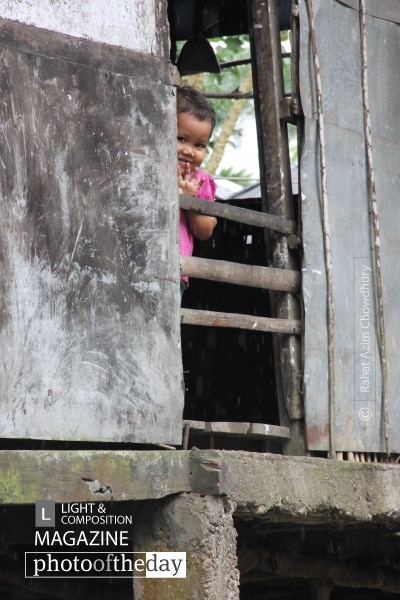
Captured in November 2012 within the Monipuri para tribal village of Jaflong, this portrait captures a moment of quiet, cross-cultural connection. The photographer encountered a shy, curious child observing him from a window, her hesitation creating a poignant atmosphere of mutual discovery. By choosing to document this interaction, the photographer highlights the rich, distinct cultural tapestry of Bangladesh’s tribal communities. The image is award-worthy for its candid emotional depth and the photographer’s ability to transform a fleeting, hesitant glance into a compelling narrative of human curiosity, framed with technical precision against the backdrop of rural life.
Rahat Azim Chowdhury
Born in 1984 in Dhaka, Bangladesh, Rahat Azim Chowdhury is a computer engineer who transitioned his lifelong interest in nature and people into a dedicated photographic pursuit. Mentored by Nazmul Shanji and refined through formal training at the PRISM Photography Institute, he specializes in candid, lifestyle, and portrait photography. Driven by a desire to document the social patterns and architectural landscapes of the developing world, he strives to create a unique artistic signature that prioritizes authentic storytelling over commercial gain.
Resonance Score Breakdown
Transparency Note: The resonance score (12.0/20) is calculated based on social engagement metrics collected before the award announcement.
Expert Photography Reviews · 7
The Space Between Us
I was standing in the grocery store aisle this morning, waiting for a woman to move her cart so I could reach the pasta.
Read the reflection →The Salt of Hesitation
There is a specific temperature to shyness. It feels like the cool, damp underside of a river stone, hidden away from the sun.
Read the reflection →Reviews & Comments
Share your thoughts about this award-winning photograph. Your reviews contribute to the community engagement score.
Most portraits of children rely on forced smiles, but this one captures the genuine, guarded tension of a stranger at the window. I’ve seen thousands of shots from Jaflong, yet the way the frame cuts her face against the dark interior creates a haunting intimacy. It’s the hesitation in her eyes that keeps me looking. I find myself wanting to protect her. In thirty years, this quiet, unvarnished moment will still feel entirely real.
At f/11, the 135mm focal length compresses the depth of field just enough to isolate the child’s gaze while maintaining the texture of the window frame. The diffraction limit hasn’t compromised the micro-contrast here; instead, it’s rendered the subtle skin tones with startling clinical accuracy. I’m genuinely moved by how the lens resolves that hesitant, crystalline spark in her eyes. It’s a rare moment where the physics of glass perfectly captures the fragility of human connection.
The frame holds a sliver of wood and a sliver of skin. A window defines the boundary. The child doesn’t look at the lens, but at the space beside it. I feel a sudden, sharp ache in my chest. It’s the hesitation. The wall is textured, heavy, real. The girl is light. Nothing here is accidental. The empty corner is not empty. It’s the weight of what she isn’t saying. I’m breathless.
One suspects the photographer didn’t just stumble upon this window. It’s a quiet, fragile moment that suggests he sat in the dust long enough for the child to forget he was a stranger. I’ve spent enough afternoons waiting for a subject to stop performing to know the cost of that hesitation. It’s a rare, honest exchange. I find myself quite moved by the stillness; he clearly earned the trust required to take this shot.
The window frame acts as a rigid guillotine, slicing the subject’s face into a precarious geometry. It’s a sharp, unforgiving boundary. The eye is trapped by the vertical wood, forced into the child’s hesitant gaze. I’m genuinely unsettled by how the negative space swallows the periphery. It’s a brutal, effective containment. The composition doesn’t invite empathy; it demands a cold, structural acknowledgment of the barrier. The frame holds, but only just. It’s a stark, architectural triumph.
The ochre of the child’s skin, caught in that fleeting, dusty light, evokes the muted, chalky stillness of a Morandi study, yet it’s the sudden, piercing turquoise of the window frame that truly undoes me. It’s a sharp, electric dissonance against the earthy, sun-baked shadows of Jaflong. One feels the hesitation in those pigments; they don’t merely sit there, they ache with a quiet, chromatic longing that lingers long after one has looked away.
The light here isn’t just illumination; it’s a soft, diffused presence filtering through the wooden slats of the Monipuri home. Rahat stood in the quiet dust of Jaflong, waiting for that singular, hesitant gaze. I’ve felt that same stillness, where the air grows heavy with unspoken questions. It’s a fragile, fleeting connection. Looking at her eyes, I feel a sudden, sharp ache for the simplicity of that moment. He didn’t rush; he simply listened.