Puerto Eden Hamlet by Nilla Palmer
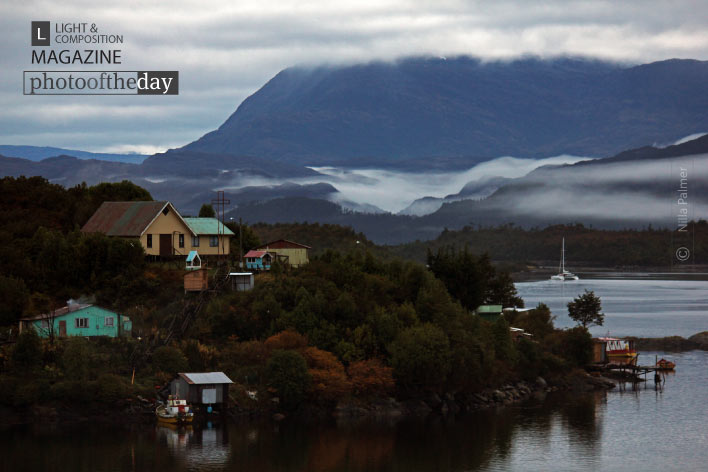
Puerto Eden emerges from the Patagonian fjords as a remote sanctuary, captured here amidst the ethereal embrace of the dawn mist. Accessible only by water, this isolated Chilean hamlet is rendered with a quiet, atmospheric intensity that highlights its profound seclusion. The photographer’s decision to frame the settlement within the soft, diffused light of early morning emphasizes the fragile beauty of one of the world’s most inaccessible inhabited places. This image is award-worthy for its evocative sense of place and the technical precision used to translate the raw, misty landscape into a poignant, serene visual narrative.
Nilla Palmer
Based in Cosenza, Italy, and originally from Brisbane, Australia, Nilla Palmer is a dedicated travel photographer and technical writer with a lifelong passion for visual storytelling. Her journey began with a 110mm film camera, later evolving through professional portraiture work with Hasselblad equipment, which instilled in her a deep understanding of the connection between subject and lens. Driven by a desire to inspire others to explore the world, Palmer specializes in capturing candid, evocative moments that reflect the essence of the diverse cultures and landscapes she encounters during her extensive global travels.
Resonance Score Breakdown
Transparency Note: The resonance score (8.6/20) is calculated based on social engagement metrics collected before the award announcement.
Expert Photography Reviews · 8
The Weight of the Mist
There is a particular density to the air when the fog refuses to lift, a heavy, silver-grey suspension that turns the world into a room with no doors.
Read the reflection →The Edge of the Watershed
When the tide recedes in a salt marsh, it leaves behind a network of intricate, branching channels that look remarkably like the veins of a leaf or the mycelium spreading beneath a forest floor.
Read the reflection →Reviews & Comments
Share your thoughts about this award-winning photograph. Your reviews contribute to the community engagement score.
Mist swallows the edges. The houses don’t sit on the land; they hover in the grey. I’ve spent minutes staring at that sliver of water. It’s the weight of the nothingness that pulls me in. My breath catches. Nothing here is accidental. The empty corner is not empty. It’s the sound of a world holding its breath. Palmer understands the restraint required to let the silence remain. It’s a rare, quiet grace.
You waited for that mist to swallow the edges of the world, didn’t you? It’s quiet, almost lonely. I’ve spent enough time in places like Puerto Edén to know that silence isn’t empty; it’s heavy. You captured that weight perfectly. And honestly, looking at this, I feel a sudden, sharp chill in my own bones. You didn’t just photograph a landscape; you felt the isolation of those people. There’s something deeply honest happening here. Well done.
At f/5.6, the Canon’s sensor captures the mist’s scattering with surprising fidelity. The focal plane barely grazes the hamlet’s weathered timber, yet the diffraction limit doesn’t soften the edges of those distant, isolated structures. It’s a delicate balance; the light’s diffusion through the moisture creates a bokeh that feels almost tactile. I’m genuinely moved by how the optics resolve such profound silence. It’s rare to see a sensor translate atmospheric density with this much quiet, haunting precision.
The horizon line bisects the frame with clinical indifference. It’s a rigid anchor against the encroaching mist. The verticality of the pilings provides the necessary counterweight to the horizontal expanse, creating a spatial tension that holds the eye captive. I’m genuinely irritated by the soft focus, yet the geometry demands respect. The composition doesn’t rely on sentiment; it relies on the architecture of the fjord. It’s a disciplined study of mass and void.
It’s a haunting, quiet frame. I’ve spent enough damp mornings in the fjords to know that mist like this doesn’t just happen; you have to earn it by shivering in the dark long before the light breaks. Palmer didn’t force the scene; she let the hamlet breathe. It’s a rare, honest restraint. I find myself wanting to pull my coat tighter just looking at it. That’s the patience I’m always searching for.
The mist in Puerto Eden feels heavy, like a secret kept by the fjords. It’s a beautiful landscape, but I find myself searching for the people behind those windows. Where are the hands that built these homes? I’ve spent my life looking for the pulse of a place, and here, it’s missing. It’s a lovely scene, sure, but it doesn’t tell me who lives there. I’m left wanting a conversation, not just a view.
The mist hangs heavy, a slow dissolve over the fjords. It’s the silence before the first line of dialogue. Palmer caught the hamlet breathing. At 1/25th, the motion blur in the water isn’t a mistake; it’s the rhythm of the tide. I’ve spent hours staring at this, feeling the damp chill of the Patagonian dawn on my skin. It’s a perfect long take. The cut would’ve ruined the isolation. This is the frame the editor keeps.
The palette here evokes a Morandi still life, where the grey of wet slate meets the bruised, melancholic violet of a Patagonian dawn. It’s a chromatic whisper, really, that fragile transition between the charcoal of the fjords and the pale, ghostly silver of the mist. I’m utterly breathless before such restraint; it’s as if the world’s colour has been drained away, leaving only the aching, quiet truth of a place that doesn’t want to be found.