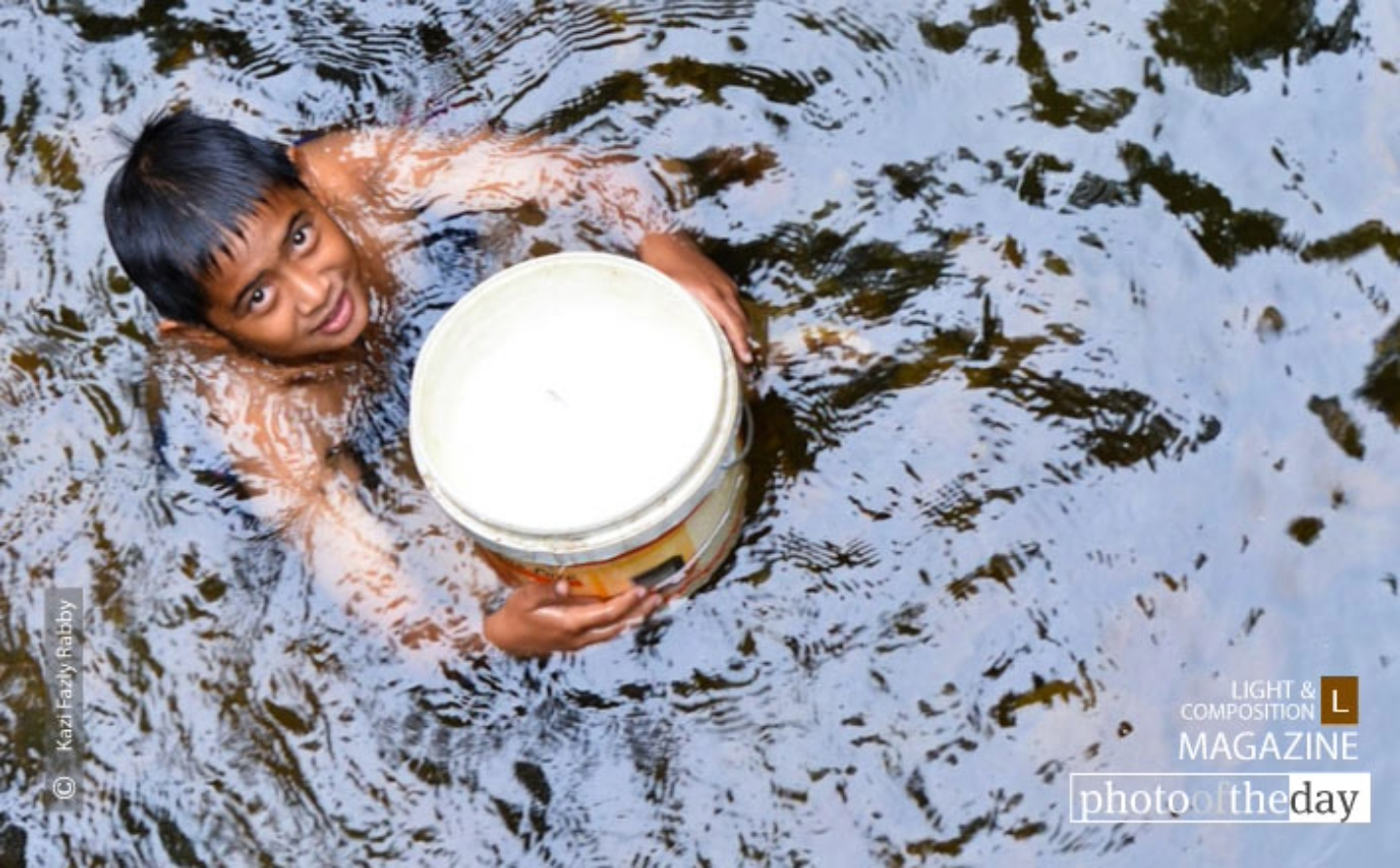
Fishermans Son by Kazi Fazly Rabby
Captured while crossing a wooden bridge, this poignant image features a young boy swimming alongside his father, carrying a bucket of their daily catch. The photographer was struck by the boy's sparkling eyes, which radiated a pure, unburdened innocence that transcended the hardships of his environment. By focusing on the child’s genuine contentment in the simple act of being with his father, the image serves as a powerful reminder of the joy found in human connection. This photograph is award-worthy for its ability to distill a complex, humble reality into a singular, evocative moment of profound emotional clarity.
Kazi Fazly Rabby
Kazi Fazly Rabby is a dedicated photographer hailing from Bangladesh, currently based in Sarawak, Malaysia. His journey with the lens began in 1998 with a Kodak film camera, and after a brief hiatus, he reignited his creative passion in 2007. Today, he finds his greatest inspiration in the quiet solitude of nature, where he captures the intricate beauty of the world with a deep sense of reverence and artistic observation.
Resonance Score Breakdown
Transparency Note: The resonance score (9.4/20) is calculated based on social engagement metrics collected before the award announcement.
Expert Photography Reviews · 8
The Weight of the Current
There is a silence that belongs only to water. It is not the absence of sound, but a heavy, liquid patience that swallows the noise of the shore. We spend our lives learning to hold things—tools, burdens, the expectations of those who came before us.
Read the reflection →The Weight of the Current
I often find myself leaning against the iron railings of the bridges that cross the canals in the older parts of the city, watching the water carry away the day’s debris.
Read the reflection →Reviews & Comments
Share your thoughts about this award-winning photograph. Your reviews contribute to the community engagement score.
Shooting through the surface interface is a nightmare of refraction and suspended sediment. Kazi’s shot captures that boy’s eyes with startling clarity, cutting through the murky, light-starved water of the Buriganga. I’ve spent enough time in turbid shallows to know how easily backscatter ruins such intimate portraits. It’s rare to see that level of warmth preserved when the water column is actively stripping away the spectrum. Honestly, that boy’s gaze just breaks my heart.
The boy’s eyes don’t just sparkle; they anchor a void. While the curator praises innocence, I’m struck by the encroaching dark of the water, which swallows the father’s labor. It’s a brutal, liquid silence. We aren’t looking at joy, but at the fragile resistance of a child against the inevitable gravity of the river. I’ve stared at this frame for an hour, and it’s the shadow, not the boy, that holds the truth.
The shutter speed holds the ripple perfectly. It’s a tight, 50mm frame that refuses to blink. You see the boy’s eyes—that’s the cut the editor keeps. It’s not just a portrait; it’s a sequence frozen mid-breath. I’ve spent hours staring at those sparkling eyes, and honestly, they make me miss a home I’ve never known. The composition doesn’t need a wider angle. Any more movement would have ruined the rhythm of this quiet, floating life.
You caught that boy’s eyes right when he wasn’t looking for a camera. That’s the hardest part of the job, isn’t it? Most people would’ve missed the way he’s leaning into his father, completely anchored by that simple, wet bucket. I felt a lump in my throat looking at his expression. You didn’t just document a catch; you found the quiet, unburdened love that survives the hardest days. And that, my friend, is everything.
We look at this boy, swimming alongside his father, and we see the weight of the catch held against the lightness of his gaze. Kazi didn’t just snap a shutter; he listened to the rhythm of the water and the quiet bond between them. It’s that sparkle in the boy’s eyes that gets me—it’s pure, unburdened joy. I find myself wanting to reach into the frame to share in that simple, profound connection.
That boy’s eyes hit me like a physical jolt. It’s the raw, unscripted connection between father and son that makes this work. Rabby caught the ripple of the water and the boy’s gaze perfectly. One tenth of a second later and the boy turns, the magic vanishes, and the frame collapses. It’s not just a portrait; it’s a fleeting, honest heartbeat. Cartier-Bresson would’ve tipped his hat to this timing. You nailed the instant, kid. Pure gold.
The boy’s eyes sparkle, but at what cost? We’re told this is pure innocence, yet I feel a sharp, uncomfortable ache watching him labor in the water. Does his contentment belong to him, or is it a narrative we’ve projected onto his poverty to soothe our own guilt? Why must we romanticize his struggle as a simple joy? It’s a beautiful frame, but it doesn’t ask enough of us. Who benefits from this gaze?
The boy’s gaze echoes the raw, unmediated humanity found in early Lewis Hine portraits, yet the fluid, low-angle perspective brings a modern intimacy Hine couldn’t access. It’s a delicate balance; the 50mm lens captures the water’s texture with a clarity that recalls Cartier-Bresson’s decisive geometry. I’ve spent decades cataloging such faces, but the genuine, unforced warmth in his eyes genuinely caught me off guard. It’s a rare, quiet triumph of empathy over mere documentation.