Billet 500 by Cameron Cope
Captured during a 4WD expedition through New Caledonia in November 2009, this long-exposure photograph immortalizes the iconic rock formation in Hienghene. By utilizing a 30-second exposure, the photographer successfully rendered the night sky, allowing the stars to shimmer above the silhouette of the landmark famously depicted on the 500-franc note. This image is award-worthy for its masterful balance of natural light and landscape, transforming a local geological treasure into a celestial scene. The composition highlights the photographer’s patience and technical precision in challenging low-light conditions, resulting in a hauntingly beautiful tribute to the rugged beauty of the island's east coast.
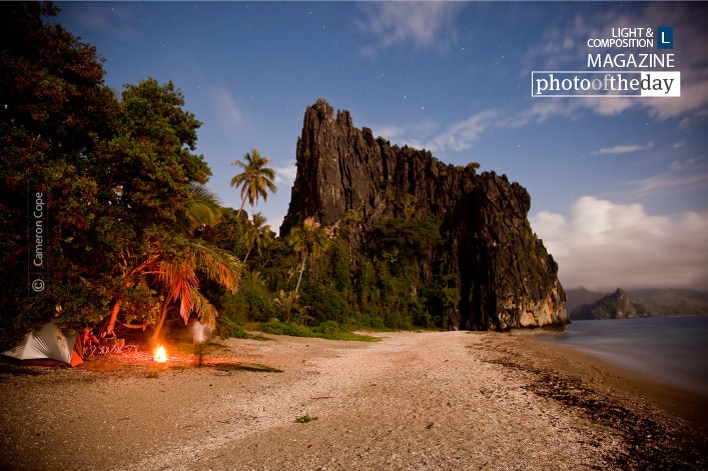
Exposure 30sec @ f/4 | ISO 400 | Focal Length 24-105mm
Cameron Cope
Originally from Gippsland, Victoria, Cameron James Cope is a Melbourne-based photographic artist specializing in travel and documentary projects. With an academic background spanning history, film, and environmental studies, he brings a deep intellectual curiosity to his work, often focusing on the intersections of colonial history, indigenous culture, and environmental issues. His photography has earned recognition in numerous competitions and has been featured in publications such as Get Lost Magazine, with his collaborative work even held in the permanent collection of the Melbourne Museum.
Resonance Score Breakdown
Transparency Note: The resonance score (12.9/20) is calculated based on social engagement metrics collected before the award announcement.
Expert Photography Reviews · 3
The Weight of the Night
I spent an hour on my porch last night, just watching the neighborhood go dark. Usually, I am inside, flipping through my phone or tidying up the kitchen, but for some reason, I stayed put.
Read the reflection →The Weight of Distance
We measure our lives in currency, in paper, in things we can hold. We trade our hours for these tokens, believing they anchor us to the earth. But there are places where the land does not recognize our coins.
Read the reflection →Reviews & Comments
Share your thoughts about this award-winning photograph. Your reviews contribute to the community engagement score.
The silhouette anchors the frame, forcing a rigid verticality against the celestial drift. It’s a precarious balance. The long exposure softens the water, yet the rock’s jagged mass refuses to yield. It doesn’t collapse into sentimentality. I’ve grown weary of such landscapes, but the spatial tension here holds. The negative space above the formation creates a necessary fulcrum. It’s technically disciplined, even if the sky’s motion threatens to overwhelm the structural integrity of the foreground.
Thirty seconds of exposure doesn’t just capture light; it forces the night to surrender its secrets. The silhouette of Hienghene’s rock formation isn’t merely a landmark here; it’s a jagged, obsidian void against the celestial drift. I’ve stared at these stars until my eyes ached, feeling the crushing weight of time itself. It’s a lonely, cold beauty. Cope doesn’t fear the dark, and because of that, he’s finally allowed the stone to speak its ancient, silent truth.
The stars don’t just hang above the Hienghene rock; they breathe. He stood there in the cooling dark for thirty seconds, letting the earth’s rotation pull the light into a soft, celestial hum. It’s a quiet surrender to the night. I’ve felt that same stillness, where the shutter feels like an afterthought to the landscape’s own rhythm. Looking at these long, silvered shadows, I find myself wanting to hold my breath, just as he surely did.